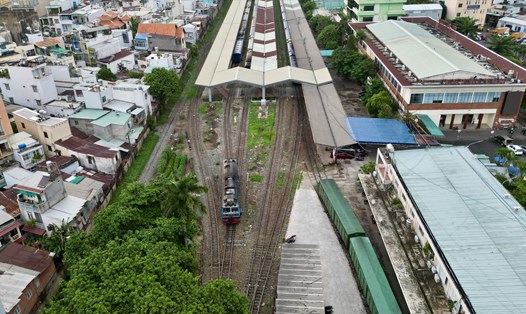
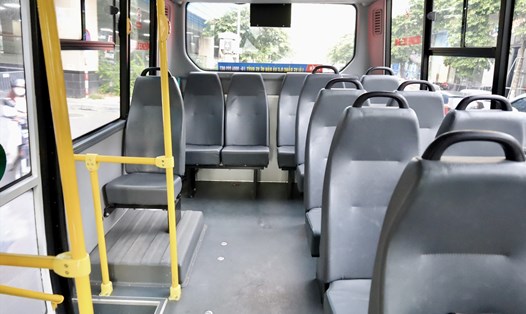
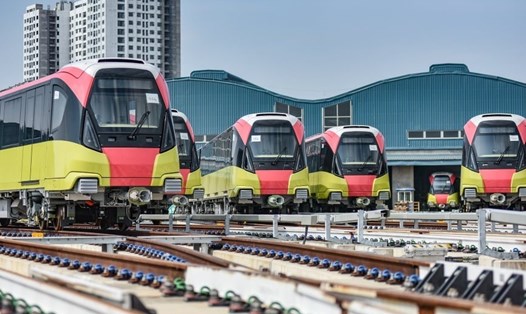
The elevated railway will be the face of future transportation
In the article "Many elevated railway lines lack connection due to different standards", Lao Dong Newspaper pointed out the bottleneck when some elevated urban railway lines in Hanoi have been put into operation but still fall into a situation of lack of connection, because each line applies different standards and technologies.
Currently, Hanoi has routes using Chinese, European and Japanese technology, leading to inconsistencies in bridge gauge, carriages, signal systems, operation and maintenance. As a result, routes are difficult to connect directly, passengers switch routes are inconvenient, while the ticket system and accompanying services have not been integrated uniformly.
This reality shows that the problem is not only in technology, but the core is the lack of a comprehensive plan and solution, if not overcome soon, it will reduce investment efficiency and the role of public transport in sustainable urban development.
According to the overall project to invest in building the Capital's urban railway system by 2030, the Hanoi People's Committee strives to build and put into operation about 96.8/397.8 km, equivalent to completing about 24% of the total length of urban railway lines according to the plan.
Accordingly, by 2030, strive to complete the construction of Line No. 2 including three sections: Nam Thang Long - Tran Hung Dao, Tran Hung Dao - Thuong Dinh and Noi Bai - Nam Thang Long; two sections of Line No. 3 including: Nhon - Hanoi station section and Hanoi station - Yen So section (Hoang Mai); Line No. 5 Van Cao - Hoa Lac.
At the same time, deploy the development of investment policy proposals and deploy the construction of urban railway lines with an investment roadmap before 2035.
By 2035, complete construction and put into operation about 301/397.8 km, equivalent to about 76% of the total length of urban railway lines.
By 2045, adjusted and supplemented urban railway lines will be completed according to the Capital's plan and the adjusted Capital's general plan. Thus, according to the updated orientation, the city has a total of 15 lines, including 10 lines according to the general plan and 5 additional lines, along with a monorail system.
The development of high-speed railways will contribute to shaping the modern traffic face of Hanoi. However, lessons from the two routes that have been operating show a reality: If each route has a different technology, it will not ensure efficiency.
This difference is not just about the origin of the equipment. It determines the entire technical structure, from signal, control, train, maintenance to human resource training.
Experts point out the core cause: Lack of a general engineer for the entire network. When there is no focal point responsible throughout from planning, design to technology selection, each project will follow its own trajectory.
If each route builds a separate system, investment and operating costs will increase, making it difficult to create overall value.
According to statistics from Hanoi Metro, in just 9 days of the Binh Ngo Lunar New Year 2026, Hanoi's two metro lines served more than 243,000 passengers, an increase of more than 32% compared to the same period. The figure shows real demand. However, if the network is not interconnected, growth potential will be limited.
Reported on common standards for urban railways
Talking to a reporter from Lao Dong Newspaper, Mr. Nguyen Hong Thai, Deputy Head of the Faculty of Economic Transport, Head of the Department of Business Administration (Hanoi University of Transport) said that urban transport needs three key connections, which are: Infrastructure connection, operation information connection and financial - maintenance connection.
If railway lines are not connected in terms of vehicles and maintenance, each line must build its own maintenance system, which will be very wasteful and difficult to create transport value and attraction for passengers" - Mr. Thai analyzed.
According to experts, the key issue lies in planning and investment organization, when the entire network does not have a unified general engineer to lead from design to technology. This leads to a situation of "one project one technology", largely dependent on the requirements of each ODA donor.
To overcome this, Mr. Nguyen Hong Thai said that it is necessary to adjust new routes in the direction of prioritizing connection, and at the same time choose technology based on the overall plan, instead of chasing after individual proposals from each investor. Otherwise, the city will be forced to build more transit routes with high costs but low efficiency.
Regarding this issue, Mr. Nguyen Cao Minh - Head of Hanoi Urban Railway Management Board said that the unit is building a common system of standards and regulations for the entire urban railway network.
This content has been reported to the People's Committee and the Hanoi City Party Committee, with short-term solutions and long-term roadmaps to gradually remove bottlenecks in technology and connectivity.