
Ho Chi Minh City People's Committee has just approved the report on the survey results of houses on and along rivers, canals, and ditches conducted by the Ho Chi Minh City Institute for Development Studies.
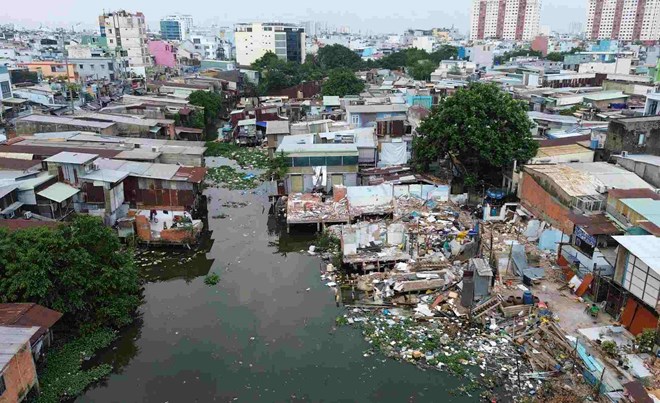
The results show that the whole city currently has about 34,712 houses located on and along rivers, canals, and ditches.
According to surveys, only about 1/4 of houses have valid construction permits, while up to 73.5% of houses are built without permits.
The Ho Chi Minh City People's Committee has assigned the Institute for Development Studies to hand over all survey data to the People's Committees of relevant wards and communes to serve the implementation of urban renovation and embellishment projects in the coming time.
According to the Resolution of the 1st Ho Chi Minh City Party Congress, term 2025 - 2030, the city sets a target to complete the relocation of 50% of houses on and along canals and ditches by the end of 2030, equivalent to about 20,000 houses.
A survey by the Ho Chi Minh City Institute for Development Studies shows that most people living in these areas work as unskilled laborers, freelancers, and have precarious jobs. The main income is under 10 million VND or from 10 - 20 million VND/month.
Regarding education level, the level of universal education is at an average level, and the proportion of highly skilled workers is still limited. This poses an urgent requirement for vocational training, skills training, and support for livelihood conversion when implementing relocation.
Regarding the compensation plan, 65.7% (about 19,399 units) want to receive cash compensation at market prices at the time of clearance.
21.2% (about 6,280 units) have resettlement needs with land plots, landed houses or apartments, mainly from 2 - 3 bedrooms and priority resettlement on the spot. 13.1% (about 3,864 units) proposed consideration, ensuring satisfactory rights in the process of implementing compensation, support and resettlement policies.
In addition to compensation, people also expressed many needs for support after relocation: 19.6% need support for moving places; 14.4% need temporary accommodation support; 13% have a need to buy or rent social housing (mainly 2-3 bedroom apartments). Many households want to borrow preferential capital to do business, change jobs or compensate for income loss.
According to the survey, the biggest concerns focus on financial issues, long-term livelihoods, the quality of resettlement housing and maintaining community relations after relocation.
The majority of people support the policy of relocating houses on and along canals and ditches, and also expect to upgrade infrastructure and improve the living environment.
However, in some areas such as District 7, District 8, Binh Tan District and Can Gio District (old), the level of consensus is not high. Can Gio District (old) alone recorded a relatively large rate of disagreement, mainly due to concerns about economic difficulties and costs of re-establishing life in new homes.
People want to make information about compensation, resettlement and livelihood support policies transparent. Therefore, the Ho Chi Minh City Development Research Institute believes that it is necessary to strengthen communication, organize direct consultations to answer questions, reduce complaint risks and raise consensus in the relocation implementation process.


