
Building digital government
Implementing Resolution No. 57-NQ/TW of the Politburo on breakthroughs in science, technology, innovation and national digital transformation, Phu Tho identifies digital transformation as a key task of the entire system.
The province is gradually shifting from a management method based on records and papers to operating on a basis of data, technology and interconnected connection.
In 2026, the province sets a target of 100% of online public services being provided comprehensively; at least 90% of dossiers are processed online, 95% of dossiers are digitized.
Public administrative service centers will deploy AI to support people; 100% of provincial-level documents, except for classified documents, are processed in a complete electronic environment.
Digital infrastructure continues to be completed. To date, 100% of communes and wards are covered with broadband fiber optic cables, 4G covers about 98% of the area; 5G network is strongly expanded in urban areas, industrial parks and socio-economic centers.
Along with that, the province is accelerating the construction of data warehouses, connecting key databases and putting data into management and operation.
A noteworthy point is that Phu Tho is testing a system for monitoring and operating socio-economic development based on real-time data.
Instead of relying on manual reports, leaders can track progress, analyze indicators and make decisions on the same platform. This is a shift from administrative management to data-based governance.
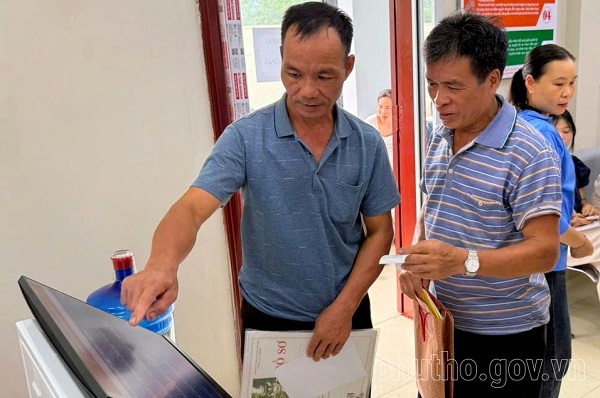
Digital transformation is also deeply implemented at the grassroots level. The movements "Digital Literacy", "Digital Leaders", "Digital Ambassadors", "Digital Villages" contribute to popularizing technology skills, helping people proactively use public services and digital utilities. As a result, technology is no longer unfamiliar but gradually becomes a practical tool in life.
Creating new momentum for economy and society
Digital transformation in Phu Tho is expanding from the public sector to production, business and essential fields.
The 2026 plan sets a target for the digital economy to contribute at least 23% of GRDP; 70% of transactions are carried out without cash; at least 60% of small and medium-sized enterprises use digital platforms, and 50% of enterprises apply electronic contracts.
In agriculture, digital technology is applied to land management, environment, disaster warning and smart production.
Artificial intelligence, big data, the Internet of Things and e-commerce are expected to improve productivity, expand markets and increase traceability of agricultural products.
Healthcare towards electronic medical records, smart management, remote medical examination and treatment and AI application supporting diagnosis and treatment.
Education is gradually forming a digital ecosystem, applying AI, virtual reality, STEM; and at the same time deploying electronic transcripts and digital school records.
In construction and urban areas, digital maps, AI, IoT are used to manage infrastructure, planning and transportation. Tourism is also renewed by digital maps, AI, virtual reality and augmented reality, thereby enhancing the tourist experience.
To realize the goals, the province focuses on six groups of solutions, from improving leadership capacity, communication and digital skills training to human resource development, mastering technology, ensuring financial resources and expanding cooperation with businesses, research institutes, ministries, and sectors.
In particular, Phu Tho focuses on building a team with digital capacity suitable for each job position; strengthening training in data management, AI, information security and system operation. This is a decisive factor for technology to truly promote its value, instead of just stopping at infrastructure investment.
With the orientation of putting people and businesses at the center, taking data as a resource and technology as a tool, Phu Tho is building a foundation for a more dynamic development method.
When digital transformation is closely linked to administrative reform, innovation and improving the quality of human resources, technology will become an important driving force for the province to accelerate, improve competitiveness and aim to become a bright spot in digital transformation in 2026.


