
On August 27, at the Fourth Session (specialized session), the Ho Chi Minh City People's Council considered and decided on many important contents under its authority, including the policy of investing in the East-West axis road project (Vo Van Kiet road) extending from National Highway 1 to the border of Tay Ninh province.
According to the submission of the Ho Chi Minh City People's Committee, the starting point of the project is at the National Highway 1 - Tan Kien intersection, belonging to Tan Nhut commune, Ho Chi Minh City. The ending point connects to Hai Son - Tan Do road, belonging to Duc Hoa commune, Tay Ninh province.
The road passes through Tan Nhut commune, Binh Loi commune of Ho Chi Minh City and Duc Hoa commune, Tay Ninh province, with a total length of about 15.1km.
The project implements site clearance according to the plan with a cross-section of 60m, initially investing in 6 lanes on both sides, the land in the middle is reserved for reserves, serving the expansion of the route in the future.
On the route, it is expected to build 6 grade-separated interchanges, including: Canal C, Canal B, Ring Road 3, Canal A, An Ha Ferry Canal and Small Ferry Canal. These interchanges are invested in a 6-lane scale in phase 1.
In addition, the project will complete 2 intersections Tan Kien and Vo Tran Chi street to increase connectivity with the existing transportation network.
The total investment of the project is nearly 16,000 billion VND, proposed by the Ho Chi Minh City People's Committee to be divided into 2 component projects.
In which, component project 1 implements compensation, support, resettlement and technical infrastructure relocation, with a total investment of about 6,775 billion VND. This funding is expected to include about 3,522 billion VND in Tan Nhut commune and 3,253 billion VND in Binh Loi commune.
Component project 2 is the construction of the East-West extended main road, with a total investment of about 9,200 billion VND.
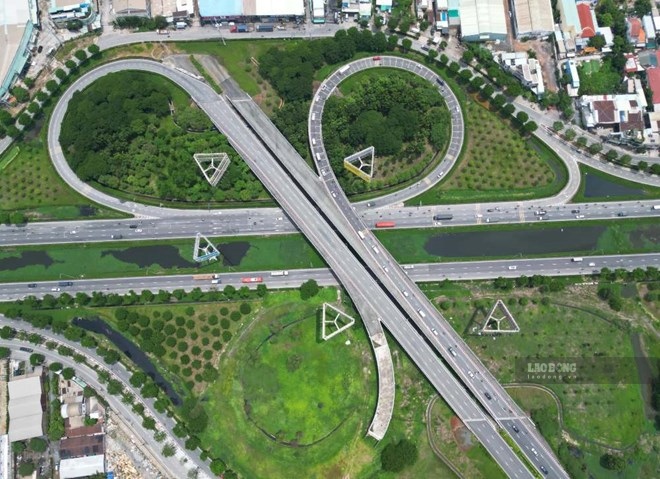
According to the plan submitted by the Ho Chi Minh City People's Committee, compensation and site clearance work is expected to be implemented from the third quarter of 2026 to the third quarter of 2028.
The preparation and approval of construction designs to be implemented after the basic design is expected to be implemented in the first quarter of 2028. Contractor selection and preparation for commencement are carried out in the second quarter of 2028.
The project is expected to start construction and construction from the third quarter of 2028, technical traffic opening in the fourth quarter of 2030 and strives to put the entire route into operation from January 2031.
According to the Ho Chi Minh City People's Committee, the extended East-West axis road project will contribute to completing the inter-regional transportation network between Ho Chi Minh City, Tay Ninh and the Southwest provinces.
The road is part of the Vo Nguyen Giap - Mai Chi Tho - Vo Van Kiet axis, about 30.6km long, connecting from National Highway 1 to the border of Tay Ninh province. When completed, the route will create a radial traffic corridor, connecting East - West of Ho Chi Minh City and neighboring localities.
The project also connects with the Ho Chi Minh City - Trung Luong - My Thuan expressway and Ring Road 3 of Ho Chi Minh City, contributing to increasing traffic capacity and reducing congestion at the western gateway.
The Duc Hoa - Hau Nghia area concentrates many industrial parks, with a large demand for connection with Ho Chi Minh City, seaports and airports. Meanwhile, the Vo Van Kiet road section from National Highway 1 to the Tay Ninh border has not been invested, making the regional transportation network incomplete.
The investment in the Vo Van Kiet extended route is expected to allocate traffic flow, reduce traffic pressure, shorten travel time and promote socio-economic development of Ho Chi Minh City, Tay Ninh and the entire region.


