
Need a smart load management system
According to Dr. Nguyen Xuan Quang - Institute of Energy Technology (Hanoi University of Science and Technology), transportation electrification is an inevitable trend of the 21st century. If in the period 2010-2020, energy transition focused on solar and wind power development, then in the period 2025-2050, electrification of energy consumption sectors will ultimately become the main driving force. In which, transportation electrification is a major challenge.
In Vietnam, transport consumes about 20-25% of total final energy and is one of the fastest growing sources of greenhouse gas emissions. Therefore, replacing gasoline and oil vehicles with electric vehicles not only helps reduce emissions, but is also part of the national energy transition strategy. However, this process will significantly increase electricity demand.
According to recent studies, by 2030, the additional electricity demand for electric vehicles is estimated at about 3.1 - 5.6 billion kWh/year, equivalent to 0.7 - 1.1% of the total commercial electricity demand. Although this increase is still limited before 2030, from 2035 onwards, especially in 2050, electricity demand for electrified transportation may account for up to 22-28% of total electricity demand, depending on the development scenario.
This requires the addition of new power sources, prioritizing renewable energy, and strong investment in smart grids, storage systems and charging stations. Along with that, a flexible electricity price mechanism is needed to limit battery charging during peak hours, avoiding putting pressure on the power system.
According to Dr. Nguyen Xuan Quang, the biggest impact of electric vehicles is not only in total electricity consumption, but also in the change in the load chart. Currently, Vietnam's electricity load usually peaks in the evening. If millions of electric vehicles charge after working hours, the electricity system may face a new form of large-scale load.
Therefore, energy transition in the future is not only a problem of building more power sources but also a problem of smart load management.
Dr. Nguyen Xuan Quang informed that Vehicle-to-Grid (V2G) is one of the technologies that can fundamentally change the electrical system in the future. This technology allows electricity to be transmitted in two directions: the power grid supplies electricity to the vehicle and when needed, the electric vehicle can recharge the power back to the grid. At that time, each electric vehicle becomes a mobile energy storage system. However, to mobilize this storage battery source, a flexible electricity price policy is needed.
Wind and solar power contribute to solving the green growth problem
According to leaders of the Electricity Department (Ministry of Industry and Trade), in order to both meet electricity demand to serve economic growth and implement commitments to reduce greenhouse gas emissions, Vietnam needs to promote the development of renewable energy.
In recent years, the Ministry of Industry and Trade has advised on perfecting many important mechanisms and policies for the electricity and renewable energy sectors; and at the same time implemented adjustments to the Power Plan VIII in the direction of prioritizing green and clean energy sources.
At the workshop "Energy Transition - Driving Force for Two-digit Growth Goals" organized by Lao Dong Newspaper, Mr. Trinh Quoc Vu - Deputy Director of the Electricity Department (Ministry of Industry and Trade) - said that the planning adjustment is implemented with the goal of "Maximally exploiting all potentials and advantages of the country to develop energy, in order to improve autonomy in providing sufficient electricity for socio-economic development and people's living needs in the upcoming accelerated development phase, meeting the goal of economic growth at a two-digit rate". According to him, renewable energy development is no longer an option but an inevitable direction.
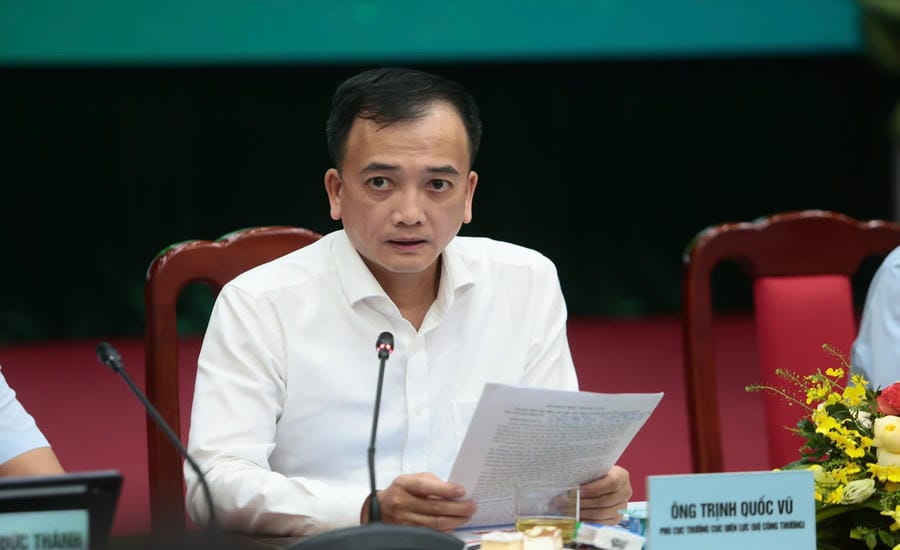
It is noteworthy that the electricity problem for green transformation is not only in building more power plants but also in developing a synchronous transmission system. Resolution No. 70-NQ/TW of the Politburo has requested "Developing a synchronous transmission grid system with power source development, capable of large-scale integration of renewable and new energy sources." This is considered an important link for wind power and solar power to maximize efficiency.
To realize this goal, the Ministry of Industry and Trade is continuing to improve institutions, remove legal bottlenecks, accelerate the progress of power source and grid projects; and encourage all economic sectors to participate in investing in the electricity industry.
According to Mr. Trinh Quoc Vu, three key groups of solutions in the coming time include perfecting mechanisms and policies, promoting the progress of power projects and diversifying investment capital sources.
With synchronous solutions from the legal framework in electricity development and project investment deployment, I believe that investors will have enough legal framework to implement power projects in general, and renewable energy projects in particular to realize the sustainable energy development strategy of Vietnam" - Mr. Vu said.
It can be seen that the transition from gasoline to electric vehicles is only the tip of the iceberg of the green transition process. The real foundation lies in building a sufficiently strong, sufficiently stable and increasingly green electrical system.


