
On the morning of April 18, the Ho Chi Minh City People's Council passed a resolution adjusting the investment policy of the Ho Chi Minh City - Moc Bai expressway project according to the public-private partnership (PPP) method, BOT contract (build - operate - transfer).
Previously, the Ho Chi Minh City - Moc Bai expressway project was approved by the Prime Minister in August 2024 with a total investment capital of phase 1 of 19,617 billion VND, implemented in the 2024 - 2027 period.
However, after the process of reviewing and actual updating, the total investment has been adjusted to increase to 22,975 billion VND, while extending the implementation time to 2028.
The project is divided into 4 component projects. In which, component project 1 - construction of the expressway under BOT contract has a total investment of 10,421 billion VND and component project 2 invests in people's service roads and level overpasses with a cost of 2,422 billion VND, keeping the capital unchanged.
The remaining two component projects related to compensation, support, and resettlement all increased capital. Component project 3 (section through Ho Chi Minh City) increased from 5,270 billion VND to 6,383 billion VND, while component project 4 (section through Tay Ninh) increased from 1,504 billion VND to 3,749 billion VND.
According to the Ho Chi Minh City People's Committee, the reason for adjusting capital increases stems from the fact that localities continue to review and fully update affected subjects and approve additional compensation, support, and resettlement plans. The actual cost at the time of 2025 is significantly higher than the preliminary calculation level in 2024.
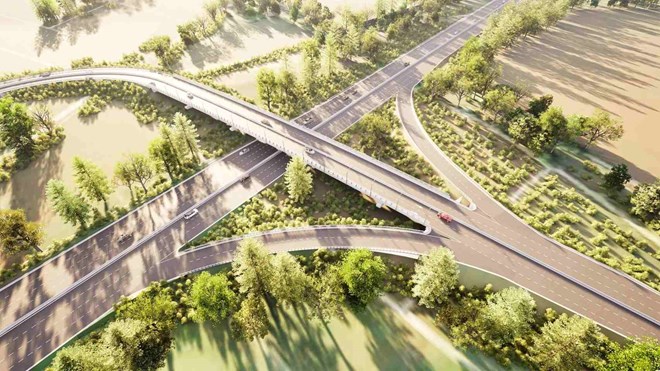
The Ho Chi Minh City - Moc Bai expressway has a total length of about 51 km, of which the section through Ho Chi Minh City is 24.7 km long and the section through Tay Ninh is 26.3 km long.
The route starts from the intersection with Ring Road 3 in Phu Hoa Dong commune (HCMC) and ends at the intersection of National Highway 22 in Ben Cau commune (Tay Ninh province).
The project is designed with a maximum speed of 120 km/h, a scale of 4 lanes in phase 1 and will be expanded to 6 lanes according to the plan.
According to the plan, component project 1 is expected to start construction in the second quarter of 2026, be completed and put into operation in December 2027.
For component project 2, about 43.14 km of people's service roads on both sides of the route will be built, along with 16 level crossings and 10 people's underpasses. Currently, package XL02 has been started on December 19, 2025, and the remaining packages are being completed procedures for early deployment, striving to be completed in 2027.
Regarding site clearance, component project 3 in Ho Chi Minh City affects about 217.7 hectares of land with 2,121 cases of recovery.
Meanwhile, component project 4 in Tay Ninh recovered land for about 2,260 households. Previously, Ho Chi Minh City had agreed to support Tay Ninh province with more than 1,800 billion VND to carry out this work.
When completed, the expressway will contribute to reducing the load on National Highway 22, strengthening the connection between Ho Chi Minh City and the ring road system, and forming a high-speed and safe traffic axis between Ho Chi Minh City and Tay Ninh.
Not only meaningful in terms of transport infrastructure, the project is also expected to create motivation for socio-economic development, promote the formation of the Moc Bai - Ho Chi Minh City - Cai Mep Port - Thi Vai industrial - urban chain, associated with the Trans-Asia Economic Corridor and strengthening regional links in the Southeast region.


