
To support river mouth oyster farmers to develop production, and at the same time ensure order and safety of waterway traffic, Quang Ninh Provincial People's Committee has issued Document No. 786/UBND-NLN1 dated March 4, 2026 on arranging salt avoidance points to serve river mouth oyster farming.
Crassostrea rivularis (Crassostrea rivularis) is a high-value farming object in many coastal areas of Quang Ninh. However, this mollusk species grows best in water environments with salinity from 10‰ to 20‰ (10‰ to 20‰).
In the dry season, when sea salinity increases, oysters develop slowly, their resistance decreases, and may even die if the situation persists.
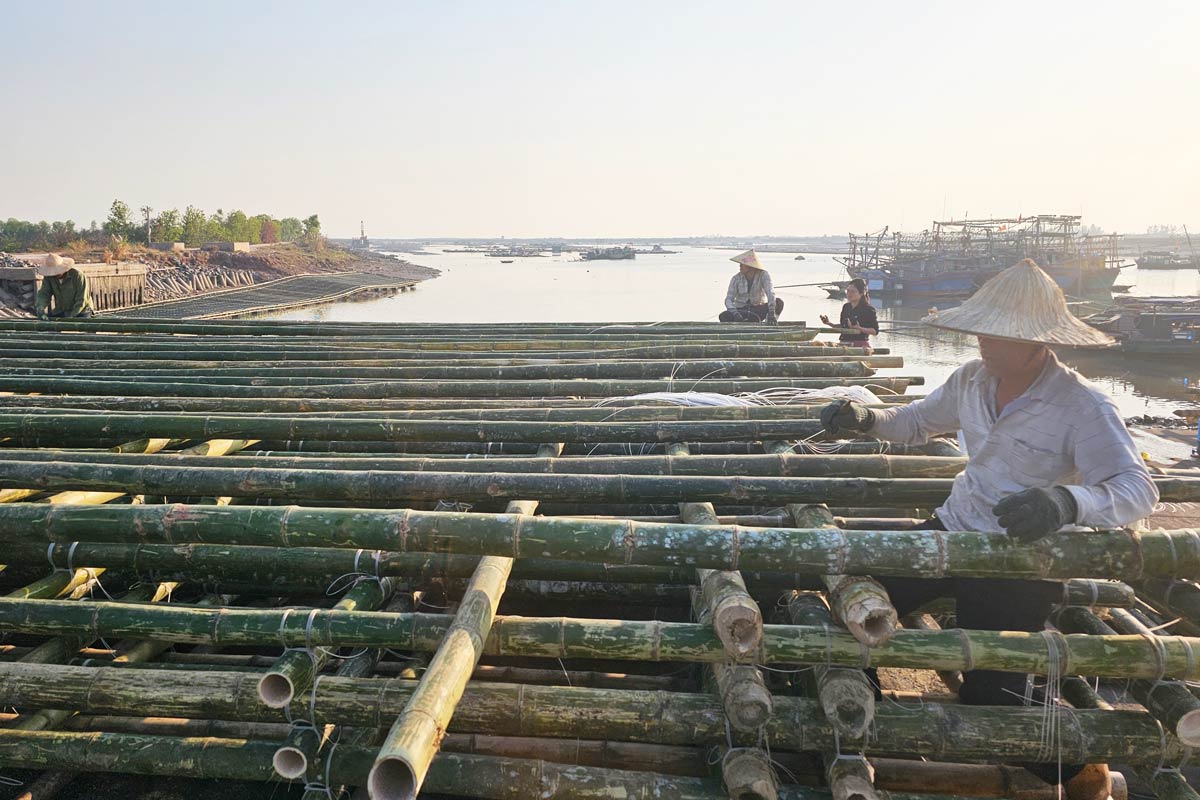
In fact, for many years, to avoid salinity, farming households have had to move rafts to the river mouth area for a few months.
When the rainy season returns and salinity decreases, the farming raft will be brought back to its original location. However, this relocation incurs large costs and potentially poses a risk of waterway traffic unsafety.
Mr. Nguyen Van Bong (born in 1965, Ha An ward) said that after Typhoon Yagi (September 2024), his family was assigned 0.6ha of water surface in the Lach Tuong area and has invested about 700 million VND to raise river mouth oysters in the form of hanging rafts.
The family has raised about 10,000 hà trees. Currently, during the salinity avoidance period, the raft must be moved to Phong Coc ward area. Each "salinity running" for a pair of rafts costs about 70 million VND, including the cost of pulling the raft, hiring someone to look after it, and renting an anchorage location.
This is something that must be done, otherwise the oysters may die. We hope that the policy of arranging salt avoidance points will be implemented in practice soon to reduce costs for farmers," Mr. Bong said.
According to a report by the Department of Agriculture and Environment, the province arranged 14 saltwater avoidance points with a total area of about 610ha in the wards: Hiep Hoa (36ha), Quang Yen (60ha), Phong Coc (311ha), Lien Hoa (46ha) and Ha An (157ha).
The time to avoid salinity is from November of the previous year to March of the following lunar year.
Oyster farming facilities are only allowed to move rafts to salinity avoidance locations after being approved in writing by competent authorities; at the same time, they must anchor in the correct location, not expand the area outside the permitted scope and fully comply with regulations on inland waterway traffic and environmental protection.
The Provincial People's Committee also specifically assigned tasks to departments, branches and local authorities in managing salinity avoidance activities for river mouth oyster farming. Farm owners must comply with regulations, and self-dismantle and restore the current status of the water area when the salinity avoidance period ends or there is no longer demand for use.


