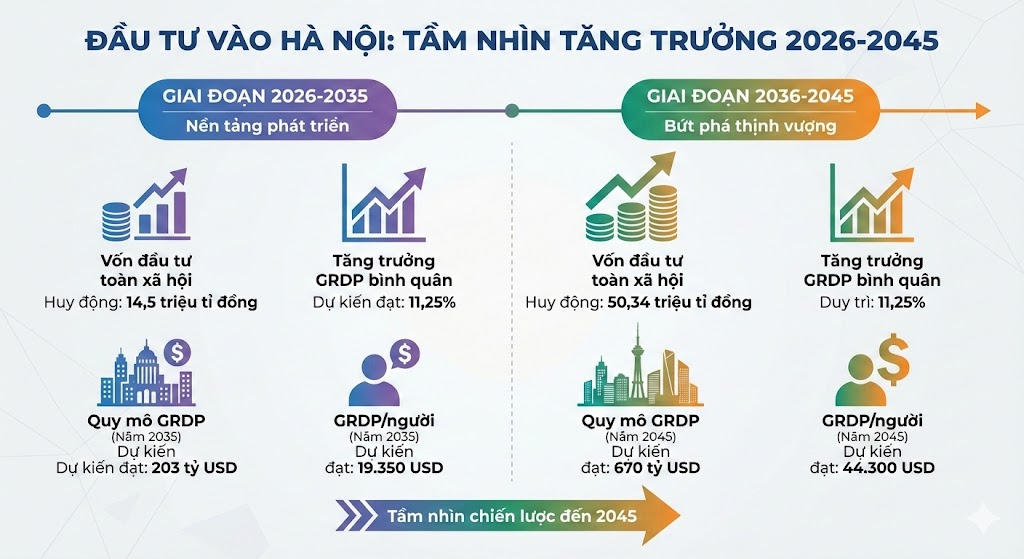
Large cash flow of two phases
Reality shows that Hanoi's biggest "bottlenecks" today still lie in urban infrastructure, transportation and land use. Traffic congestion, school-hospital overload, lack of green space, sprawling urban development... are reducing the quality of life and hindering growth.
Therefore, the top priority of the investment strategy is to build a synchronous framework infrastructure system: Ring roads, radial axes, urban railways, digital infrastructure and social infrastructure. This is not only a "hard" investment, but also a way to release resources, reduce logistics costs, and expand development space for the Capital and the Capital region.
According to planning orientations, in the period 2026-2035, Hanoi is expected to mobilize about 14.5 million billion VND of social investment capital, of which the private sector and population account for more than 60%. This shows that the main driving force comes from the private sector - a key factor determining the resilience of the urban economy.
Another strategic investment direction is to develop large, modern urban areas with synchronous technical and social infrastructure. Instead of fragmented expansion, Hanoi needs new growth poles - places where housing, services, education, healthcare, culture, and trade converge - to reduce pressure on the historical inner city area.
In parallel with that is the task of restructuring and rebuilding the city. Many old, inefficient land use areas need to be "awakened" by methodical reconstruction projects, with strict control mechanisms to avoid wasting resources and destroying the landscape. Investment here is not only economically significant, but also an investment in identity, urban memories and the quality of life of the people.
Hanoi has long been an attractive destination for foreign investment capital. However, in the new phase, FDI attraction criteria need to shift strongly from "quantity" to "quality". Prioritizing high-tech projects, innovation, R&D centers, finance, healthcare, high-quality education... will help the Capital participate more deeply in the global value chain.
It is expected that in the 2026-2035 period, the FDI sector will contribute about 1.3 million billion VND, equivalent to nearly 9% of total social investment capital; in the 2036-2045 period, this figure may increase to more than 5 million billion VND.The important thing is that Hanoi must create a transparent and stable investment environment, open administrative procedures and high-quality human resources to retain technology "eagles".
It is necessary to balance between growth and sustainability.
A problem that cannot be ignored is balancing economic growth and sustainable development. Investment in the environment, green space, culture - sports, tourism, and heritage preservation needs to be placed on par with pure economic investment. The Capital cannot "reach out" if it is traded for pollution, overload and loss of identity.
In the period 2036-2045, when basic infrastructure has been synchronously invested, Hanoi will enter a period of in-depth development, with a GRDP scale expected to reach 670 billion USD, and a GRDP per capita of about 44,300 USD. This is an ambitious goal, requiring long-term vision and implementation discipline in investment.
However, the issue of concern today is Hanoi reconstruction. In the planning, the City People's Committee sets out a great ambition: In the period 2026 - 2035, Hanoi will relocate 200,000 people in the Red River area; 200,000 people in the West Lake area and surrounding areas; 42,000 people in some streets within Ring Road 3.
When restructuring the city in the period 2036 - 2045, Hanoi relocates 26,730 people in the Old Quarter, 23,000 people in the Old Quarter, and 370,000 people in the remaining areas of Ring Road 3 for urban reconstruction.
Thus, in the period 2026 - 2045, the city will relocate more than 860,000 people to serve the urban reconstruction process.
According to the Hanoi People's Committee, the policy of population reduction is to reduce pressure on the inner city. People subject to clearance and relocation are partially arranged for on-site resettlement, and partially in new urban areas at growth poles (Dong Anh, Gia Lam, Hoa Lac...) are invested in synchronous, modern construction, full of amenities (schools, hospitals, parks), ensuring a better quality of life than in the old place of residence.
Regarding the information that Hanoi plans to relocate more than 860,000 people from the inner city, architect Ngo Doan Duc - former Vice Chairman of the Vietnam Association of Architects said that relocating people out of Hanoi's Old Quarter is not a new story. Previously, the city has repeatedly implemented the relocation of people from the Old Quarter, including arranging people to Kien Hung area. However, reality shows that there are many cases of people returning to their old residences after relocation. "This is a phenomenon that has happened and is a lesson that needs to be seriously considered" - architect Duc said.
Mr. Duc said that if Hanoi implements migration on a larger scale, the preparation stage must be considered very carefully, from compensation and resettlement policies to legal constraints. The new place of residence solves the social security problem for people, avoiding the situation of "going back and forth".
If the new housing does not meet the needs for schools, healthcare, and jobs, people can hardly agree. Therefore, the preparation must be carried out carefully and clearly, placing people's interests in parallel with the goal of urban development" - the architect said.
Regarding the area along the Red River, he believes that the relocation of spontaneous residential areas to implement riverbank planning and improve urban landscape is necessary.
According to architect Pham Thanh Tung - Chief of Office of the Vietnam Association of Architects, Hanoi is currently under great pressure of population density, especially in the core area of Ring Road 2, where population is increasingly concentrated. Therefore, the policy of relocating residents out of the urban core area is a correct and necessary decision.
According to him, migration will contribute to reducing population density from the inner city to suburban areas, thereby creating conditions for a better living environment, while reducing pressure on technical infrastructure and transportation systems, helping the Capital develop towards civilization and modernity.
Mr. Tung said that the relocation of people from the inner city can be seen as a real "revolution", because the scale is up to nearly 1 million people. Therefore, the Hanoi government needs to have careful calculations and fully prepare plans to arrange new housing to ensure stable life and long-term security for people. The migration process needs to be associated with synchronous investment in social security conditions such as schools, hospitals and other essential services, so that people can feel secure living in their new homes in the long term.
Only when the issue of social security and large-scale relocation is resolved will the investment of nearly 65 million billion VND in nearly 20 years bring real efficiency, creating a breakthrough for the development of the Capital.