
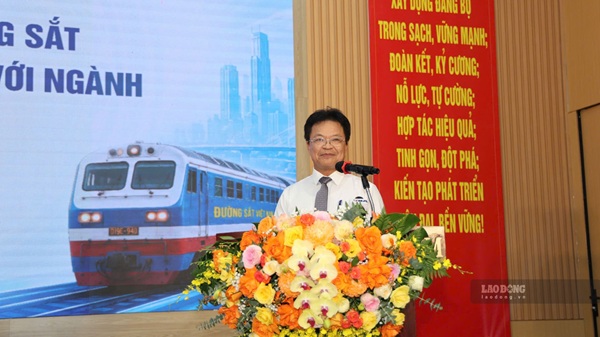
Speaking at the ceremony, Mr. Dang Sy Manh - Chairman of VNR's Member Council emphasized that the history of the Railway industry is not only marked by works or trains, but above all written by the sweat, intelligence and even blood and bones of many generations of officials and workers.
In the fighting to ensure traffic, 921 officials, workers and youth volunteers (TNXP) of the railway industry bravely sacrificed, nearly 3,000 people left part of their blood and bones on the battlefield.
Historic slogans such as: "Live clinging to the bridge, clinging to the road, die resiliently and bravely", "The enemy destroys, we repair, we go", "Broken bridges are like broken bones, broken roads are like broken intestines" or "Heart can stop beating, but traffic blood vessels cannot be blocked" have become sacred oaths of previous generations.
That heroic epic is evidenced by the touching memory of Ms. Nguyen Thi Hong Chien - Former Youth Volunteer of Company 87 (Team 873). Joining the Youth Volunteer from 1965 when she was only 17 years old, Ms. Chien and her comrades stayed on the vital railway line from Cau Len (Thanh Hoa) to the border of Hoang Mai station (Nghe An) - a place that suffered heavy bombs and bullets.
With tears rolling down his tearful cheeks, Uncle Chien choked up recalling the carpet bombing on May 11, 1967 at Nui Nap (Thanh Hoa). As soon as the railway line was repaired, enemy aircraft suddenly returned to bomb, killing 13 female youth volunteers aged nineteen and twenty and 4 railway workers on the spot.
Sharing the same arduous memories, Mr. Tran Manh Trung - former Deputy Director, Secretary of the Party Committee of Gia Lam Railway Factory - shared about the fierce 1972: "During the day, workers evacuated, at night they flocked back to the factory, clinging to machines to repair locomotives and carriages under bombs and bullets so that trains could arrive on time to the front.
After the country's reunification, tens of thousands of railway workers and military forces, youth volunteers completed the restoration of the North-South railway line in just 14 months. On December 31, 1976, the Unification train officially rolled, becoming a symbol of peace and reunion.
According to Mr. Hoang Gia Khanh - General Director of VNR, entering the renovation period, the railway industry has 11 times shortened the travel time of North-South passenger trains, and promoted restructuring.
Especially in the last 5 years, VNR has recorded a strong breakthrough in management and operation thinking, promoting international intermodal transport. To date, from Vietnam, passenger trains can connect to 23 countries and freight trains connect to 40 countries around the world.
Honoring the special "mother-to-child succession" tradition of the industry, the ceremony honored 4 families with 5 generations and 15 families with 4 generations continuously holding the profession.
Ms. Nguyen Thanh Huyen - a level crossing guard in Nhu Quynh (Hung Yen), representing a family of 5 generations working on the Gia Lam - Hai Phong railway line - shared that although the work is hard, facing dust and danger lurking throughout the 12-hour shift, she is still always proud and continues to guide her children and grandchildren to follow in the fire truck business.
VNR leaders believe that, with the traditional foundation of solidarity, discipline and the concern of the Party and State, the Railway industry will continue to play a core role, gradually master technology to prepare resources for high-speed railway projects, and join the country in entering a new era of development.


