
The printed table by the window
In Guangzhou, there is a house that if you rush through Van Minh street, you can easily get lost in the street rhythm and miss it.
House number 13, now number 248 – 250 Van Minh street. The house with red brick walls, dark wooden window frames. In the middle of a modern city moving every hour, that house stands silently, humbly, but contains very great values.
I walked into the house on a still sunny Guangzhou morning.
Walking through the wooden door, through the narrow stairs, through the brick steps that have been stained with time, I went up to the third floor. The higher I went, the louder the streets outside became. When I stopped in front of the wooden table close to the window, I almost forgot that I was in the middle of a big city.
On the table surface, the newspaper pages are kept with a few thin wooden bars. Next to them are ink cartridges, rolling shafts, printing molds. Light passes through the red window bars, falling onto the old lines, onto the dark wood surface, down to a small space. Here, Leader Nguyen Ai Quoc printed and published Thanh Nien newspaper - the first mouthpiece of the Vietnamese Revolution.
I came here with the Press - Media group within the framework of the "Red Journey of Research and Learning" of Vietnamese youth in China. Nearly 200 Vietnamese youth participated in that journey, bringing youth, eagerness to learn about history and the desire to contribute to fostering Vietnam - China friendship. But when stopping at the house on Van Minh street, standing in front of a small printing table by the window, I felt like I had just broken away from the rhythm of a business trip to face a personal question of journalism: How did Uncle Ho do journalism more than 100 years ago in this place?
The answer does not come far away but from this house itself. The third floor of the house is divided into small spaces, and in those small spaces, history has arranged many great things next to each other.
In the 1920s, the French colonialists implemented a policy of ruling and brutal repression in Indochina, suppressing patriotic voices. In that context, finding a safe space to build revolutionary bases, organize forces, train cadres and spread new ideas was a vital requirement.
In November 1924, Comrade Nguyen Ai Quoc, as a representative of the Communist International, came from Moscow to Guangzhou. He came with a clear mission: To organize and gather the revolutionary forces of Vietnam; to spread Marxist-Leninist theory; to prepare in terms of ideology, politics and organization for the path of national liberation.
Guangzhou at that time was a vibrant international exchange center, a favorable area for revolutionary activities. With a genius political vision, Leader Nguyen Ai Quoc chose this place as a strategic stopover. In this land, he took advantage of proletarian international solidarity, gathering patriotic Vietnamese youth, igniting the revolutionary fire, creating a springboard for the light of reason to shine on his homeland.
In June 1925, the founder of the Vietnam Revolutionary Youth League. But for revolutionary theory to not only lie in classrooms, for the revolutionary voice to go beyond the four walls, there needs to be a common forum. A voice in Vietnamese. A sustainable means to overcome control, overcome enemy pursuit, overcome geographical distances to reach those who are eager to find a way to save the country.
And the historic decision was made: To publish a newspaper.
On June 21, 1925 in Guangzhou, Thanh Nien newspaper - the mouthpiece of the Vietnam Revolutionary Youth Association founded by Leader Nguyen Ai Quoc, published its first issue - the newspaper that laid the foundation for Vietnamese Revolutionary Journalism.
Standing in front of the wooden table next to the third floor window, I suddenly saw that June 21, 1925 was no longer a time milestone lying still in books. It had the shape of a small room. There was the deep red color of the window frame. There was a streak of sunlight falling on the table surface. There was the shadow of young people who had quietly studied, written articles, printed newspapers, hidden documents and prepared for a journey that no one knew of the dangers.
Newspaper pages carrying light
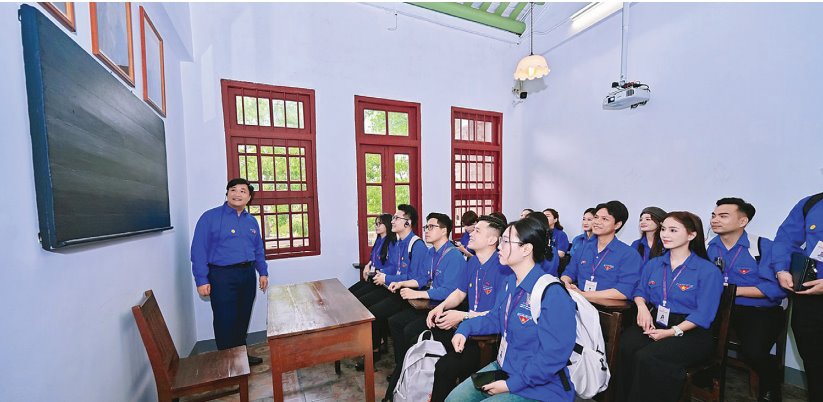
In the printing room on the third floor, everything was quiet.
But the quieter it is, the more sounds that evoke that room.
I imagine the sound of paper being placed on the table. The sound of the wheel rolling through the ink layer. The sound of people gently exchanging words. The sound of footsteps stopping on the stairs. The sound of a political class just ending, and then the same space continues to light up for the preparation of the newspaper.
I don't know how the nights here at that time took place. None of us could see the full past. But standing in that room, in front of artifacts and documents carefully preserved, one can imagine somewhat the hardship of the early days.
Journalism in that situation not only needs knowledge. It also needs courage. It needs calmness in the face of danger. It needs patience to each word. Because each newspaper page is not simply paper and ink. It is a secret message, a seed of thought, a small flame that must go through many shadows to reach readers.
According to documents preserved at the relic, Thanh Nien newspaper in 1925 printed a total of 88 issues in the period from June 1925 to April 1927. In extremely difficult conditions, each issue maintained about 100 copies.
If viewed with today's measure, that number is very small. Very different from a line of news spreading on social networks in just a few minutes. But in the context of secret operations at that time, a hundred newspapers were a hundred journeys that could face danger. A hundred possibilities of being detected. A hundred times trust was sent in silence.
From Guangzhou, those newspapers had to find their way back to Vietnam, overcome the French secret network, through the search of the colonial government, through stages that could not be publicly named. The newspaper pages were disguised, secretly transferred back to their hometowns thanks to the carefree and sincere support of the Shipbuilding Union led by the Communist Party of China. When they arrived in the country, in many localities, revolutionary bases and patriotic organizations reprinted, hand-copied, and passed through each newspaper page, creating a strong wave of propaganda, paving the way for the birth of the Communist Party of Vietnam, February 3, 1930.
I kept thinking about that journey.
A newspaper so small that it can be hidden in a discreet cover. Yet on the secret journey home, it carries theory, belief, direction and even the aspiration to liberate the nation. It may have been read under the oil lamp. It may have been passed around in a closed room. Perhaps the reader must speak very softly, must hide it quickly when there is a strange noise outside the door.
Those newspapers have gone through darkness like that.
And precisely because they go through darkness, the light they carry becomes even more precious.
Leader Nguyen Ai Quoc was not only the founder, the guide of the line, but also directly held the pen as a key writer. To deceive the enemy, he flexibly used many pen names: Team Leader, Corporal, Dream, HT, HL... Right on the front page of the first issue, the pen name Team Leader appeared with the article "The duty of a soldier". For him, journalism is not outside the struggle of the nation. Journalism is revolution. The writer is also a soldier. The pen is a weapon. The newspaper is a battlefield. Each letter, if written with correct ideals, truth and responsibility to the people, can contribute to awakening people.
Besides Uncle Ho, the first red seeds such as Le Hong Son, Ho Tung Mau, Truong Van Linh, Le Duy Diem... also diligently wrote articles, edited, and printed. I imagined them in that third-floor room: Young people far from home, living simply on bunk beds, studying in training classes, and then preparing each page of newspaper together.
They do not have a truly meaningful editorial office like we do today. No modern publishing system. No means of transmitting information in an instant. But they have one thing that any journalist needs, which is faith in the revolution, and responsibility to the people.
The surprising thing is that, despite being born in a secret situation and with rudimentary means of production, Thanh Nien newspaper in 1925 showed a very modern journalism thinking. The newspaper has columns such as "International News", "Domestic News", "Answering Readers' Questions", "Knowledge Questions". The magazine is presented in Vietnamese and Chinese characters, highlighted with the image of a five-pointed star. In particular, the column "Women's Stories" appeared in issue 71, dated November 28, 1926, showing Uncle Ho's timeless vision: From the very beginning, he highly appreciated the role of women in the cause of national liberation.
What moved me was not only the content of the newspaper, but the way that newspaper came to people.
Thanh Nien newspaper in 1925 did not turn theory into distant things. It spoke to the masses in a language that could be understood, could be remembered, could be passed down. It did not consider readers as passive crowds, but considered them as subjects who needed to be explained, dialogued, enlightened and accompanied. In the context of being hunted, that newspaper still paid attention to international, domestic, knowledge, readers' questions, women and specific issues of revolutionary life.
The strong vitality of those online newspapers quickly became a thorn in the side of the French colonial government in Indochina. They searched, finding every trick to destroy them. But the more they were hunted down, the more the value of the newspaper became apparent.
Louis Marty, the French Chief of Intelligence at that time, in classified reports, had to admit: Reading through these 88 issues of newspapers written and revised by Nguyen Ai Quoc himself, we clearly see the technique he used. The newspaper writer tried to use familiar Sino-Vietnamese nouns... to help readers gradually understand communist theory. Nguyen Ai Quoc - the editor-in-chief of Thanh Nien newspaper showed great patience.
I understand that patience here is patience with readers, patience with reasoning, patience with each issue, patience so that a great thought does not fall down like a strange order, but gradually permeates human awareness with familiar, simple, and persuasive words.
Leaving the printing room, I went through other spaces of the relic. What moved me was not only the history that had taken place here, but also the way this place was preserved by the friendly country. The house is preserved solemnly and meticulously, enough for later arrivals not only to "see" a relic, but also to imagine part of the life of patriotic Vietnamese youth who used to study, live and work here.
That preservation does not make history distant. On the contrary, it brings history closer.
In a journey for young people, the presence of this red address is of special significance. Because friendship is not only nurtured by diplomatic rituals or big slogans. Friendship is also nurtured by common memories, by understanding of history, by the young generation looking back at the revolutionary footprints of previous generations. For our Press group alone, that visit is like a vocational training session without a lesson plan, where the teacher is history and the lesson is artifacts.
I still always ask myself: How will today's journalists write to be worthy of that source?
History is not only for remembrance, history is also for reflecting on oneself
The visit to the house on Van Minh street left a deep aftertaste in me. Quieter. More unique. This is where the source of Vietnamese Revolutionary Journalism began to flow from thin pages of paper, silent hands and a great ideal.
Standing before that origin, journalists cannot just be moved. Journalists must ask themselves. Today, we are living in an era where information moves faster than previous generations imagined. A news stream can spread around the world in seconds. Artificial intelligence, social networks, digital platforms, big data are fundamentally changing the way journalism is produced, distributed and received.
In our time, there were no more newspapers that had to be hidden through wharves, seaports, checkpoints. No more newspaper delivery lines that had to face the pursuit of secret agents every hour. But in our time there were other challenges. Speed pressure. Temptation of views. Fake news, misinformation, sensational information and virtual values jostling in media life. Sometimes, the most difficult thing for journalists today is not finding ways to take information far, but keeping that information correct, clean, responsible and beneficial to society.
In a time that is too fast, the ink roller lying still on the third floor of Van Minh street suddenly reminded me of the necessary slowness of journalism.
Slow is not slow in the face of the times. Slow is knowing how to stop to verify.
Slow is knowing how to think more before a word.
Slow is knowing how to ask yourself how what you write will affect readers, public trust, and the interests of the people and the country.
A century ago, Leader Nguyen Ai Quoc showed a sustainable principle of revolutionary journalism: Writing must have purpose, object, method and ideals. The writer writes for the masses to understand. The writer does not turn reasoning into distant concepts. The writer uses a friendly, patient language. The writer does not consider journalism as sideline work, but considers it a front of the revolution.
With young journalists, I realize that I am not allowed to chase after the flashiness of words that obscures the truth. I am not allowed to let personal emotions overwhelm political standards, professional standards and the accuracy of a newspaper article. But we also cannot write rigidly, emotionlessly, just arranging events after events. Because events, if told with a pure heart and a responsible pen, will get closer to readers.
The sun has peaked, the sunlight covers the trees on Van Minh Street in a gentle color. I stood in front of house number 248 - 250 again before leaving. Outside, the rhythm of Guangzhou life continued. Pedestrians passed by. Cars lined up. The sounds of modernity covered the old neighborhood.
But for me, behind that door, history is still breathing. The source of Vietnamese Revolutionary Journalism continues to flow, quietly but persistently, in the hearts of today's writers.


