There must be a "safe valve
In the process of urban development, many new issues arise faster than the ability to adjust by law. Therefore, empowering special urban areas to experiment with new mechanisms and policies within the control framework is a necessary direction.
Sandboxes help localities test models, evaluate effectiveness with actual data before replicating. Experts believe that Hanoi needs to deploy sandboxes from practical problems, instead of just chasing new technologies.
Accordingly, priority areas may include smart transportation, AI and data applications in urban management, urban development in the direction of public transport (TOD), green transportation, underground space, low-lying space and urban logistics. These are areas with rapid changes, requiring flexible mechanisms for testing before widespread deployment.
According to experts, sandboxes can be considered as a "policy laboratory", where new models are deployed within a defined scope, time and conditions. Test results are the basis for adjusting, replicating, or stopping inappropriate models.
Granting testing rights is also synonymous with risk control. Assoc. Prof. Dr. Nguyen Hong Thai - traffic policy expert, University of Transport and Communications, said that sandboxes need to be clearly limited in scope, time, evaluation criteria, monitoring mechanisms and risk management. If it is done well, it should be replicated, if it is not suitable, it should be adjusted, if it is not effective or there are major risks, it should be stopped. The important thing is that each pilot model needs to be evaluated by actual results and specific data.
This approach helps localities have more space for innovation but does not turn experiments into uncontrolled mechanisms.
From mechanisms to practical works
The spirit of proactiveness in management is being shown by Hanoi through promoting a series of infrastructure projects. On the morning of September 5, 2026, the city is expected to organize the commencement, inauguration, and technical opening of 16 key projects. Among them, the project to invest in the construction of Ring Road 1, Hoang Cau - Voi Phuc section, more than 2.2km long, 50m cross-section, with a total investment of more than 7,200 billion VND, is one of the notable projects.
At the same time, 5 large projects are expected to be ordered to start construction, including component project 2 of Ring Road 3.5; Hanoi - Ho Chi Minh City national railway line, Phu Xuyen - Ngoc Hoi section, 26.5km long; National railway of the Eastern Ring Road, Ngoc Hoi - Kim Son section; West Lake renovation project according to BT method and Multi-purpose Urban Area in Binh Minh - Tam Hung.
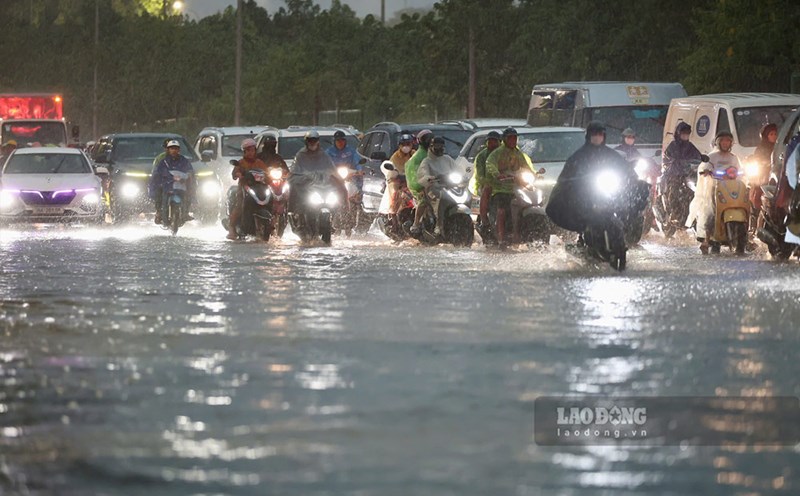
In the field of flood control, Hanoi has implemented 10 urgent public investment projects with a total investment of about 5,600 billion VND.
According to Mr. Nguyen Duc Hung - Director of the Hanoi City Technical Infrastructure Management Center, drainage work is shifting from handling each flooded point to synchronous management according to the basin and interconnected operation.
The projects have added about 33.08m3/s of pumping capacity, an additional 83ha of regulating lakes, creating about 3.4 million cubic meters of rainwater regulation capacity. Initial effectiveness was recorded in the rain on July 28, 2026, when 34/71 annual flooding points were controlled, many areas that had been prolonged flooding no longer had prolonged waterlogging. However, the drainage system is still lacking compared to the plan. The area of regulating lakes only reached 23.53% of the plan, and the capacity of key projects reached 26.35% of the planned capacity.
According to Assoc. Prof. Dr. Nguyen Hong Thai, the value of the superior mechanism lies not only in solving a project, but also in creating a more flexible management method for the city.
Hanoi needs to strongly shift from the thinking of "managing each project" to "managing an urban system". Each large project when deciding to invest must answer two questions: What contribution does it make to the overall structure and does it limit future development choices or not?" - Mr. Thai emphasized.
According to experts, Hanoi needs to protect "development rights in the future", such as railway corridors, school land funds, hospitals, parks and strategic infrastructure.
In a 50--100 year vision, urban areas cannot develop just by short-term decisions. If designed with clear goals, appropriate limits and a strict monitoring mechanism, sandboxes can become a tool for Hanoi to proactively test, evaluate and select suitable models.
Through this, the superior mechanism not only helps remove the current bottleneck but also expands the space for self-determination, increases adaptability and creates a foundation for the Capital to develop modernly and sustainably in many generations.