Key project behind schedule due to lack of materials
One of the projects most clearly affected is Ring Road 3 HCMC - a project with a total investment of more than 75,300 billion VND, more than 76km long, passing through HCMC, Dong Nai and Tay Ninh after the merger.
Started in June 2023, the project was initially expected to be completed in mid-2026. However, due to a shortage of foundation sand and construction stone, the progress had to be adjusted, expected to be completed by the end of 2026, about 6 months behind schedule.
According to the Ho Chi Minh City Traffic Construction Investment Project Management Board (TCIP), the progress of the section passing through Ho Chi Minh City, previously more than 47km long, is currently about 80%.
In which, the elevated section nearly 15km long through Thu Duc City (old) reached nearly 90% of the volume. The Western bidding packages through Cu Chi, Hoc Mon and Binh Chanh (old) only reached more than 70% due to a shortage of foundation sand and construction stone for a long time.
To compensate for progress, TCIP is coordinating with contractors to work directly with material mines to ensure supply, and at the same time coordinate volume flexibly between construction units.
According to the Ho Chi Minh City Transport Board, the Ho Chi Minh City - Moc Bai expressway project alone in 2026 will require about 2.3 million cubic meters of sand, 2 million cubic meters of leveling soil and about 500,000m3 of rock.
Along with that are a series of projects being accelerated such as Ring Road 2, Ho Chi Minh City - Thu Dau Mot - Chon Thanh expressway, Ho Tram - Long Thanh expressway, Can Gio bridge, Phu My 2 bridge, Binh Tien road bridge, Can Gio - Vung Tau sea crossing road...
Right this year, Ho Chi Minh City is also expected to start construction of Ring Road 4, Thu Thiem 4 bridge, expand National Highway 1, National Highway 13, National Highway 22 and the North-South axis, causing the demand for construction materials to continue to increase sharply.
Opening up directions for exploiting sea sand and crushed sand
According to the Ho Chi Minh City Department of Agriculture and Environment, the total demand for materials serving 64 projects in the area in 2026 is very large. The demand for construction sand is about 15.56 million cubic meters, but the current exploitation capacity is only about 630,000m3 (a shortage of nearly 14.9 million cubic meters).
For filling sand, the demand is about 52.89 million cubic meters while the supply capacity only reaches nearly 26.93 million cubic meters (a shortage of nearly 26 million cubic meters). Filling soil is also short of about 11 million cubic meters when the demand is up to 23.67 million cubic meters, but the current exploitation capacity is only about 12.69 million cubic meters.
This pressure of shortage forces Ho Chi Minh City to quickly find alternative material sources to ensure progress.
Mr. Trinh Quoc Dung - Deputy Head of the Technical Infrastructure Department (Ho Chi Minh City Department of Construction) - said that the city will focus on effectively exploiting existing mineral resources, applying technology in management, strengthening inspection of actual exploitation output and accelerating the implementation of special mechanisms to increase material supply.
According to Mr. Dung, construction sand and filling sand are still the two groups of materials with the largest shortage today. The city will continue to coordinate with ministries and sectors to accelerate projects to dredge rivers, canals, and ditches associated with mineral recovery. At the same time, research and rationally exploit material sources from Dau Tieng Lake, irrigation lakes, expand the use of sea sand, crushed sand (from stone), and reduce dependence on natural sand sources that are increasingly scarce.
Transforming construction waste into resources
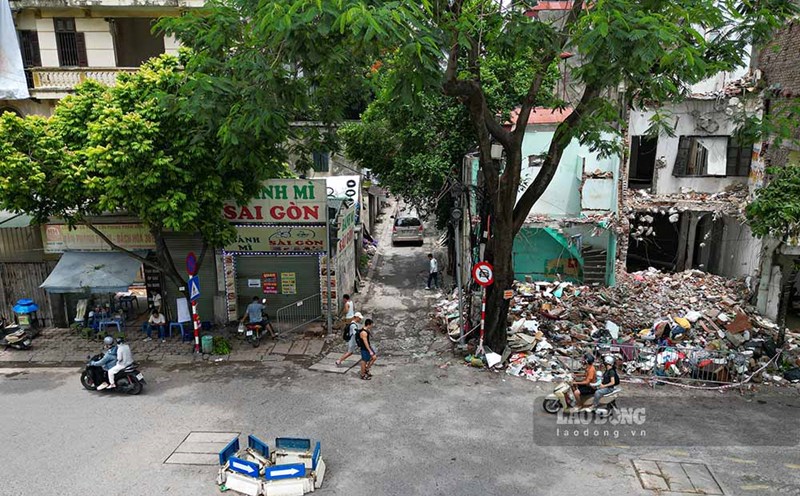
Ho Chi Minh City is promoting construction waste recycling as a long-term solution to supplement material sources. The City People's Committee has assigned the Ho Chi Minh City Construction and Building Materials Association (SACA) to complete the project on recycling construction waste for consideration. According to Mr. Dinh Hong Ky, Chairman of SACA, rapid urbanization makes the amount of construction, renovation, and demolition waste increasing. Looking at the circular economy, this is a valuable secondary resource, instead of an environmental burden.
Representatives of the Ho Chi Minh City Department of Construction said that with many infrastructure and urban embellishment projects, the amount of construction waste continues to increase. Recycling this type of waste not only reduces environmental pressure but also helps save resources, towards sustainable urban development.