
The information was announced by the Ho Chi Minh City Urban Railway Management Board (MAUR) on the morning of December 18.
Metro Line 2 has a total length of nearly 11.3 km, of which more than 9.2 km is underground, more than 0.8 km is elevated, the rest is the road leading to Tham Luong depot. The line includes 10 underground stations (including Ben Thanh station), 1 elevated station and 1 depot area.
This is a pioneering project applying specific mechanisms and policies according to Resolution 188.
According to the technology plan approved by the Ho Chi Minh City People's Committee, Metro No. 2 will be upgraded to GoA4 automation level, meaning it operates completely automatically, without the need for train drivers or train staff.
The standards system mainly applies European standards, while fully meeting current standards and regulations of Vietnam, ensuring the ability to synchronously connect with Metro Line 1 and other metro lines in the future.
Currently, MAUR is coordinating with units under the Ministry of Construction to absorb, explain and complete a list of standards and regulations applicable to the project.
To date, 100% of compensation, support and site clearance work has been completed; the relocation of technical infrastructure works is expected to be completed in early 2026.
The Ho Chi Minh City People's Committee has approved the project adjustment policy. MAUR is coordinating with departments, branches and consulting units to complete procedures, including: Approving the adjusted feasibility study report; developing and approving the contractor selection plan; organizing EPC bidding; completing the technical design after FEED.
The goal is to qualify to start construction of the entire route on January 15, 2026.
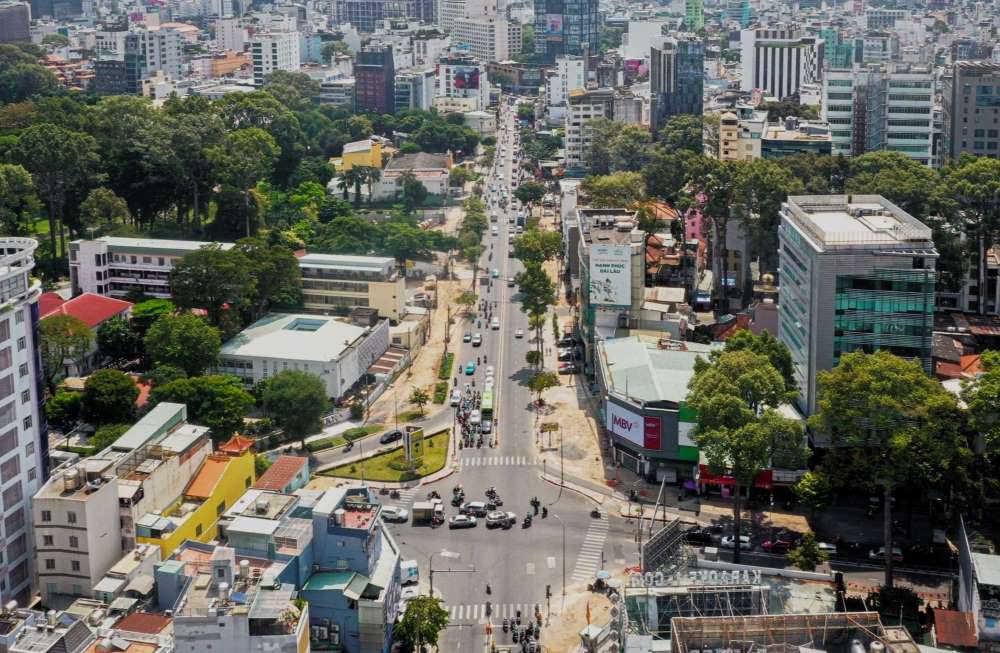
According to MAUR, after completion, Metro Line 2 will play a role as a backbone connecting the central area with the Northwest of Ho Chi Minh City, meeting the needs of public passenger transport on the Ben Thanh - Cach Mang Thang Tam - Truong Chinh - Tham Luong corridor.
Metro No. 2 was first approved in October 2010 with a total investment of more than VND 26,116 billion (equivalent to USD 1.374 billion).
By November 2019, the project was adjusted to nearly VND47,891 billion, mainly using ODA loans from ADB, KfW and EIB.
By March 2025, the Standing Committee of the Ho Chi Minh City Party Committee agreed to transfer all ODA capital to the city budget.
According to MAUR, along with exchange rate fluctuations, price spikes, scale adjustments and integration of TOD urban development, the total investment of the project has increased significantly, to about 57,000 billion VND.
According to the new plan, Metro Line 2 will be extended by more than 200 m due to the addition of a section of underground directly connecting to Ben Thanh Station and adjustment of the starting point of the route.
Forecast of rapid increase in travel demand causing the number of trains to be adjusted: 14 trains (3 cars) by 2030; 16 trains (6 cars) by 2040; 22 trains (6 cars) by 2060
Peak travel demand is forecast to increase from more than 11,800 passengers/hour/way in 2030 to over 40,500 passengers/hour/way in 2060.
The cost of compensation, site clearance and resettlement also increased from VND 4,249 billion to more than VND 5,174 billion.
The project has added urban development components according to traffic orientation (TOD) at depots and stations to effectively exploit land funds, create more financial resources and form new urban areas along the route.
According to MAUR, after 1 year of operation (as of December 15, 2025), Metro Line 1 (Ben Thanh - Suoi Tien) has safely operated 78,194 trains, serving about 18.95 million passengers (reaching 114.21% of the plan).
On average, there are 1.5 million visitors per month, about 52,000 visitors/day and peaked at more than 110,000 visitors/day during the holidays.


