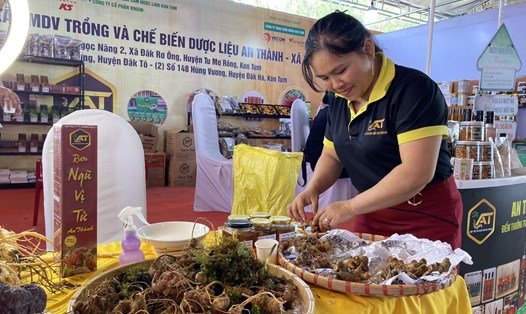
Da Nang City People's Committee has just issued a document on implementing forest environment leasing to plant, develop and conserve Ngoc Linh ginseng in Da Nang city.
A noteworthy point is that Da Nang City People's Committee requested the Department of Science and Technology to advise the City People's Committee to allocate capital to invest, research, and apply science and technology services (system of equipment serving the extraction, cloning, DNA testing and system of equipment testing the composition of saponin essence of Ngoc Linh ginseng....) to analyze and test the quality of Ngoc Linh ginseng, contributing to combating the problem of fake ginseng and ginseng of unknown origin.
Previously, in 2023, to prevent the situation of trading in fake and counterfeit Ngoc Linh ginseng, Kon Tum province (old) - now Quang Ngai - also invested in a system of machinery to test the precious active ingredients in ginseng worth 13 billion VND.
Including a system of equipment serving the work of extracting, cloning, testing DNA and equipment testing the composition of saponin sapodilla bioactive ingredient. The equipment and tools have been fully equipped, ensuring conditions for analyzing and testing sapodilla and other medicinal materials.
Investing in a DNA testing system for Ngoc Linh ginseng of Quang Ngai province and in the future Da Nang is very necessary. Because the reality from the two localities in the past time shows that the situation of "fraudulent traders" smuggling fake and counterfeit ginseng into the market to deceive consumers is very common. Subjects label Ngoc Linh ginseng for tubers that look like Ngoc Linh ginseng such as Northern Panax pseudoginseng, Chinese ginseng, Lai Chau ginseng... to sell to customers at the price of Ngoc Linh ginseng.
In particular, some businesses make fake confirmations of having links to grow ginseng with people or take advantage of planting area confirmations and links to take them for sale, business or call for investment capital cooperation.
For a long time, when suspecting fake ginseng, functional agencies have had to take samples to send for testing in Hanoi or Ho Chi Minh City, which is both time-consuming, passive, and costly. Therefore, the introduction of Ngoc Linh ginseng for DNA testing and on-site active ingredient analysis is both a technological step forward and creates evidence-based trust for consumers, instead of being subjective as in most recent times.
This not only protects consumers, but also protects genuine ginseng growers. Because in a "gold and dross mixed" market, real people sometimes suffer losses when the value of products is dragged down by counterfeit goods. When there is a clearer authenticity, real value has the opportunity to be properly valued.
Localities proactively invest, research, and apply scientific and technological services to analyze and inspect the quality of Ngoc Linh ginseng, contributing to combating the problem of fake ginseng and ginseng of unknown origin, which is also a way to protect national brands.
Ngoc Linh ginseng is not only a rare medicinal herb, but is expected to become a product of international stature. But the more a high-end brand, a "national treasure", the more it needs a strict quality control system. Otherwise, fame itself will become fertile ground for counterfeit goods to develop more and more large-scale.
However, technology is not the only solution to the problem of fake Ngoc Linh ginseng. Because DNA testing only really works when it comes with a synchronous management system, from mandatory testing regulations, traceability, to market control and appropriate service costs. Otherwise, technology may exist, but it is not enough to change reality.
A product that wants to go far cannot only rely on fame, but must rely on standards. And with Ngoc Linh ginseng, that standard is starting to be shaped from scientific data itself.