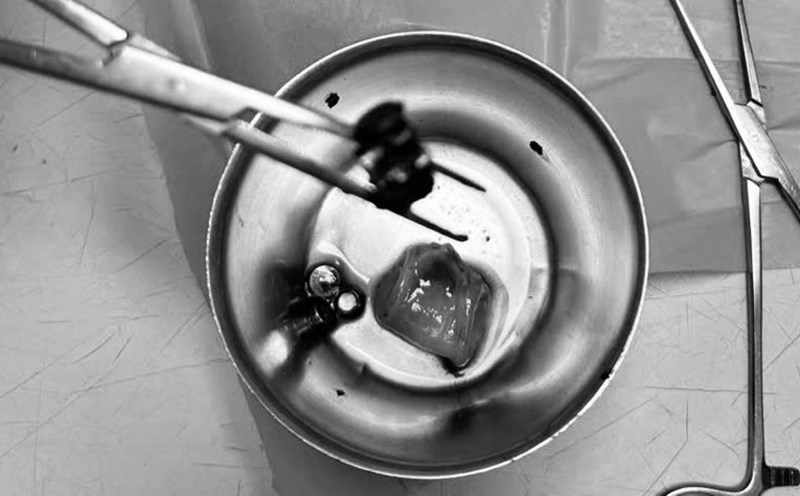
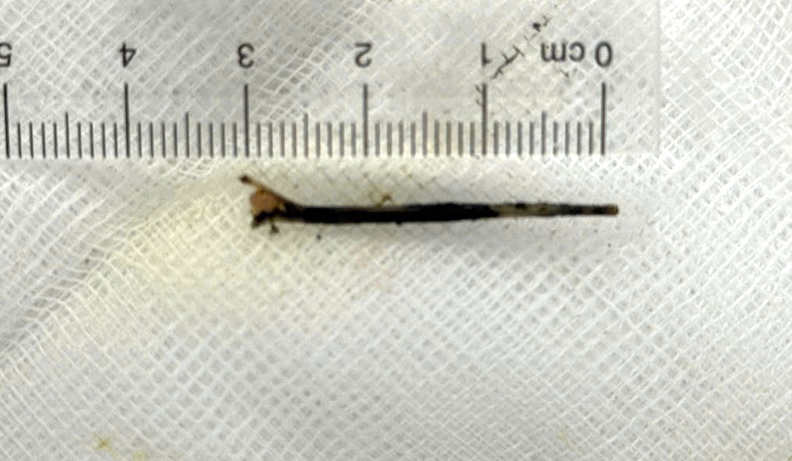
As Lao Dong newspaper has reported, recently, doctors at Can Tho Central General Hospital successfully performed the reverse cordyceps endoscopy (ERCP) technique to remove a foreign object, a fish bone.
This case is quite special when a bone about 3cm long penetrates the stomach wall into the bile ducts, causing disruption of bile flow and leading to bile duct inflammation and prolonged abdominal pain.
This dangerous warning, BS.CKII. Nguyen Khac Nam, Deputy Head of General Surgery Department, Can Tho Central General Hospital, informed that bone choking is a life-threatening accident that can occur at any age. Most foreign objects pass through the digestive tract harmlessly and are excreted by feces.
Gastrointestinal perforation due to foreign objects swallowing is very rare, occurring in less than 1% of patients and is most commonly observed in the sigmoid and rectal regions. Long, sharp or thin foreign objects such as fish bones, chicken bones and needles can puncture the intestines.
However, the fact that the foreign object swallowed and then moved to the liver as in the case of the patient mentioned above is extremely rare and very few cases have been reported in medical literature to date.
Accordingly, the foreign object can reach the liver by one of the following routes: directly through the abdominal wall, moving from the digestive tract. The movement of the foreign object is usually asymptomatic or may be the cause of acute abdominal pain.
Patients may not remember swallowing the foreign object. In addition, the interval between swallowing and symptoms may change, making diagnosis difficult.
Gastrointestinal foreign objects such as toothpicks, fish bones or sharp objects that are at risk of puncturing the digestive tract can cause serious complications such as abscesses, peritonitis if not detected and treated promptly. In this case, the foreign object also causes bile duct obstruction, with the risk of leading to bile duct dilation, liver cell damage and secondary cirrhosis, seriously affecting health, and even threatening the patient's life.
Doctors recommend that people be careful in eating, especially when using foods with small, sharp bones; and should go to a medical facility early when they have abnormal symptoms such as prolonged abdominal pain, fever, jaundice to be diagnosed and treated promptly.