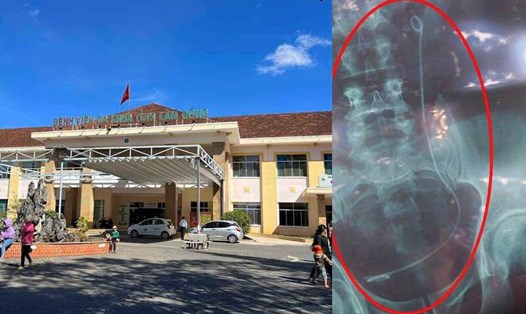
People are frustrated because the waiting time for medical examination is prolonged
Recorded by reporters on the morning of February 4, at Hong Ngoc General Hospital, Ms. Nguyen Thi Loan (36 years old, Cau Giay, Hanoi) just stepped out of the X-ray room to check her lungs. Throughout the process of changing clothes and entering the room, it only took about 3 minutes to complete.
I have respiratory diseases, so the doctor took me for a lung X-ray. Even changing clothes only took a few minutes. The scanning process is too fast, only takes a few tens of seconds. I got into the scanner, the doctors took a quick shot and it was done, the scanner was even faster than taking pictures. The doctor reminded me that it was done, then I knew" - Ms. Loan shared. In fact, other X-ray cases are also similarly fast.
Therefore, the information that a X-ray scan must take 6 minutes, and a heart ultrasound scan must take 30 minutes to be reimbursed by health insurance... makes many people feel unreasonable.
Hospitals in Hanoi are overloaded, patients are queuing in long lines waiting. Waiting due to the large number of patients is understandable, now we still have to wait because even the unreasonable regulations are really unbearable" - Mr. Nguyen The Thang, a relative of a patient queuing for examination at E Hospital, sighed and shared with Lao Dong reporters.
However, this is one of the regulations in Decision No. 2775/QD-BYT promulgating professional documents guiding technical procedures for diagnostic imaging and interventional electrophoresis.
According to this decision, the time to perform some technical services is used as a basis for assessment and payment of health insurance. Specifically, a regular X-ray scan lasts 6 minutes or more, and a heart ultrasound must last 30 minutes to be paid by the health insurance fund. In case the implementation time is shorter than the prescribed level, the cost is at risk of not being paid.
A doctor at E Hospital shared with reporters: In fact, whether X-rays and ultrasounds for patients take place quickly or slowly depends entirely on the patient's condition.
If the patient is healthy and walks quickly, the total X-ray scan time is only about 3 minutes. If the patient is seriously ill, the scan time will be longer. Ultrasound is also the same, some patients need a few tens of minutes of ultrasound to be able to detect the disease. We do it best for the patient, diagnose the disease correctly, not according to time regulations" - the doctor said.
Doctors believe that, along with the rapid development of science and technology, the X-ray and ultrasound system is increasingly modern, providing clear images and significantly shortening the operating time.
In addition, the professional qualifications and experience of the team of doctors also help the diagnosis process take place faster while still ensuring accuracy.
Advanced science, modern machinery, highly skilled doctors, X-rays are done just by pressing, why wait 6 minutes for a patient for a scan? Current heart ultrasound usually only takes about 10-15 minutes, in some cases only 2-3 minutes to collect all necessary images. However, due to the regulation that each scan must take 30 minutes, an ultrasound machine in the morning can only perform about 8 scans. If this number exceeds, the remaining scans may not be reimbursed by health insurance" - a specialist in diagnostic imaging shared.
According to doctors, the rigid application of timelines not only causes waste of resources but also directly affects patients. In the context that many hospitals are always overloaded and the number of patients waiting for X-rays is large, this regulation prolongs waiting times, creating more pressure for both doctors and patients.
Notably, health insurance patients may face the risk of having to pay for their own costs if the scan does not meet the "time limit", even though professional quality is still guaranteed.
Many opinions believe that taking the time of performing the technique as a condition for health insurance payment does not accurately reflect the nature of diagnostic imaging activities. X-ray or ultrasound is not just the time the machine operates, but a whole process, including receiving patients, preparing posture, setting technical parameters, performing scans, reading, analyzing images and returning results. The time for each step can vary depending on the patient's condition, physical condition and doctor's experience.
Adjusting regulations according to each patient's condition is necessary
Dr. Nguyen Trong Khoa, Deputy Director of the Department of Medical Examination and Treatment Management, said that the Ministry of Health has organized meetings and exchanges with relevant parties, and will also have an official document sent to the Ministry of Finance and Vietnam Social Security to review the assessment and payment of health insurance for imaging techniques.
The Department of Medical Examination and Treatment Management also coordinates with the Electromechanical Association to unify professional procedures, thereby adjusting the average time for performing X-ray techniques and some other diagnostic imaging techniques to suit reality, applying uniformly nationwide.
According to Dr. Nguyen Trong Khoa, X-ray is a whole process including receiving patients, preparing machinery, taking pictures, reading results and returning results, not just counting the machine running time. Therefore, it is not possible to take purely X-ray time as a mandatory condition for health insurance payment.
He believes that adjusting regulations according to each patient's condition is necessary. 6 minutes is only the average level for a normal X-ray scan, and should not be applied rigidly to all cases in the appraisal and insurance payment work.
Leaders of the Department of Medical Examination and Treatment Management also noted that in imaging, the important thing is that doctors prescribe correctly, avoiding abuse causing waste. The technique implementation time is only relatively standardized, depending on the doctor's skills and the specifics of each case.
Previously, in September 2025, the Department of Medical Examination and Treatment Management issued an official dispatch to hospitals and Departments of Health of provinces and cities on reviewing the guidance on diagnostic imaging and interventional electrophoresis technical procedures according to Decisions 2775 and 2776/QD-BYT. The Ministry of Health also received recommendations from the Association of Private Hospitals on some contents in these two guidelines for consideration and adjustment.
The Department of Medical Examination and Treatment Management has requested units to urgently report any problems arising during the implementation process to summarize and report to the leaders of the Ministry of Health and improve regulations in accordance with reality.