
The city's plan identifies the development goal to 2030 to build and develop Hai Phong into a modern, civilized, ecological and livable industrial port city of Southeast Asia; pioneering in industrialization, modernization, innovation, digital transformation and green transformation; being the leading marine economic center, high-quality tourism, services - logistics and clean energy nationwide, an international center for training, research, application and development of marine science and technology.
The material and spiritual life of the people has been improved, social security and welfare are comprehensive, approaching typical cities in the region; national defense - security - social order and safety are solid; taking the lead in building a socialist model associated with socialist people.
The goal by 2050 is for Hai Phong to be a modern, smart, globally connected and livable industrial port city of world stature; a marine economic center, a seaport center, a key national and international logistics hub, a high-quality tourism center, an international center for training, research, application and development of science and technology. The material and spiritual life of the people has been elevated to the level of leading cities in Asia and the world.
According to the plan, Hai Phong prioritizes developing key industries that play a leading role in growth: Electronics industry - information industry - high technology; seaport services - logistics - international trade; modern trade and urban services, forming a closed value chain of industry - logistics - trade - services. The city encourages the development of typical economic sectors such as: sea and island tourism and resort services; green marine economy and sustainable aquaculture; culture, sports, entertainment and port city cuisine.
The city will pay attention to developing emerging industry groups with high growth potential such as: Digital technology and digital transformation industry; renewable energy and green industry; creative services, digital finance and digital content industry; circular economy, ecological agriculture and green logistics; supporting service and value chain linkage industry groups.
Along with that, Hai Phong continues to maintain reasonable, efficient, and sustainable traditional economic sectors and manage the transformation process: shipbuilding and mechanical engineering; textiles and garments - footwear; sea transport; agriculture and fishery. The fields of education, health, science and technology, culture, and social security are placed on par with economic development, clearly showing the direction of development for people, for quality of life.
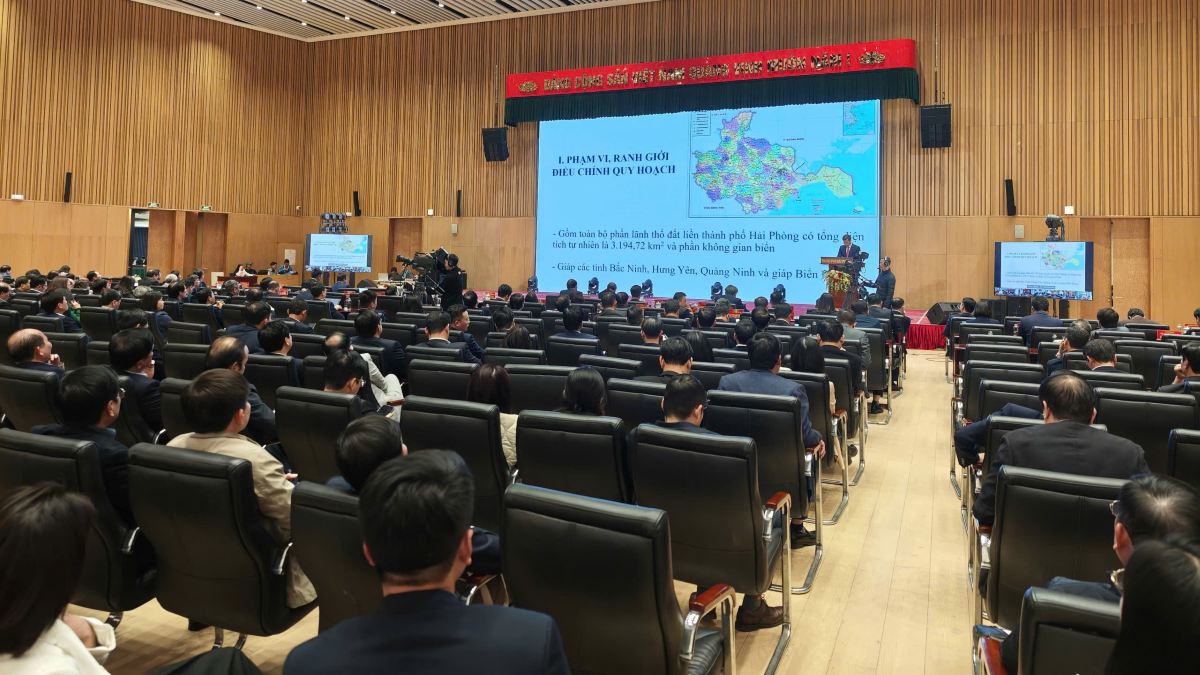
Also according to the plan, Hai Phong identifies development with 4 driving areas: seaport - international logistics along the Dinh Vu - Lach Huyen - Cat Hai, Nam Do Son axis; green and smart industry concentrated in the East, the Southern Coastal Economic Zone is the core; sea tourism on Cat Ba - Do Son island - Hai Phong urban center and cultural - spiritual - ecological tourism associated with the world cultural heritage of Con Son - Kiep Bac; City Political - Administrative Center as the core and urban development along the 2 banks of the Cam River.
Regarding the development of functional zones, Hai Phong will form a strategic economic development quadrilateral: Dinh Vu - Cat Hai economic zone; southern coastal economic zone of Hai Phong; specialized economic zone of Hai Phong and northern economic zone...
A noteworthy new point in this planning adjustment is the integration of development space after the merger, thereby creating a foundation for Hai Phong to shift from the "one center - one sea corridor" development model to the "multi-center - multi-corridor - multi-value chain" model. Adjusting the planning in the direction of multi-center, multi-corridor and multi-value chain is considered a necessary step to solve the problems posed by reality.
The adjustment of Hai Phong City Planning for the period 2021 - 2030, with a vision to 2050, is an important basis for Hai Phong to continue to affirm its role as a driving force for the region's development, while creating a solid foundation for the next development period.


