
Domestic steel market breakthrough growth in the first 6 months of 2026
According to data from the Vietnam Steel Association (VSA), Vietnam continues to improve its position on the world steel map, ranking in the top 10 largest raw steel producers in the world.
In general, in the first 6 months of 2026, Vietnam's raw steel production reached 15.18 million tons, an increase of 26.9%, higher than the general growth rate of the processing and manufacturing industry of approximately 11.4% and the growth rate of the entire industry of approximately 10.8% and the construction industry of 9.51%. Raw steel consumption reached 14.81 million tons, an increase of 25.5% compared to the same period in 2025. Of which, exports of raw steel were 1.696 million tons, an increase of 5.3% compared to the same period in 2025.
The production of finished steel of all kinds reached 18.21 million tons, an increase of 15.1% compared to the same period in 2025 (recording an increase in all items except galvanized steel down 14.4% and cold-rolled steel down 6.2%). The sales of finished steel reached 17.954 million tons, an increase of 14.2% compared to the same period last year (recording an increase in all items except cold-rolled steel down 3.6% and galvanized steel down 9.5%).
However, besides good growth items such as construction steel and hot-rolled steel serving domestic demand, galvanized steel and cold-rolled steel have negative growth in both production and sales. Faced with challenges from trade remedy measures and green transformation mechanisms, steel enterprises are making efforts to find and expand export markets, in which Vietnamese steel exports in June 2026 (approximately 17%), Q2/2026 positive growth, but have not yet compensated for the negative growth in the first 5 months of 2026.
Specifically for iron and steel, in the first 6 months of 2026, Vietnam imported approximately 7.8 million tons, worth more than 5.6 billion USD, an increase of 2.84% in volume and 4.6% in value compared to the same period in 2025. Exports of finished steel of all kinds are estimated at 5.5 million tons of steel, approximately the same level as the same period last year; Export value is estimated at 3.7 billion USD, an increase of 0.3% compared to the same period in 2025.
Cement market growth slows down
According to information from the Cement Information and Data Center (CIDC), in June 2026, the total cement production output of the industry reached 10.59 million tons, down 1% compared to May but up about 8% compared to the same period in 2025. The decrease is not large and production activities in general are still stable, although some lines are temporarily suspended for periodic maintenance and repair.
Accumulated in the first 6 months of the year, total production reached 58.14 million tons. Cement consumption reached about 60.98 million tons. These figures show that the operating foundation of the market in the first half of the year is still positive, although June showed signs of slowing down.
Domestic cement consumption in June reached nearly 7.5 million tons, down 3% compared to May but up 16% compared to June 2025. Accumulated in the first 6 months of the year, domestic cement consumption reached 41.58 million tons, up 16% over the same period. Accordingly, domestic cement demand still maintained at a significantly higher level than the previous year, but the growth rate slowed down in the last month of the second quarter of 2026.
If domestic consumption only decreases slightly, exports are the region that more clearly shows the stagnation in June. Total cement and clinker exports reached 2.93 million tons, down 6% compared to May but still up 9% compared to the same period last year. Export value reached about 111.4 million USD, down 6% compared to the previous month. In which, cement exports reached 1.80 million tons, almost flat compared to May and the same period last year. Conversely, clinker exports reached 1.13 million tons, down 14% compared to the previous month but still up 27% compared to the same period.
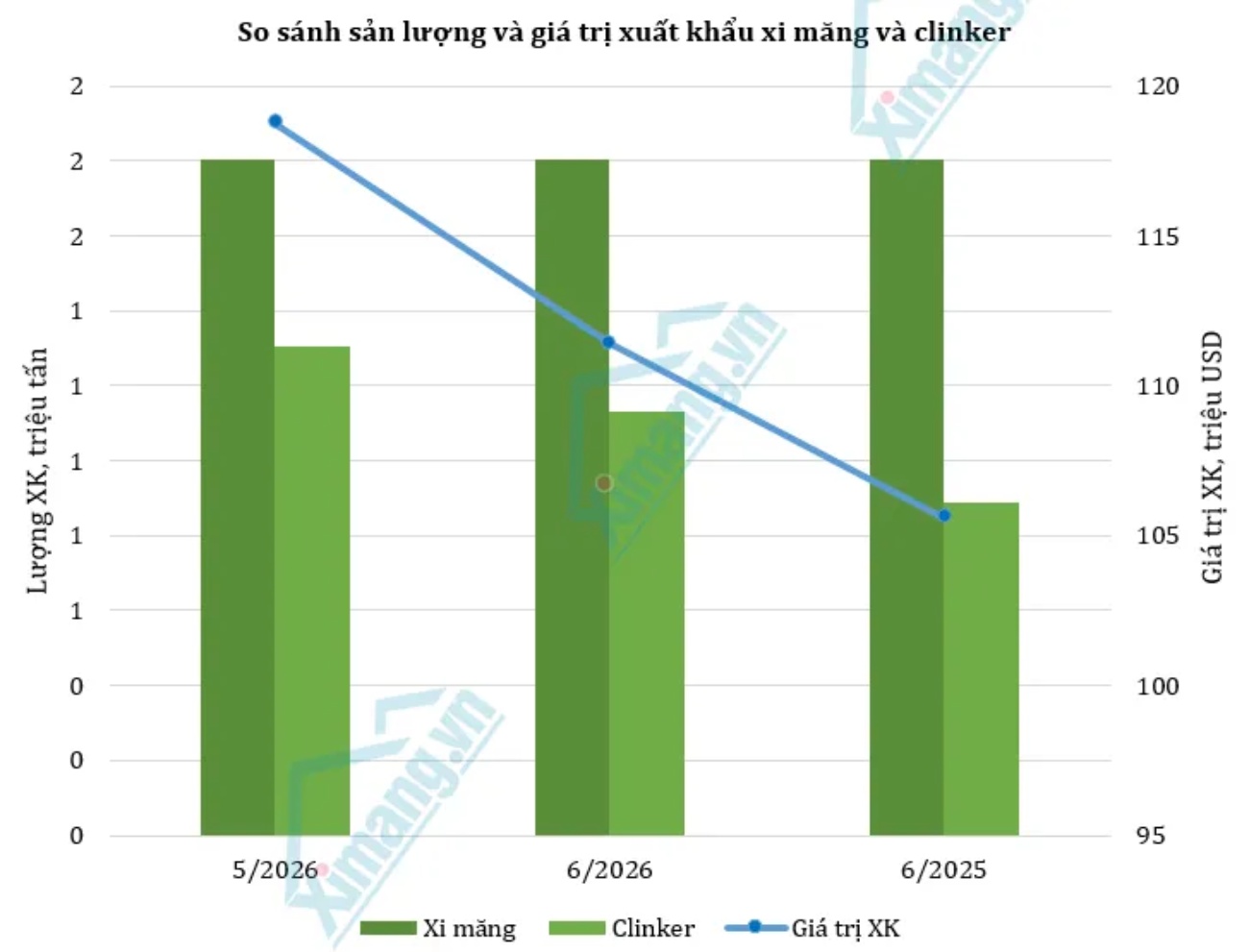
The cement market enters the second half of the year with a better growth foundation than the same period last year, but the speed of improvement will depend heavily on the ability to transform investment drivers into actual material demand.
It is predicted that in the coming months, regulating output closely to actual demand, controlling inventory and costs will continue to be of great significance. In the long term, increasing the proportion of finished cement, diversifying export markets and consolidating domestic distribution systems can help cement enterprises reduce dependence on clinker exports and limit the impact from fluctuations in the international cement market.


