
The 2024 Land Law has now been implemented in practice in many localities, along with the more unified application of guiding regulations. In that context, the content related to the distinction between compensation and support when the State reclaims land continues to be an issue of great concern to the people, because this is the direct basis for determining the legitimate rights of land users.
Not clearly understanding the boundary between these two mechanisms can lead to misunderstandings of policies and complaints during the process of land recovery.
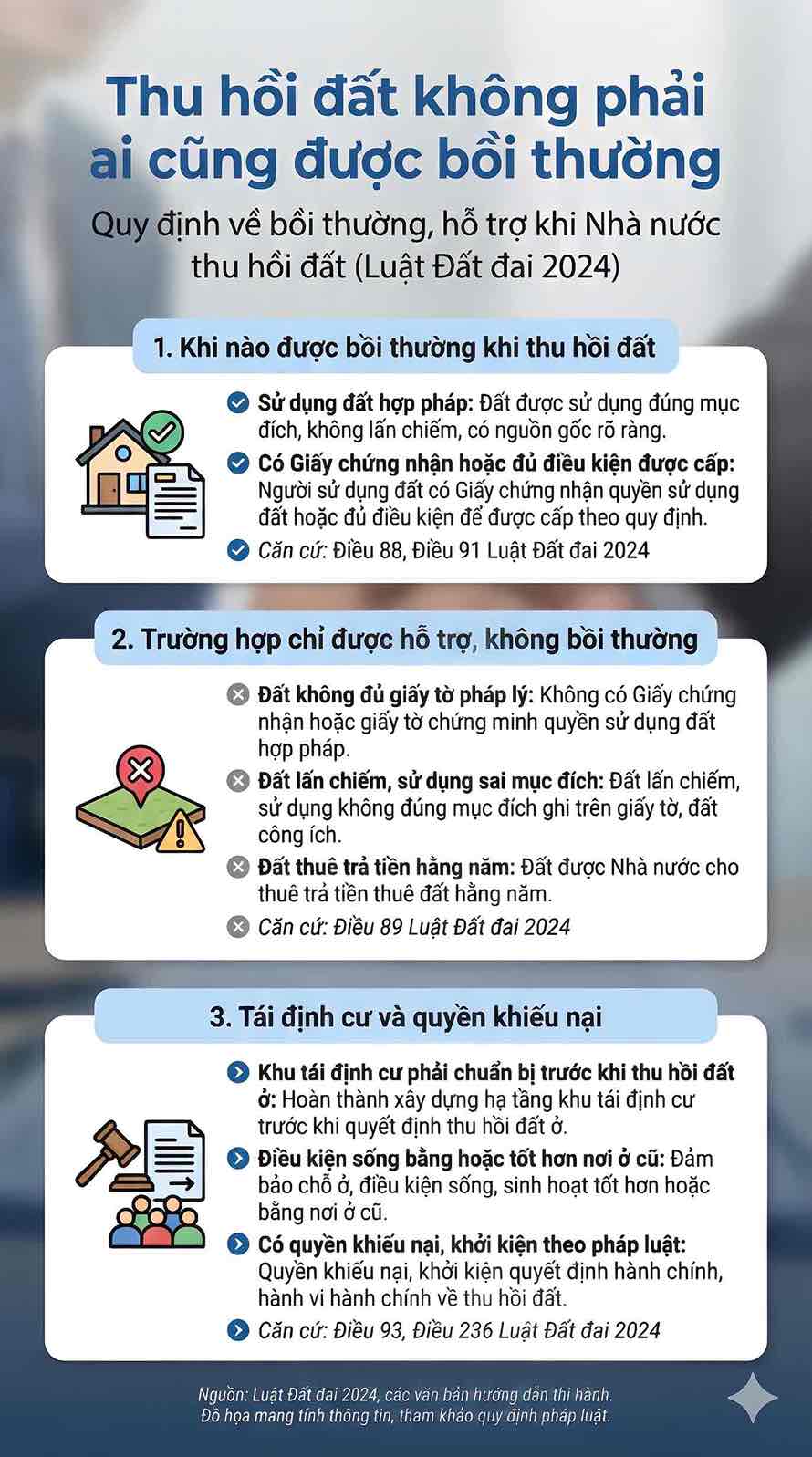
Cases eligible for land compensation.
According to Article 88 of the 2024 Land Law, land users will be compensated when the State reclaims land if they are legally using the land and have a Land Use Rights Certificate, or are eligible for a Certificate according to regulations but have not been granted one.
This regulation aims to ensure the rights of people to use land stably and long-term, but due to objective reasons, legal procedures have not been completed. In case of eligibility, the land user will be compensated for the land, and will also be considered for compensation for assets attached to the land and other legal costs according to regulations.
The law also clearly stipulates the principle of compensation. According to Article 91 of the 2024 Land Law, compensation is prioritized by land with the same purpose of use as the type of recovered land. In case the locality does not have a suitable land fund, the land user will be compensated in cash according to the specific land price decided by the Provincial People's Committee at the time of land acquisition.
Cases that are not compensated are only supported.
Not all cases of land acquisition are compensated. Article 89 of the 2024 Land Law stipulates that land users who are not eligible for compensation will be considered for support by the State, depending on each specific case.
Common cases include: land used without legal documents; encroached land; land used for the wrong purpose; land rented with annual land rent payment. The support in these cases is decided by the provincial People's Committee, based on actual conditions and local policies.
This is easily misunderstood in reality, when many people think that without a Certificate, no benefits will be considered. In fact, the law still has a support mechanism to reduce difficulties for people who are using land, even if they do not meet the compensation conditions.
Resettlement and complaints of people whose land is recovered
The 2024 Land Law stipulates more strictly on resettlement. According to Article 93, the resettlement area must be fully prepared before reclaiming residential land, ensuring living conditions equal to or better than the old place of residence. This regulation aims to overcome the situation of land recovery in the past but slow resettlement arrangement, causing difficulties for people as in the past.
In addition, the Law continues to affirm the right to complain and file a lawsuit of those whose land is recovered. According to Article 236 of the 2024 Land Law, land users have the right to complain about the decision to reclaim land, compensation, support, resettlement plan or file a lawsuit in court according to the provisions of the law on administrative proceedings.
The complaint and lawsuit shall be made in accordance with legal procedures and shall not result in loss of the right to compensation and support, except in cases where there is a decision to temporarily suspend according to regulations.
In the context that the 2024 Land Law is being implemented synchronously and entering 2026 with the requirement of unified application in practice, land users are recommended to proactively review the legal status of the land plot, complete the land registration dossier, and register changes in accordance with regulations.
Understanding the line between compensation and support when the State reclaims land is an important basis to protect legitimate rights and interests, while limiting the risk of disputes and complaints in the process of land recovery according to current law.


