
On the morning of September 21, at the 5th session (specialized session) of the 11th Ho Chi Minh City People's Council, the Ho Chi Minh City People's Committee submitted a proposal for investment policy for the project to invest in building and completing the technical infrastructure of the Northwest Solid Waste Treatment Complex in Ho Chi Minh City.
The scale of compensation and site clearance of the project is about 310 hectares.
Regarding transport infrastructure, the project is expected to build a new road system with a total length of about 12.3 km, including traffic roads and green trees along the route. Roads have road boundaries from 15 - 24 m.
In addition, the project will invest in synchronous water supply, drainage, public lighting systems and technical trenches, pipes, and tunnels to arrange underground power and telecommunications lines.
A notable item is the ash and slag landfill area of about 14 hectares, serving the treatment of ash and slag generated from waste-to-energy plants and recycling using hygienic landfill technology. The project also builds a wastewater treatment area.
In addition, the canal system in the area will be renovated, combined with the construction of management and operation roads along the canal. The complex is built with fences, management and operation roads and green isolation strips around.
The project also invests in medium and low voltage power transmission lines and transformer stations to serve the planned area; building a headquarters and operating office area throughout the complex.
The total investment of the project is about 12,106 billion VND, implemented in the period 2026 - 2031.
Of which, compensation, support and resettlement costs are about 6,790 billion VND; construction costs are about 3,632 billion VND. The remaining funding is for equipment, project management, construction investment consulting and contingency.
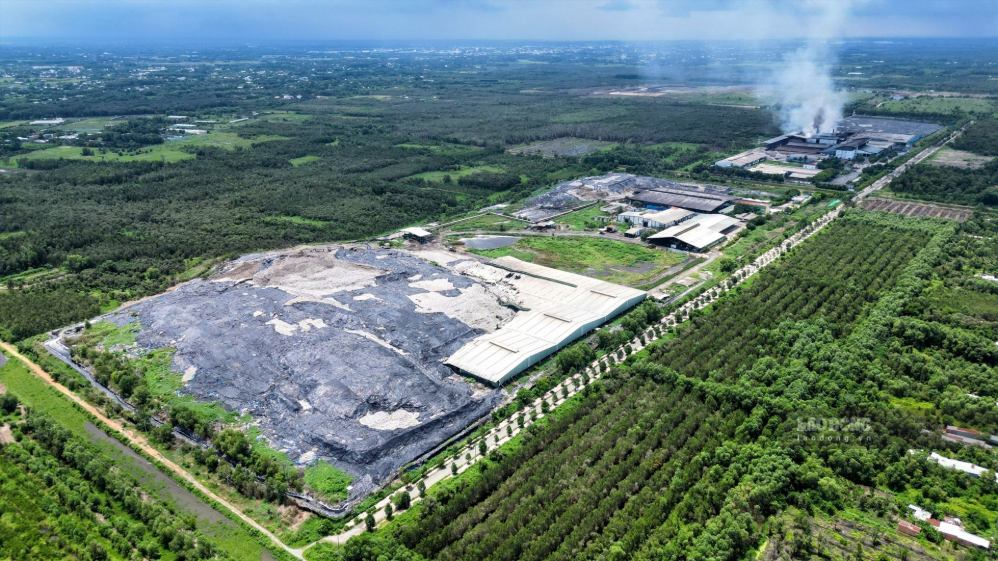
According to the Ho Chi Minh City People's Committee, after merging with Binh Duong and Ba Ria - Vung Tau, the city currently has about 14 million people, the average amount of domestic solid waste generated is about 14,000 tons/day and night.
Ho Chi Minh City has 4 centralized solid waste treatment areas including Nam Binh Duong Solid Waste Treatment Complex, Toc Tien, Da Phuoc and Tay Bac.
The Northwest Solid Waste Treatment Complex alone currently has 3 operating investors, receiving and treating about 6,500 tons/day and night, equivalent to about 46% of the total treatment capacity at 4 complexes. The city assesses that this area is under great pressure on infrastructure and treatment capacity.
According to forecasts released by the Ho Chi Minh City People's Committee, the total amount of waste in the area may increase to nearly 58,000 tons/day and night by 2030, about 65,000 tons/day and night by 2040 and 72,000 tons/day and night by 2050.
In which, in 2030 alone, domestic waste is expected to be about 16,500 tons/day, industrial waste about 38,000 tons/day, and medical waste and construction waste nearly 3,400 tons/day.
According to the Ho Chi Minh City People's Committee, the Northwest Solid Waste Treatment Complex has a planned scale of about 822 hectares.
In this phase, the city focuses on deploying on an area of about 646 hectares, including 336 hectares that have been cleared and 310 hectares that need to be further recovered. The remaining area of about 175.61 hectares will be invested in the next phase.
After completion, the project will create more than 480 hectares of clean land to attract investment, meeting the treatment needs of about 27,000 tons of waste/day and night by 2030.
Currently, there are 23 domestic and foreign investors interested in and registered to invest in the complex, including 14 investors proposing large-scale waste-to-energy plants and 9 investors interested in hazardous waste treatment.


