
The conference was organized by the Vietnam General Confederation of Labour on January 15-16. Experts, scientists, and trade union officials participated.
Many new and progressive points
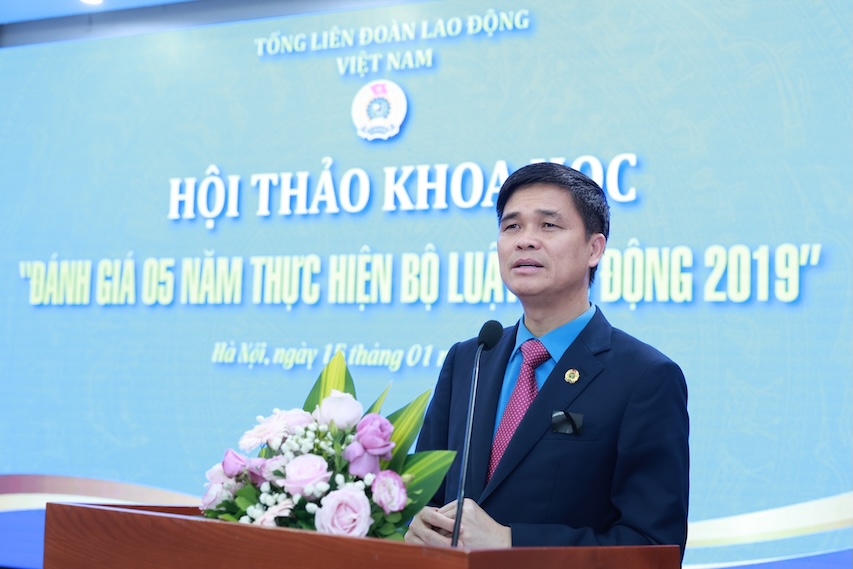
Speaking at the opening ceremony, Vice President of the Vietnam General Confederation of Labour Ngo Duy Hieu said that after 5 years of implementation, the 2019 Labor Code has created a more open and flexible legal framework, better ensuring the legitimate rights and interests of workers and employers, contributing to promoting the development of the labor market, laying the foundation for building harmonious, stable and progressive labor relations.
The 2019 Labor Code takes effect from January 1, 2021 with many progressive and breakthrough new points, such as: Expanding the subjects of application to workers who do not have labor relations; regulations on labor contracts are built in the direction of strengthening flexibility in concluding, implementing and terminating labor contracts; strengthening the flexibility and autonomy of parties in labor relations regarding wages through dialogue and negotiation; more flexible and harmonious in working hours, rest hours and overtime; strengthening the protection of female workers on the basis of ensuring gender equality; perfecting regulations on dialogue at workplaces, collective bargaining in the context of having many employee representative organizations; More flexible in the mechanism for resolving labor disputes.
Besides the achieved results, over 5 years of implementation, the current new context raises many issues and requirements that need to be evaluated and researched to continue to improve the 2019 Labor Code. One of them is that currently, our Party and State are promoting the application of science and technology, innovation and digital transformation, striving to achieve the goal of "2 digits" growth in the period 2026 - 2030, bringing the country into a new era. The strong development of science and technology in the coming time will directly affect the labor force and labor relations, changing the nature of work, working methods and labor management, requiring a more flexible and modern labor legal framework.
In addition, the development of the economy and international integration are creating major changes, requiring a more equitable approach to workers' rights regarding salaries, bonuses, social security, working conditions...
At the Workshop, delegates focused on exchanging views on: Assessing labor relations in the context of digital transformation and proposing a legal framework for informal labor; perfecting the mechanism for establishing the minimum wage and salary regulations to aim to ensure a realistic, accumulated living standard and improve the resilience of workers;
More effectively protect workers' rights by improving regulations on labor contracts, labor discipline and working hours - rest hours, especially the issue of reducing weekly working hours to less than 48 hours; improve policies to promote real gender equality and protect female workers in the new situation;
Legal solutions to improve the effectiveness of dialogue activities at workplaces, collective bargaining, signing collective labor agreements; improve regulations on resolving labor disputes and strikes to suit reality.
Collective bargaining rights and representation of informal labor
It is noteworthy that the issue of informal labor is analyzed specifically. According to Mr. Nguyen Huy Khanh - Vice Chairman of the Hanoi Labor Federation, as of 2025, the number of informal workers in Hanoi is 1.92 million people (an increase of 16.8% compared to the previous year) and accounts for 51.6% of the total number of employed workers.
Regarding this force, Mr. Khanh analyzed: Informal labor is accounting for a large proportion in the labor market structure, strongly impacting development and job security in general. However, most of this labor force has low professional qualifications and education or people from rural areas, lacking formal job opportunities; the work is mainly concentrated in industries that are easily changed, unsustainable, precarious, and less protected by labor law because they do not sign labor contracts.
With such characteristics, most informal workers do not enjoy social security and welfare regimes like official workers; the means and working environment of informal workers are only basic; many occupations and jobs still contain many risks of labor safety and hygiene.
Informal workers are often weak in negotiation to ensure working conditions as well as opportunities, requiring increased income. This leads to the consequence that many workers in this area have lower incomes than the regional minimum wage.
From the above basis, the Hanoi City Labor Federation made a number of recommendations to be completed in the Labor Code. In which, expanding the concept of workers in the 2019 Labor Code in the direction that everyone who participates in the labor process to seek legitimate benefits is considered a worker, this is both consistent with the concept of workers in the Employment Law and covers all subjects of workers.
The current regulations of the 2019 Labor Code are restricting workers in labor relations. Therefore, the City Labor Federation proposes the concept of workers as follows: "Workers are people who are 15 years of age or older, capable of working, participating in or having the need to participate in at least one labor activity to seek legitimate income and benefits, except for some light jobs as prescribed by law, the working age may be under 15 years old". Then, the law may classify workers into workers with labor relations, workers without labor relations...
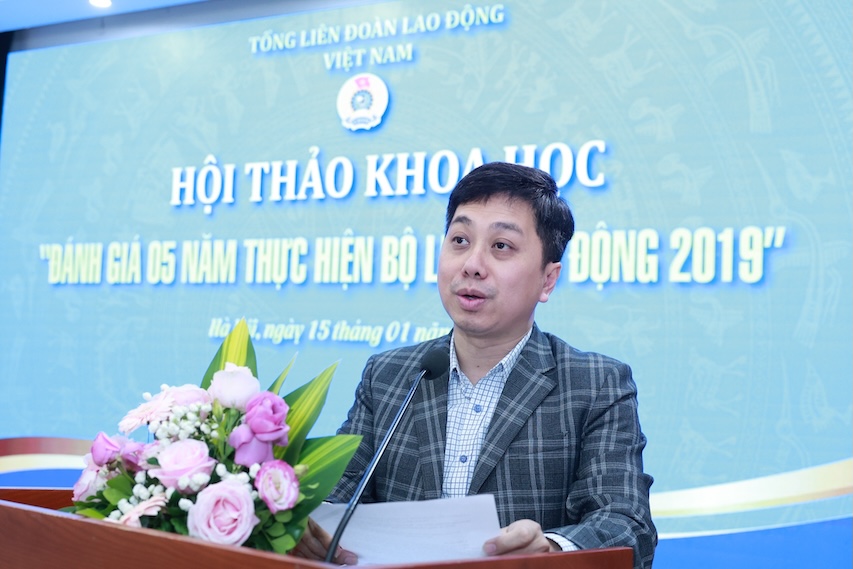
Also giving opinions on informal labor, Dr. Nhac Phan Linh - Deputy Director of the Institute of Cadre Training and Scientific Research, Deputy Director of the Institute of Strategy and Policy of the Front pointed out gaps, in which emphasizing the gap in the right to collective bargaining and representation is the biggest shortcoming in the exercise of rights for informal labor.
Informal workers operate scatteredly, lacking linkages. The 2019 Labor Code focuses on "Organizing representatives of workers at enterprises", but lacks a mechanism for free trade unions or professional associations to have the right to negotiate common labor conditions (such as minimum fare framework, gasoline support fees).
In addition, the 2019 Labor Code also lacks a dialogue mechanism when there are no regulations requiring informal labor-using enterprises to have periodic dialogues with this labor group.


