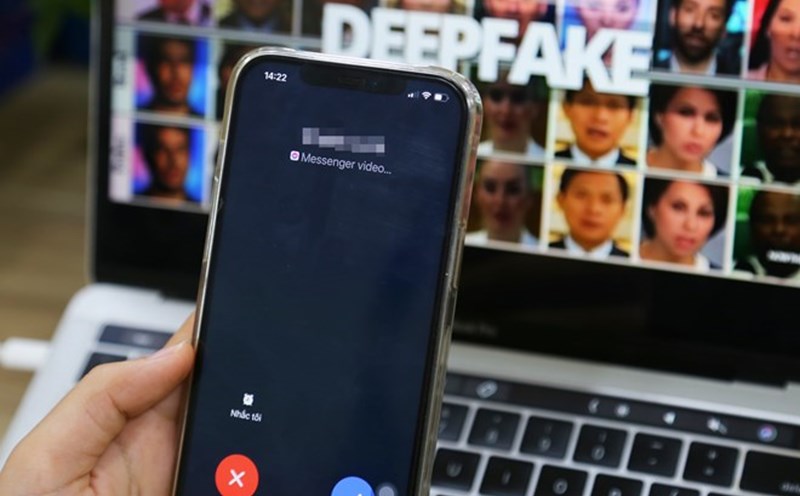
Familiar calls under the guise of fake technology
In the days leading up to Tet, when the pace of life in each family becomes more busy with cleaning, shopping, and preparing for reunion, calls from relatives far away become familiar. It is in that context that many people have become victims of sophisticated scams, starting from voices and images that seem unmistakable.
In recent days, Ms. Dang Thi Giang (Bac Ninh) was busy arranging family matters when she received a video call from a social media account named her son working in China. On the screen is a familiar face, a voice just like her son's, from greeting to everyday sayings, nothing unusual.
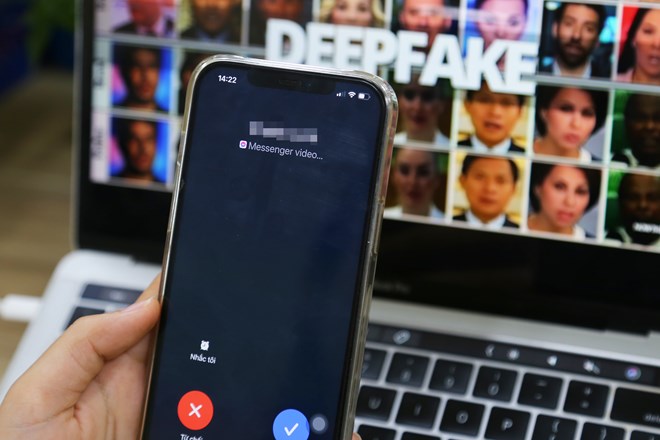
The person in the call appeared in a hurry, saying they were having problems related to work, needing family urgently support with a sum of money to "resolve it in time to go home before Tet". The call took place quickly, continuously urging, citing weak signals, not convenient to talk long. While answering the phone, Ms. Giang was answering and doing housework, her mind was only revolving around thinking about how to help her child solve the trouble in time.
The person in the call kept reassuring her that everything would be fine after transferring the money, telling her not to tell anyone because of "company internal matters". Seeing that her son seemed tense and his voice was hurried, she did not ask further, nor checked again. The entire call only lasted a few minutes but was enough to create a sense of urgency, causing her to find every way to arrange money for her son to solve work.
Starting from the psychology of worrying about her child working far from home, hoping that her child would be able to return home for Tet with her family in the busy year-end period, Ms. Giang did not have time to suspect but immediately transferred money to her account according to previous instructions. The transfer took place in a hurry, without time to think or verify further. Only when calling back to her child afterwards, did she bewilderedly realize that she had transferred money to a stranger. "Everything looks so similar that I didn't think it was fake. If I hadn't called back directly, I wouldn't believe I had been scammed" - Ms. Giang shared.
If in the past, scams often stopped at requesting direct money transfers, now the scenario has been "upgraded" more sophisticatedly. Defrauders step by step guide victims to follow seemingly familiar operations in the transaction process. When all operations are similar to normal procedures, vigilance gradually decreases, causing many people to only realize the risk when they have lost account control.
Mr. Nguyen Van Phuc (Hanoi) - owner of a grocery store cum beer and soft drink distributor located on Cau Giay street - said that the time near Tet is when he has to continuously order to deliver to small retail outlets in time. A few days ago, he received a call from a phone number displaying the name of a familiar partner - who has regularly supplied soft drinks to the store for many years.
On the other end of the line, the caller spoke in a familiar tone, reminded of the previous orders and asked "Do you want to import more Tet goods or not, they are currently at preferential prices?" Because there are many customers at the store, Mr. Minh said it was not convenient to exchange, so the partner said he had compiled a list of goods and sent a link via text message for him to see and order quickly in time to send the car home in the day.
A few minutes later, Mr. Minh Phuc received a link via Zalo, the interface displayed like an internal order page with a logo, product images and familiar prices. The caller continued to urge, saying the warehouse was closing orders early, the price was decreasing sharply, if not confirmed, the delivery schedule would have to be postponed to after Tet. Thinking it was a long-term partner, and it was the peak selling time, Mr. Minh Phuc clicked on the link and followed the instructions.
The website requires login to confirm the order. After entering information, the system reports that it needs to authenticate further with a bank OTP code to "maintain the transaction limit". Immediately after entering the OTP code, Mr. Minh Phuc's phone began to show abnormal signs, the screen freeze for a few seconds and then automatically exited the banking application.
Before he could understand what was happening, Mr. Minh received continuous debit messages from his account. Trying to reopen the application, the machine responded slowly, unable to operate normally. The call from the partner was also immediately cut off, the texting account no longer responded. "At that time, the phone seemed to be no longer mine. All operations were remotely controlled, I only had time to watch the money being debited without being able to do anything" - Mr. Minh Phuc recounted. When restarting the phone and contacting the bank, he realized that the account had been taken over, and all the accumulated money to prepare for Tet goods had been withdrawn in just a few minutes.
Why are fake technology increasingly difficult to identify?
From seemingly very ordinary stories, it can be seen that technology fraud tricks are penetrating deeper into life with an increasingly sophisticated level. Behind familiar calls is the support of modern counterfeit technologies, posing a major challenge for users in identifying real and fake.
Talking to Lao Dong Newspaper, Mr. Vu Thanh Thang - Senior Director of AI of SCS Network Security Joint Stock Company said that forms of fake voice and image scams are called Deepfake. Currently, scam tools in this form are developing very quickly, while user awareness is still limited.
Just a small amount of data collected from social networks, bad actors can recreate faces and voices with high similarity, enough to deceive victims in short situations such as voice calls or video calls" - Mr. Thang informed.
According to Mr. Thang, the sophistication of these tricks is being upgraded day by day. In which, bad guys do not need to make victims believe immediately, but just create enough familiarity so that they skip the necessary verification steps.
Especially during Tet, when the psychology of worrying about relatives far away, increased time and work pressure, people are more likely to react emotionally than rationally. Scenarios such as "needing money urgently", "handling incidents before Tet", "partner urging payment" are all built very close to the actual context.
From a technical perspective, Mr. Vu Ngoc Son - Chief Technology Officer of Vietnam National Network Security Technology Joint Stock Company (NCS) said that fake technology today has gone far beyond the common imagination of users. "Many people still think that fake products are easy to recognize, but in fact, in short situations such as video calls or a few-minute voice calls, it is very difficult to distinguish," Mr. Son said.
Mr. Vu Thanh Thang recommends that families should first agree on the principles of confirmation when an emergency occurs, especially for the elderly. "Just one call back through another channel, or a personal question that only relatives know about, can also help avoid major risks," Mr. Thang said.
For businesses and business people, Mr. Vu Ngoc Son emphasized that transaction procedures should not be shortened just because of the pressure of the end of the year. Changing payment information, confirming orders or transferring money needs many steps of checking, avoiding dependence on a single call or text message.