
Talking to Lao Dong Newspaper, Prof. Dr. Nguyen Dinh Duc - University of Technology (Vietnam National University, Hanoi) - said that Vietnam still has many bottlenecks in research investment, innovation mechanisms and technology business development. If these barriers are not removed soon, the goal of creating breakthroughs in science and technology according to Resolution 57 will be difficult to achieve as expected.
The technological gap is still large
According to Prof. Dr. Nguyen Dinh Duc, in recent years, Vietnam has achieved many positive results in science and technology development and innovation. Research capacity has improved both in quantity and quality, many universities have shifted from training models to research universities associated with innovation, while paying more attention to peak research, core technology and technology transfer.
Some fields such as mathematics, physics, materials science, information technology, artificial intelligence, biomedicine, high-tech agriculture, telecommunications and digital transformation have formed strong research groups, capable of regional and international integration. The technology startup ecosystem is also developing rapidly, with many businesses participating in the fields of software, fintech, e-commerce, artificial intelligence, big data and semiconductors.
However, according to Mr. Duc, if placed in relation to leading countries such as Singapore, South Korea, Japan or China, Vietnam is still quite far away.
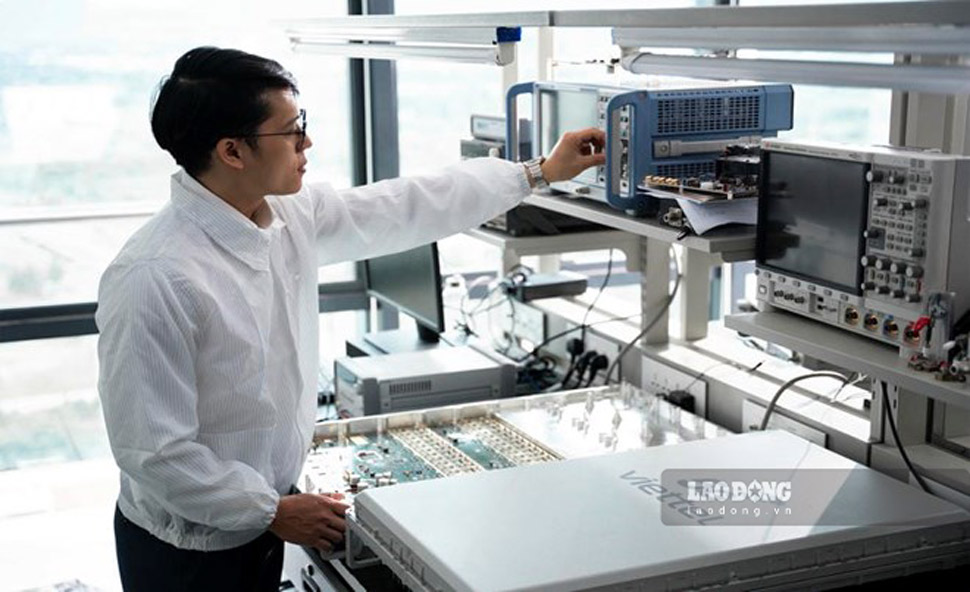
That gap is reflected in the low level of investment in R&D, the limited number of international patents, the ability to master core technology is not strong, the linkage between universities, research institutes and businesses is still loose, the science and technology market has not developed to the right level and not many technology businesses are strong enough to lead the global value chain" - Prof. Dr. Nguyen Dinh Duc analyzed.
Reality also shows that the investment space for research and development in Vietnam is still quite large. According to statistics from the World Bank (WB), by 2025, total investment in R&D of Vietnam from both the state budget and businesses has not yet reached 0.7% of GDP, lower than Thailand (1.1%) and Singapore (more than 2%).
The R&D human resource ratio of Vietnam is also less than 10 people/10,000 people, only equal to 7.6% of South Korea, 13% of France, 29.8% of Malaysia and 58% of Thailand. Notably, more than 84% of R&D human resources are concentrated in the state sector, while the non-state sector accounts for less than 16%.
According to Mr. Duc, Vietnam's weakness lies not in people but in the ecosystem. A scientist who wants to create valuable products needs a modern laboratory, stable funding, flexible mechanisms, a strong research group and accompanying businesses. Meanwhile, technology businesses wanting to develop also need long-term capital, product testing mechanisms, innovative public procurement policies and high-quality human resources.
Vietnam is in a stage with great potential but needs a stronger institutional boost. We must shift from applying technology to technological innovation, from processing to design and gradually enhance our position in the global value chain" - Mr. Duc emphasized.
Bottlenecks need to be removed
To realize the goals of Resolution 57, Prof. Dr. Nguyen Dinh Duc said that it is necessary to simultaneously remove four major bottlenecks including: Investment in R&D, innovation institutions, university autonomy and development of technology enterprises.
According to him, first of all, it is necessary to strongly increase investment in research and development but in a focused direction, avoiding spreading out. Resources need to be prioritized for strategic areas such as artificial intelligence, semiconductors, advanced materials, biotechnology, new energy, environmental technology, digital infrastructure, network security, precision mechanics, automation and basic science.
In parallel with that is the innovation of the financial mechanism for science. According to Professor Duc, scientific research, especially research on foundations and core technologies, always contains risks, so it cannot be managed by administrative thinking heavily focused on procedures.
It is necessary to strongly shift from pre-inspection to post-inspection, from procedure management to results-based governance, from fear of risks to accepting controlled risks. If scientific risks are not accepted, there will be no scientific breakthrough" - Prof. Dr. Nguyen Dinh Duc said.
He proposed that there should be policies to encourage businesses to invest in R&D, order universities and research institutes, participate in national technology programs, be supported in testing new products and prioritize in innovative public procurement mechanisms.
Along with that is a strategy to develop science and technology human resources. Vietnam not only needs to train many engineers but also build a team of core technology experts, chief engineers, leading scientists and technology leaders in enterprises. At the same time, there needs to be a mechanism to attract Vietnamese intellectuals abroad and international experts, creating an environment for talented people to feel secure in researching and contributing.
According to Prof. Dr. Nguyen Dinh Duc, the most important thing is to innovate thinking and organize drastic implementation. From policies to results, it is necessary to concretize them with resources, responsibilities, products, deadlines and clear monitoring mechanisms, avoiding the situation where policies are correct but implemented slowly or lack breakthroughs.
If those things are done, science and technology, innovation and digital transformation will truly become strategic levers for Vietnam to break through, not only overcome the middle-income trap but also gradually master the technologies of the future" - Prof. Dr. Nguyen Dinh Duc affirmed.


