
Each locality has a development problem
At the national conference summarizing 1 year and 6 months of implementing Resolution No. 57-NQ/TW dated December 22, 2024 of the Politburo on breakthroughs in science, technology, innovation and national digital transformation, General Secretary and President To Lam requested that, for localities, it is necessary to strongly shift from passive thinking waiting for guidance to proactive thinking in organizing implementation and creativity within the framework of law and decentralization and delegation of power of the Central Government.
General Secretary and President emphasized that each locality needs to start from practical conditions, comparative advantages and development needs of its locality to choose the right focus and key points. Not every locality can do all strategic technologies, but every locality must know how to apply science and technology, innovation and digital transformation to solve its most practical problems, making management and administration better and more productive, contributing to local growth.
According to the synthesis of the Ministry of Science and Technology, this spirit is gradually being realized when many localities proactively choose fields suitable to their own conditions and advantages, instead of spreading out.
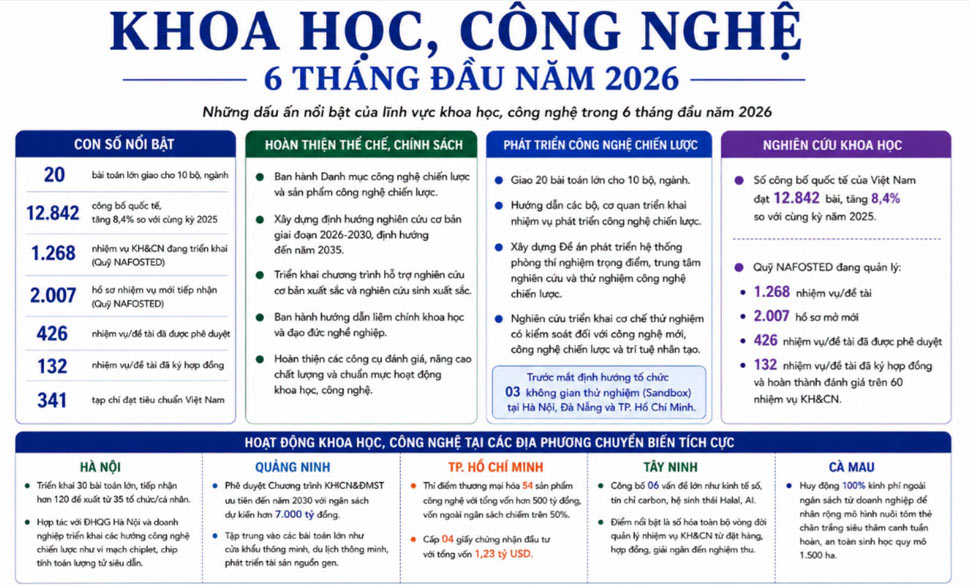
In Hanoi, more than 30 major problems have been deployed, attracting more than 120 proposals from 35 organizations and individuals. The city also promotes cooperation between Hanoi National University and businesses to research some strategic technologies such as chiplet microchips and superconductive quantum computing chips.
Meanwhile, Quang Ninh approved the Science, Technology and Innovation Program to 2030 with a budget estimate of more than 7,000 billion VND, focusing on areas associated with local development needs such as smart border gates, smart tourism and gene asset development.
In Ho Chi Minh City, science and technology are promoted in the direction of product commercialization. The city is piloting the commercialization of 54 technology products with a total capital of more than 500 billion VND, of which non-budget capital accounts for over 50%. At the same time, the city has issued 4 investment certificates with a total capital of 1.23 billion USD.
In Tay Ninh, science and technology are applied to solve problems related to digital economy, carbon credits, Halal ecosystems and artificial intelligence. The locality has also completed the digitization of the entire life cycle of science and technology task management, from ordering, signing contracts to disbursement and acceptance.
In Ca Mau, socialized resources are mobilized to develop a circular super-intensive white leg shrimp farming model, biosafety with a scale of 1,500 hectares, of which non-budgetary funds invested by businesses reach 100%.
It can be seen that, while implementing Resolution 57 together, each locality is choosing a different direction, associated with its advantages and development needs. This is also a way for science and technology to be put into solving practical problems instead of being implemented according to a common model.
From policy implementation to policy innovation
Not only requiring localities to proactively implement, General Secretary and President To Lam also set higher requirements for the role of local authorities in the process of implementing Resolution 57.
General Secretary and President emphasized that localities must boldly register, dare to accept major problems, proactively propose new mechanisms, new models, and new ways of doing things; detect problems from practice to propose to the Central Government to amend and improve institutions. Localities are not only places to implement policies but also must become places to create policies, test policies and contribute to the process of perfecting the country's development institutions.
This requirement shows a shift in thinking in implementing Resolution 57. Localities not only organize the implementation of policies from the Central Government but are also encouraged to proactively propose solutions, models and mechanisms suitable to reality, thereby contributing to the process of policy completion.
The practical implementation in the first 6 months of 2026 shows that many localities have begun to form their own ways of doing things. Hanoi focuses on strategic technology research; Quang Ninh develops smart border gates and smart tourism; Ho Chi Minh City promotes the commercialization of technology products; Tay Ninh applies digital transformation in management; Ca Mau exploits science and technology to improve agricultural value.
These initial results show that Resolution 57 is being realized in the direction of promoting the advantages of each locality instead of applying a unified model. When science and technology, innovation and digital transformation are linked to specific problems of each region and each industry, the effectiveness of the resolution is not only measured by the number of programs or plans issued but also by the practical values created for socio-economic development.


