
The Law on Artificial Intelligence takes effect from March 1, 2026, establishing a new management approach based on risk levels, to promote AI development along with risk control and human protection.
The law does not apply a prior licensing mechanism for most AI systems, businesses self-assess and take responsibility according to the post-inspection mechanism. At the same time, the regulations also set limits for harmful AI usage acts, such as manipulation, fraud or infringement of the interests of organizations and individuals.
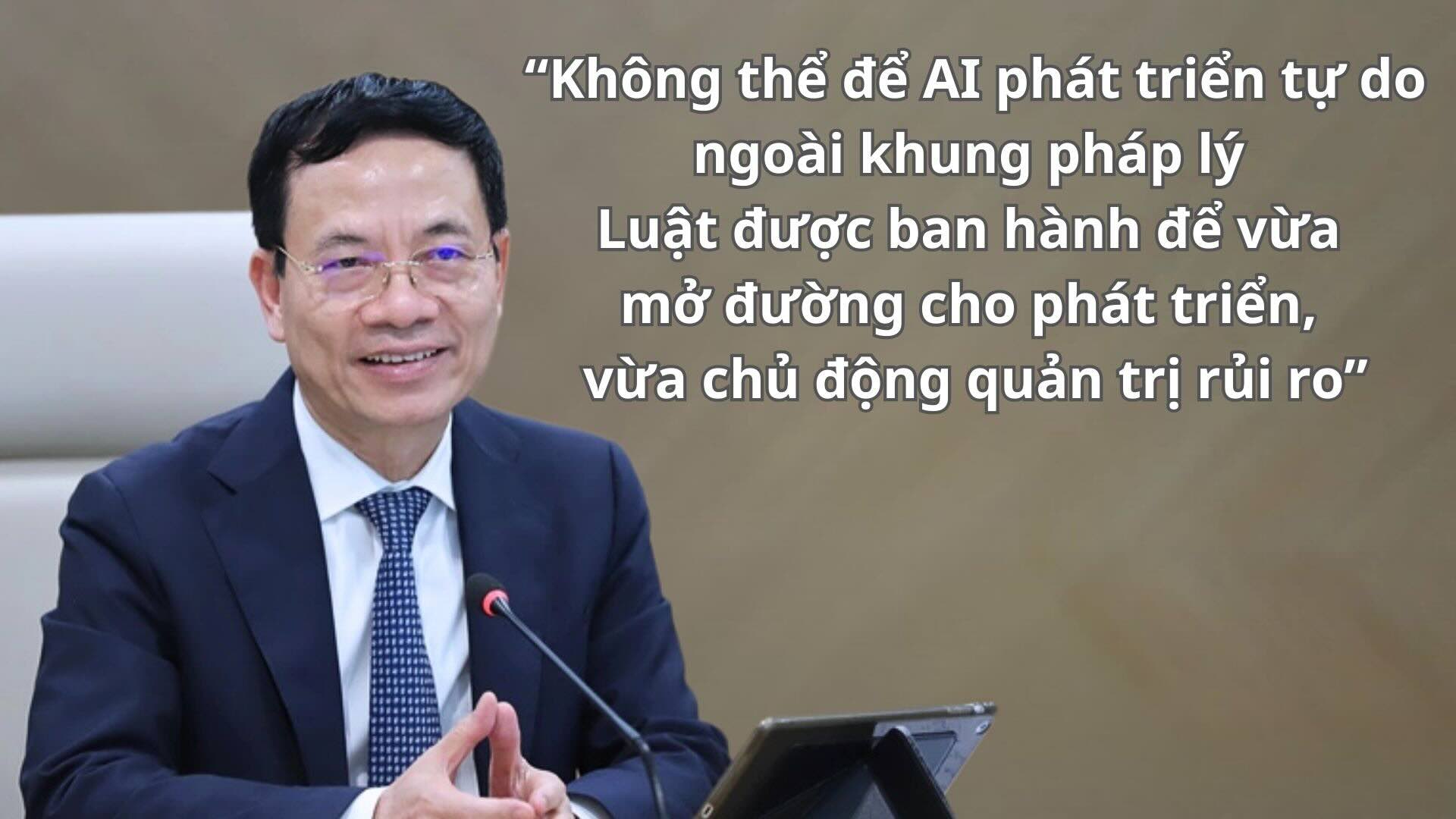
Speaking at the 10th session of the 15th National Assembly, Minister of Science and Technology Nguyen Manh Hung emphasized that artificial intelligence is the technology with the strongest spillover effect in decades, impacting the economic structure and national governance methods. "It is impossible to let AI develop freely outside the legal framework. The law is promulgated to both pave the way for development and proactively manage risks," the Minister stated clearly.
Minister Nguyen Manh Hung also affirmed that AI is a supporting tool, and the final decision in important social issues must still be taken by humans. This is a consistent principle in law-making: Technology development must go hand in hand with protecting people and national interests.
According to Mr. Tran Van Son - Deputy Director of the National Institute of Digital Technology and Digital Transformation (Ministry of Science and Technology), the law initially establishes a management framework for activities related to artificial intelligence, from research, development to supply and deployment. The risk-based management approach is considered the basis for classifying and applying management requirements appropriate to each system group.

Mr. Son said that the law has laid the foundation for requirements related to transparency and content recognition created by AI, thereby contributing to increasing control and strengthening user trust. At the same time, the post-inspection mechanism and self-assessment responsibility of businesses are oriented to balance management requirements and promote innovation.
According to him, technical contents and specific procedures are expected to continue to be guided in sub-law documents, in order to ensure feasibility and adaptability to the rapid development of technology.
From a business perspective, Mr. Dau Anh Tuan - Deputy Secretary General of the Vietnam Chamber of Commerce and Industry (VCCI) said that the promulgation of the law shows an active approach in building institutions, in line with the trend of technological development in the world. According to him, the legal framework needs to play a supporting and orienting role for innovation activities.
Mr. Tuan also said that in the process of implementation, it is necessary to focus on ensuring policy flexibility, and at the same time continue to improve processes in a clear, transparent and convenient direction for businesses. Investing in data infrastructure and computing capacity is considered an important factor for the development of artificial intelligence in the long term. In addition, clarifying responsibilities in the stages of the AI development and use process is also a content that needs to continue to be concerned about.
Mr. Tran Van Tri - LuatVietnam.vn believes that the implementation of the law in practice will require more specific guidance related to intellectual property, AI system labeling and legal liability for AI-element products. According to him, clearly defining principles and limits will help businesses more conveniently in the process of applying technology.
From a professional perspective, Ms. Tran Vu Ha Minh - Chief Advisor on responsible artificial intelligence of FPT Software, said that AI in Vietnam is developing rapidly but not synchronously, in which high-quality human resources are still limited. However, this is also considered a suitable stage to shape AI development standards in a responsible direction.
Regarding the legal aspect, lawyer Hoang Le Quan - Lexcomm Law Firm said that the requirements for transparency and content recognition created by AI need to be further guided more clearly in the implementation process. According to him, these regulations need to be built in a direction that harmonizes with international practices, in order to both meet management requirements and not affect the competitiveness of businesses.
The Law on Artificial Intelligence was passed by the National Assembly on December 10, 2025 with a high approval rate. In the context of AI developing rapidly and spreading to many fields, the promulgation of a specialized law is considered a necessary step.
The official entry into force of the law helps Vietnam gradually establish a legal corridor for artificial intelligence. A policy framework that is flexible, transparent and practically suitable is expected to support the sustainable development of the AI ecosystem in the coming time.


