
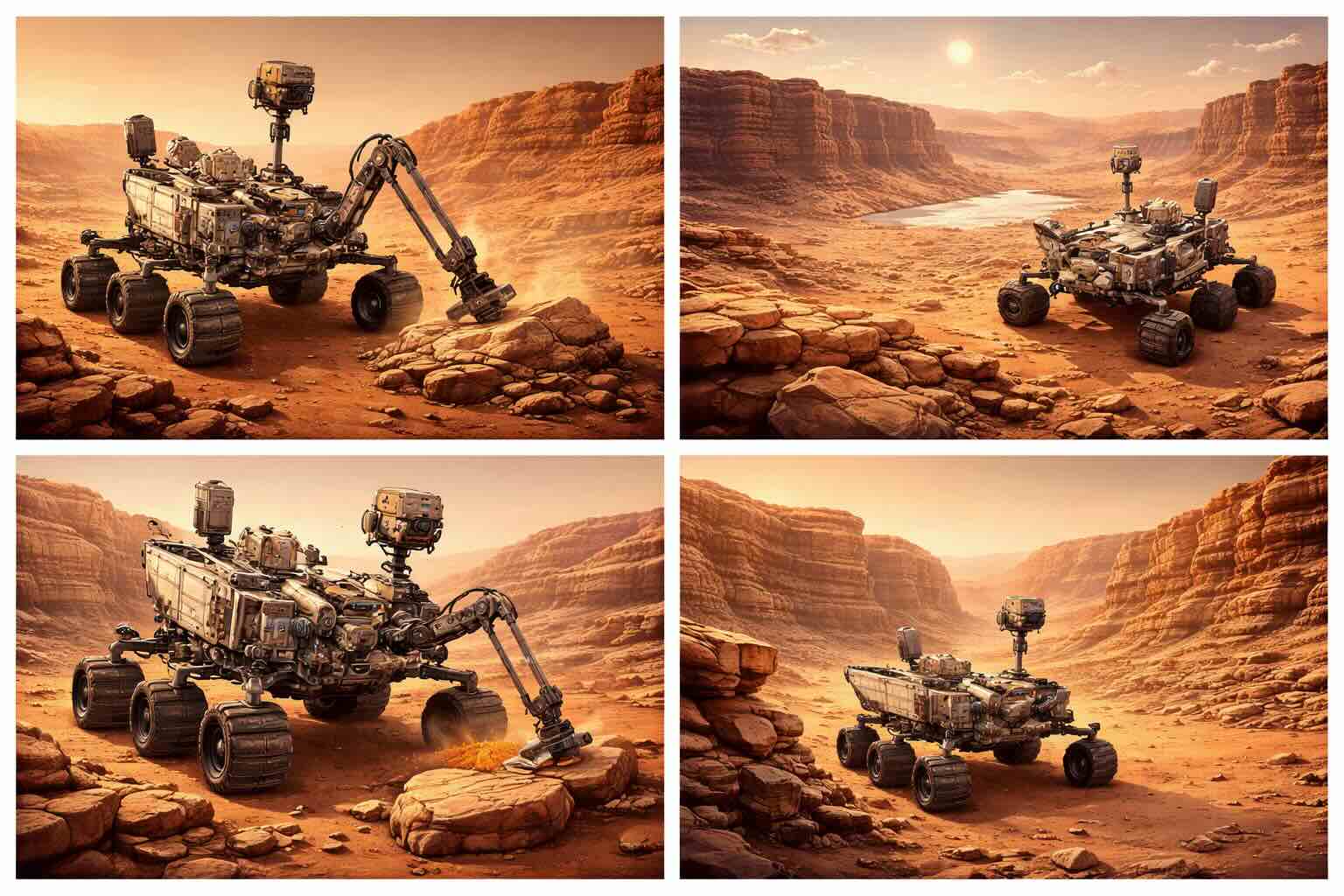
In 2025, scientists discovered long-circuit organic molecules called ankan in the ancient mudstone layer on Mars. In a new study, a scientific team led by Alexander Pavlov - Researcher at the Goddard Space Center of NASA believes that the initial content of these molecules may be much higher than what is currently observed.
Stone samples collected by the Curiosity rover show ankan concentrations of only about 30 to 50 parts per billion. However, the research team believes that the Cumberland mudstone found on Mars has been exposed to strong radiation on the surface of Mars for about 80 million years, causing most organic matter to decompose over time.
Based on laboratory simulation experiments, the scientific team estimates that the initial concentration of these molecules can range from 120 to 7,700 parts per million. This level is significantly higher than what can be formed from non-biological processes such as interplanetary dust, meteorites, hydrothermal chemical reactions or serpentination.
Researchers believe that the abundance of long-circuit organic molecules may be related to compounds similar to fatty acids. On Earth, these compounds are largely created by living organisms.
However, the research team emphasized that this discovery is not evidence confirming that life once existed on Mars. Scientists believe that there is still a possibility of organic molecular formation mechanisms that humans do not clearly understand, or factors that have not been taken into account in the process of assessing the impact of radiation on organic matter.
Previously, studies have confirmed that Mars contains many different types of organic molecules. However, their origin and significance for the existence of life is still a big question that needs further research.


