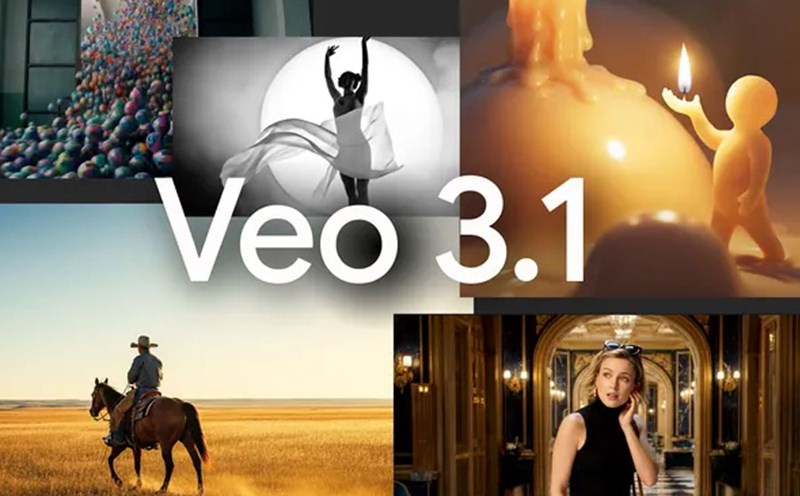
Google has just officially updated Veo 3.1, the company's latest artificial intelligence video creation model with a series of notable improvements, strongly aimed at the need to produce short and high-quality content.
The biggest highlight of this update is the ability to create original vertical video, upgrading resolution to 1080p and 4K, along with a clear improvement in the "Ingredients to Video" feature.
According to Google, Veo 3.1 allows users to create videos with higher image consistency, smoother motion and clearer details than previous versions.
In particular, the feature of creating vertical videos with a frame ratio of 9:16 is considered a strategic step, helping Veo 3.1 be more suitable for short video platforms such as YouTube Shorts, as well as the trend of consuming content on mobile devices.
With the upgraded "Ingredients to Video" feature, users can create lively videos just from reference images and short suggestions.
Google said Veo 3.1 has improved storytelling and dialogue capabilities, helping videos have a more natural content flow.
Another notable point is the character's consistency when the characters will maintain a similar appearance even when changing the setting or setting, helping users easily use the same character in many different scenes. In addition, objects, backgrounds and patterns can also be reused flexibly.
Regarding image quality, Veo 3.1 currently supports upgrading video to 1080p and 4K resolution. According to Google, 1080p provides sharper, clearer images, while 4K helps to show rich texture and high detail, suitable for large screens and professional projection needs.
The improved features of Veo 3.1 are being deployed on many platforms in the Google ecosystem, including YouTube Shorts, YouTube Create, Gemini, Flow, Vertex AI, Google Vids and Gemini API.
This shows that Google is promoting the integration of AI for video creation into both popular content creation tools and business solutions.
Notably, all videos created by Veo 3.1 are digitally copyrighted SynthID. Thanks to that, viewers can verify whether the content is created by AI by uploading videos or images to Gemini, contributing to increasing transparency in the context of AI content becoming increasingly popular.