
Towards reducing education management staff
According to the direction of the Government leaders, the People's Committees of provinces and centrally-run cities focus on directing relevant agencies and units to urgently complete the arrangement of public preschool, general and continuing education institutions in the area before August 30, 2026 and prepare good conditions to ensure the 2026–2027 school year.
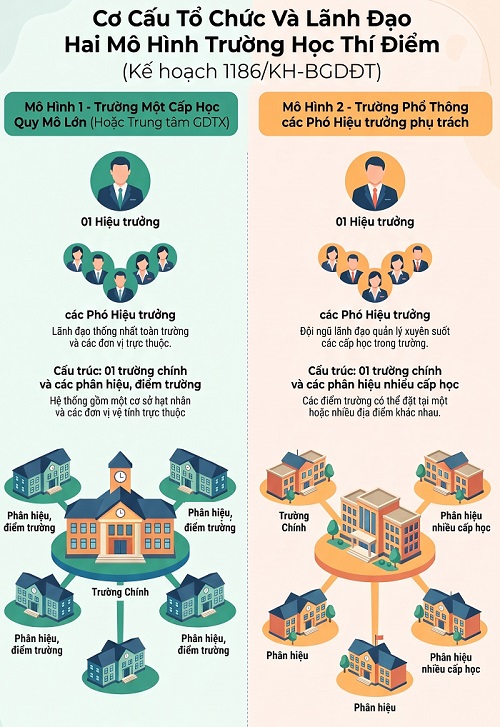
To guide localities to implement, the Ministry of Education and Training (MOET) issued a Plan to promote the implementation of arranging the network of public preschool, general education, and continuing education institutions in the period 2026-2030.
According to the Ministry of Education and Training, the arrangement of the network of public preschool, general and continuing education institutions is consistent with the policy of strongly shifting from "education management" to "education development management"; shifting the focus from reducing mechanical focal points to restructuring the network of educational institutions according to population size, population distribution, creating favorable conditions for learners and improving the quality of education.
This is also aimed at innovating school governance, expanding the scale of schools and classes to effectively use facilities, teaching staff, management staff and investment resources; linking the arrangement of educational institutions with streamlining management focal points and restructuring staff.
The purpose of the arrangement, according to the Ministry of Education and Training, is to "reduce education management staff, increase direct teaching staff", pilot the model of a main school, with branches and school sites; consolidate management focal points to form large-scale educational institutions.
The Ministry of Education and Training requests localities to ensure unified and synchronous implementation, clearly identify roadmaps, plans and resources for implementation.
Ensuring the right to education and access to education for students
The Ministry of Education and Training also noted that the arrangement must be based on the principles:
The arrangement of the network of educational institutions must be consistent with the two-level local government model, socio-economic development planning, population size and development space; taking the goal of improving the quality of education, investment efficiency and management capacity as a consistent orientation; not implementing mechanical arrangement only to reduce focal points; in the process of implementation, it is necessary to evaluate and draw lessons from phase 1, form a management model, assess the impact of related subjects, and propose solutions to implement the next phase closely and effectively, absolutely not allowing students to not go to school due to difficult circumstances.
Compliance with professional and educational science principles; suitable to the psychological and physiological characteristics of the age group, level of education and type of educational institution. Do not merge kindergartens with general schools; do not merge general schools with continuing education centers, vocational education centers; do not arrange specialized educational institutions with mass general schools. Prioritize reorganizing educational institutions of the same level of education or with close geographical locations.
Especially, the learner must be the center. Ensure the right to study and access to education; create more favorable conditions for students to go to school, without generating geographical and cost barriers; do not affect the work of mobilizing students to go to class to maintain and improve the results of universal education.
Ensure that each commune-level administrative unit has at least 01 kindergarten and 01 general school. Plan and develop a network of high schools in accordance with the spirit of Resolution No. 71-NQ/TW dated August 22, 2025 of the Politburo.
Linking network arrangement with innovation in school governance and streamlining management focal points; effectively using the teaching staff, facilities and investment resources; promoting digital transformation, strengthening decentralization and delegation of power associated with accountability of localities and educational institutions.
Ensure stability, inheritance, and minimize negative impacts on teaching and learning activities, the psychology of students, teachers and parents. Organize flexible implementation, with roadmaps suitable to the reality of each region, especially mountainous, border, island and ethnic minority areas, ensuring safety for teachers, learners, and managers.
The Ministry of Education and Training requests localities to regularly monitor and evaluate the implementation situation based on data and practical impacts; promptly detect problems to adjust plans, improve mechanisms and policies and replicate appropriate models.


