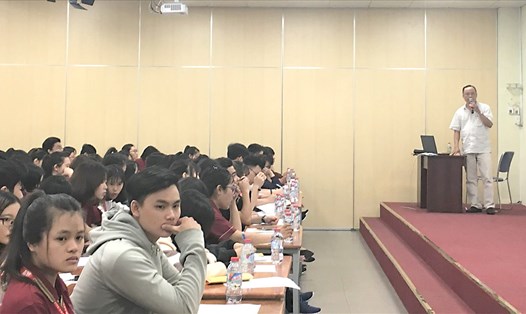
Talking to Lao Dong Newspaper, Mr. Tran Thanh Hai - Principal of Vien Dong College (HCMC) - shared perspectives and expectations from new policies.
In the context of the Central Government issuing many major resolutions to develop education and training, how do you see the opportunities of non-public schools today?
- Many resolutions have been issued such as: Resolution 68 on the development of the private economy and non-public educational institutions clearly not outside this category; Resolution 71 on breakthroughs in education and training development; Resolution 57 on scientific and technological breakthroughs, innovation; Resolution 59 on promoting deep international integration on scientific breakthroughs... Resolutions are issued when combined, creating breakthroughs for the non-public education sector.
In particular, the 6th guiding viewpoint in Resolution 71 clearly affirmed: Non-public education is an important component of the national education system, besides the pillar being public education. This is a strategic affirmation, creating a very important political foundation for the development of the non-public education sector in the coming time.
Along with that, it is necessary to mention the policy of subsidizing tuition fees for secondary school graduates participating in vocational training streaming. Decree No. 238/2025/ND-CP of the Government.
This is the form of "public investment - private governance", meaning that the State invests directly in the budget for learners and whether students study in public or private schools, they are compensated for tuition fees equally. As for the system of private schools participating in governance, operation, organization of training, and implementation of student streaming, I think this is a very wise policy of the Central Government in promoting non-public education.
How will increasing public investment in the non-public sector affect the quality of training of private schools, sir?
- The biggest change is in efficiency. When we expand public investment to the private sector with clear norms and constraints, for example, subsidizing tuition fees for secondary school graduates, competition will be formed. In a competitive system, efficiency will certainly arise. The first effect is that learners benefit - the ultimate beneficiaries of public investment.
In addition, in reality, businesses, especially private enterprises and foreign-invested enterprises, are more interested in skills, skills and job-meeting ability than coming from public schools or private schools. The private sector, with its high flexibility, has invested heavily in the skills of students, especially in the context of strong artificial intelligence development. Flexibility in timetables and training hours also helps private schools easily meet the seasonal needs of businesses, hospitals, tourist areas, resorts... These are the advantages of non-public education.
I propose to continue to expand the "public investment - private governance" model not only for learners but also for teachers. If we have a mechanism to invest in lecturers in non-public sectors, accompanied by the obligation to participate in public projects, teaching in the public sector according to standard hours, it will create harmony, increase the efficiency of public investment and create healthy competition throughout the system.
In addition to the resolutions that have been issued, the Law on Vocational Education (amended) has just been passed by the National Assembly at the 10th session. What do you expect from this law?
- In my opinion, the biggest breakthrough of the amended Vocational Education Law is the official removal of the vocational secondary school system, replacing it with a vocational secondary school system with a program integrating cultural knowledge in 3 years. This is a very big step forward, in line with the trend of many developed countries such as: North America, Europe, Japan, South Korea.
Full integration of cultural knowledge helps vocational students have a better foundation for the chosen career. More importantly, vocational high school diplomas are determined to be equivalent to high school diplomas. Students can go to work, or take articulation courses to colleges and universities when they have the conditions, in the spirit of lifelong learning.
The law also allows colleges to open vocational secondary schools right in the school without having to establish new schools, and at the same time convert continuing education centers into vocational secondary schools. This is a very necessary and reasonable approach.
However, I believe that the spirit of the 6th guiding viewpoint in Resolution 71 has not been clearly expressed in the revised Law on Vocational Education as well as the revised Law on Higher Education. The State needs to further clarify the role of public education as a pillar, and at the same time affirm that non-public education is an important component of the national education system.
Regarding resource allocation, in my opinion, it is necessary to implement according to the principle: Wherever the private sector can do it, let the private sector do it; The State should focus resources on strategic areas such as defense, key medicine, scientific research, especially in the context of the rapid development of artificial intelligence. Then, investment in education will be truly effective and breakthrough.
Thank you very much, sir!
Mr. Tran Thanh Hai is the only representative among hundreds of non-public colleges participating in the 11th National Patriotic Emulation Congress.