
It is expected to reduce 32,625 principals, vice principals and 11,041 school staff.
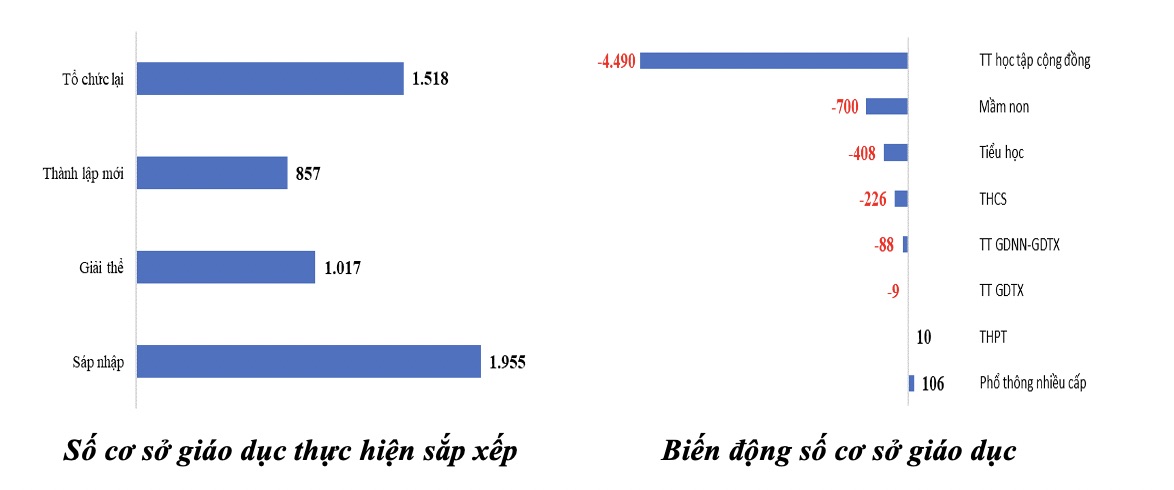
According to statistics from the Ministry of Education and Training, in the 2025 - 2026 school year, localities have reviewed the network of public educational institutions, assessed the scale of schools, classes, school sites, staff and facilities to develop appropriate arrangement plans, implemented according to a roadmap, ensuring no interruption of teaching and no impact on the interests of related parties. As a result, 1,955 educational institutions have been merged, 1,017 institutions have been dissolved, 857 new institutions have been established and 1,518 educational institutions have been reorganized.
According to pre- and post-arrangement data, the total number of public educational institutions decreased from 45,390 to 39,581 institutions (equivalent to a decrease of about 12.8%), contributing to streamlining management focal points, improving the efficiency of using staff, facilities and investment resources. The number of community learning centers decreased from 6,630 to 2,140 centers, a decrease of 4,490 centers (equivalent to a decrease of about 67.7%), associated with the process of arranging commune-level administrative units and reorganizing continuing education institutions at the grassroots level.
From July 2026, implementing the direction of General Secretary and President To Lam and the Government and Prime Minister, the Ministry of Education and Training has guided localities to continue to arrange the network of educational institutions with the goal of reducing at least 30% of public educational institution headquarters in rural, mountainous, and difficult areas and striving to reduce over 50% in urban and central areas compared to July 1, 2025; drastically reducing remote schools with fewer than 3 classes; ensuring that each commune-level administrative unit has at least 1 preschool education institution and 1 general education institution.
By August 20, 2026, 16 localities have basically completed, the remaining localities will complete before August 30, 2026; accordingly, the total number of educational institutions is expected to decrease from 37,515 to 18,575 institutions (down 50.5%); reduced 32,625 principals, vice principals and 11,041 school staff.
The remaining principals and vice principals after arrangement will be considered for assignment as teachers directly teaching classes to contribute to overcoming the current local teacher surplus and shortage situation. The remaining education support staff after arrangement will be assigned to job positions where educational support personnel are still lacking in the number of employees who do not immediately meet the training and fostering standards of the new job position (except for accounting and school health work positions), or assigned to the teacher job position if they meet the training standards of teachers and meet the requirements for professional and nghiệp vụ capacity to immediately meet the teacher job position.
Along with that, flexibly and optimally use the teaching staff through measures of mobilization, transfer, assignment, or arrangement of teachers to teach inter-schools between school sites, branches and educational institutions in the same area.
Ensuring regimes and policies for teachers and management officials after arrangement
The Ministry of Education and Training issued Official Dispatch No. 5747/BGDĐT-GDNNGDTX guiding the implementation of tasks for the 2026-2027 school year for vocational education and continuing education.
In which, the Ministry of Education and Training requests ministries, central agencies, localities, and units to focus on arranging vocational education and continuing education institutions; ensuring stability in job positions, regimes, and policies for teachers and management officials in the process of network arrangement...
The Ministry of Education and Training proposed to focus on reviewing and arranging the network of public vocational education institutions, continuing education centers, vocational education centers, vocational education-continuing education centers, community learning centers in accordance with the model of two-level local government, population size, socio-economic development situation and human resource needs of each locality; overcome the situation of spreading investment, duplicated training industries and professions, small scale, low efficiency.
Ensure that the team of teachers, management staff and educational support personnel is suitable for the scale, structure, training industries and occupations and the requirements for performing tasks of educational institutions, ensuring stability in job positions, regimes, and policies for teachers and management staff in the process of network arrangement.
Reasonably arrange the network of vocational education and continuing education institutions, classes, branches, and school sites reasonably distributed, operating effectively, efficiently, and smoothly, without interruption of teaching and management activities, fully and promptly implement regimes and policies for teachers and management staff of vocational education and continuing education institutions when arranging organizations.


