
Gold futures recovered slightly after a trading session on Wednesday, closing at 4,758 USD/ounce on the COMEX exchange - up 19 USD in the session as the market reflected a complex mixture between geopolitical cooling signals and concerns about monetary policy.
Spot gold price slightly decreased by 0.32% to 4,719.53 USD/ounce at 3:30 PM Vietnam time. Silver price decreased by 2.31% to 75.96 USD/ounce, while platinum and palladium were almost flat. Bloomberg Dollar Spot Index increased by 0.06%.
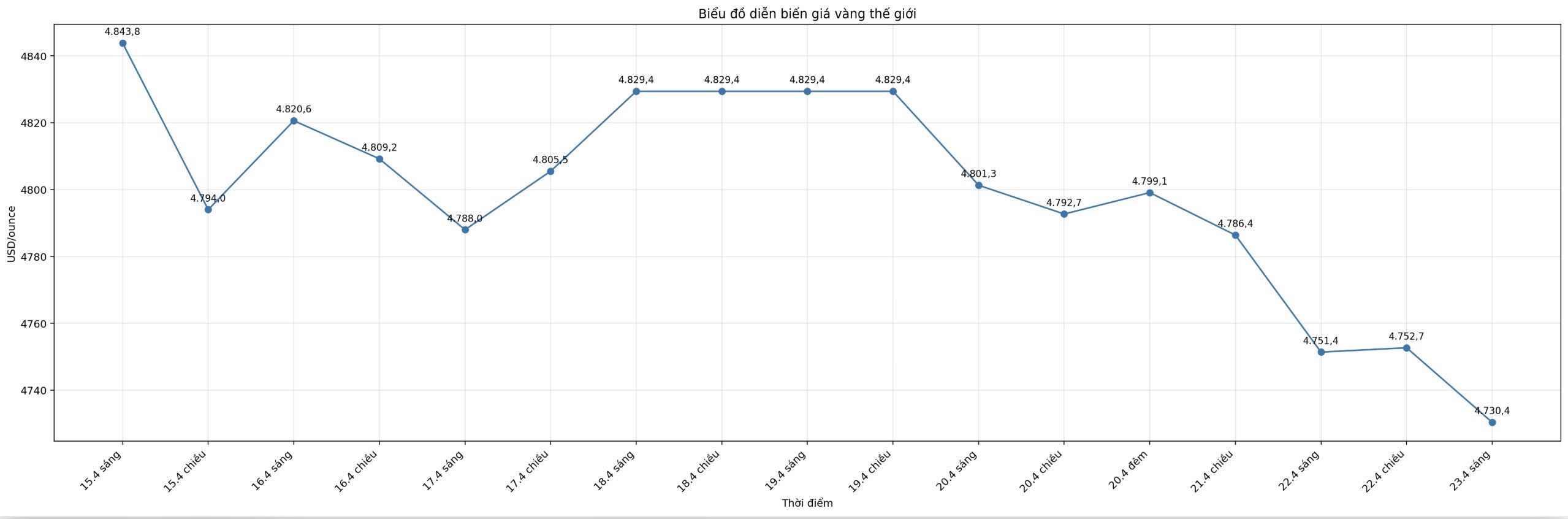
This increase took place despite the stronger USD after US President Donald Trump decided to extend the ceasefire between the US and Iran indefinitely, thereby helping gold prices regain part of their deep decline in Tuesday's session, when prices fell to their lowest level since April 13.
Mr. Trump announced the extension of the ceasefire just hours before the initial two-week agreement expired, saying he would postpone further military actions until Tehran makes a new peace proposal. This announcement initially helped spot gold prices increase by nearly 1%, trading around 4,755 USD/ounce, while oil prices fell as the risk of escalation was immediately eased.
The biggest pressure factor in the session did not come from the Middle East but from the US Congress. Mr. Kevin Warsh - Chairman of the US Federal Reserve (Fed) candidate testified before the Senate Banking Committee and made statements interpreted by the market as "hawkish". Mr. Warsh affirmed that he did not make any commitments to the White House regarding interest rate cuts and commitments to ensure the independence of the central bank, while promoting structural monetary policy reforms.
The market was previously almost certain that the Fed meeting on April 28-29 would keep interest rates unchanged at 3.50–3.75%, but Mr. Warsh's hearing further reinforced the possibility that interest rates would remain high for the rest of the year. For gold - a non-performing asset, the prolonged high interest rate environment reduced its attractiveness compared to high-yield assets, and this outlook put pressure on the day's developments, although prices still closed upwards.
Despite the extension of the ceasefire, the geopolitical context remains unstable. The Strait of Hormuz - an important global oil transportation route - is largely closed, as Iran refuses to reopen while the US Navy maintains a blockade of its ports. Tehran considers the blockade an act of war. Meanwhile, peace talks scheduled for Tuesday did not take place; US Vice President JD Vance canceled a trip to Islamabad after Iran announced through Pakistan that they would not attend. Therefore, the extension of the ceasefire is currently unilateral from the US side, and analysts warn that the sustainability of this agreement is still uncertain. Any new escalation could trigger safe-haven demand for gold and push prices back to the $4,900,000–5,000/ounce range.
Behind the daily fluctuations, the story of structural demand is still maintained. Central banks have been net buying gold for 23 consecutive months, with Poland, Kazakhstan, Uzbekistan and Malaysia among the countries actively accumulating reserves in early 2026. According to the World Gold Council, global gold demand reached a record level of 1,313 tons in the third quarter of 2025 - driven by both institutional and individual investors seeking shelter from prolonged inflation and monetary risks. Total exploitation supply increased by only about 1% last year, indicating that the physical market is still tight. The combination of limited supply and stable institutional demand creates a supporting price base for the market even during periods of macroeconomic pressure.
The short-term outlook for gold depends on three factors. The first is the diplomatic process: any credible resumption of US-Iran talks could continue to ease oil prices, thereby reducing inflationary pressure but also weakening one of the factors supporting gold. The second is the chain of economic data, including PMI and unemployment claims, which could affect Fed policy expectations and the diễn biến of the USD. The third is the process of approving Mr. Warsh, which is still influenced by political factors, including Senate debates regarding the role of incumbent Fed Chairman Jerome Powell.
Major financial institutions such as JPMorgan and Goldman Sachs continue to forecast gold prices fluctuating in the range of 4,000–6,300 USD/ounce during the year, while the metal has increased by more than 40% in the past 12 months. The closing price of 4,758 USD/ounce in Wednesday's session shows that the market is in a state of accumulation, instead of entering a downward trend.


