
The announcement ceremony was organized by the Vietnam Chamber of Commerce and Industry (VCCI) and Fulbright School of Public Policy and Management (FSPPM) in Can Tho City; with the key theme "Business development - key driving force for growth".
Attending were Mr. Le Tan Can, Deputy Minister of Finance.
Speaking at the opening, Assoc. Prof. Dr. Ho Sy Hung - Chairman of VCCI - informed that the annual economic report of the Mekong Delta in 2025 is a specialized research publication implemented by VCCI for the fifth consecutive year, according to the task assigned by the Prime Minister in Resolution 57/NQ-CP dated April 21, 2022 on perfecting the institution of the socio-economic region.
The publication provides the Party, State, local government and business community with a realistic, objective and sufficiently in-depth picture of a particularly important economic region of the country.
Mr. Hung said that this year's report is built on a standard data platform, combining synchronous macroeconomic statistics with quantitative models and in-depth analysis.
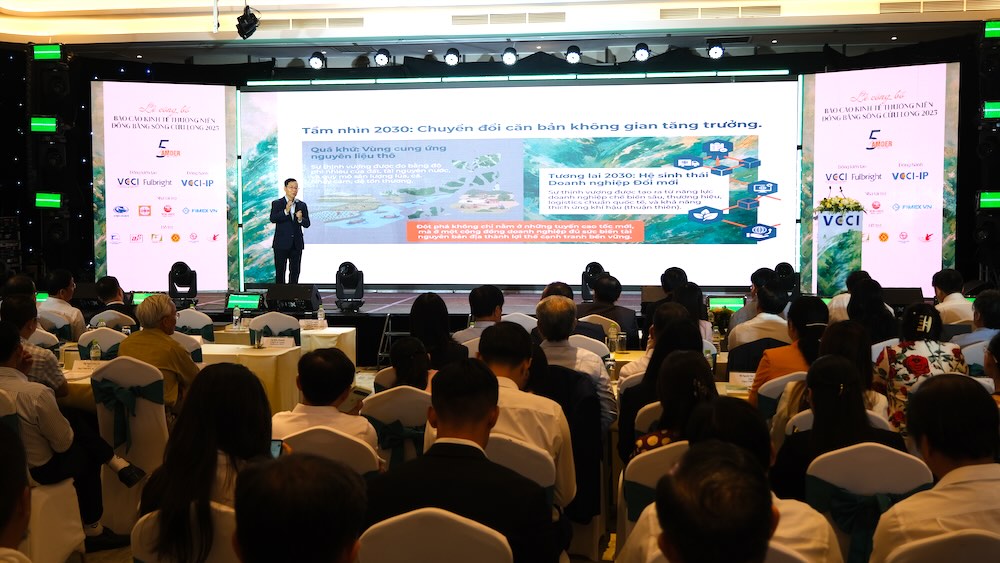
Some core findings that the annual economic report of the Mekong Delta in 2025 has pointed out:
Development paradox
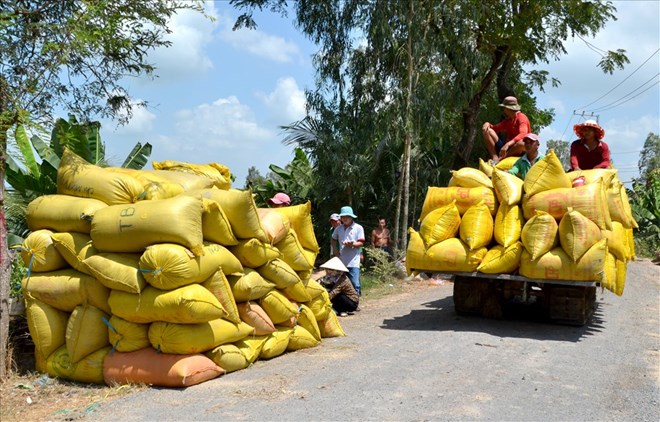
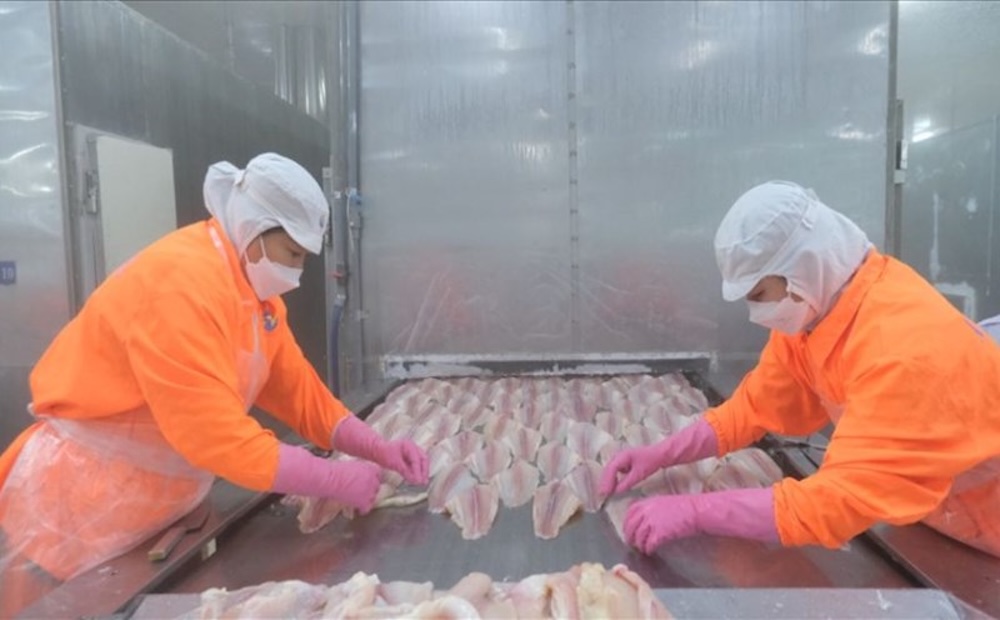
The Mekong Delta is facing an increasingly profound development paradox. The region contributes more than 50% of rice production, 65% of aquaculture, 70% of fruit and over 90% of rice exports of the country. This is also home to 18% of the population and brings in 58% of the foreign currency surplus for national reserves.
But this is the region with the lowest business density in the country since 2023, labor productivity is only about 133 million VND/laborer/year, belonging to the lowest group, attracting FDI in 2025 of less than 1 billion USD, accounting for only 2.45% of the whole country.
After adjusting the boundaries, no longer Long An, the inherent limitations of industry, FDI and business capacity are even more clearly revealed. The old growth model has reached the limit ceiling.
There is no shortage of businesses, but businesses cannot grow.
Up to 87.8% of Mekong Delta businesses are micro-enterprises, while the proportion of micro-enterprises moving to small scale has decreased from 9.1% in the period 2001 - 2002 to only 1.3% in the period 2022 - 2023.
The region has an absolute advantage in agriculture, contributing more than 30% of GRDP, but the number of agricultural enterprises accounts for less than 5%.
Logistics bottleneck
This report also points out that logistics bottlenecks continue to erode the competitiveness of businesses.
Logistics costs account for 20-25% of product costs, about 70% of exported goods still have to be transshipped through ports in Ho Chi Minh City and the Southeast region, the Can Tho - Cat Lai route is only 165 km long but takes up to 5 hours to travel.
Expressway infrastructure has been significantly improved, but expressways only truly create breakthroughs when accompanied by a second layer of infrastructure, including cold storage, classification centers, inspection, digital logistics...
Credit finance has not yet become a tool for business transformation
In 2025, the credit balance increase of the region only accounted for 2.67% of the whole country, lower than the rate of capital mobilization growth. Credit for agricultural exports only accounted for 8% of agricultural debt.
The financial system is still leaning towards asset mortgages, not enough to finance deep processing, green transformation and value chain upgrades.
Domestic private enterprise
This is the most strategic discovery. Product space analysis shows that the nucleus of upgrading the comparative advantage of the Mekong Delta lies mainly in the domestic private enterprise sector, contributing 45% of the total 357 industries that the region has advantages in.
Regional development policies must put domestic private enterprises in the center, and at the same time reposition FDI in the direction of creating links and spreading and repositioning state-owned enterprises to play a "pivot" role in infrastructure, cold logistics, energy, environment and technology.
At the announcement ceremony, the research group, experts, and businesses continued to report and point out issues that need to be concerned about.
Mr. Truong Canh Tuyen - Chairman of Can Tho City People's Committee - highly appreciated the contributions that the annual Mekong Delta Economic Report has made to research, administration, policy planning and the overall development of the entire region over the years.


