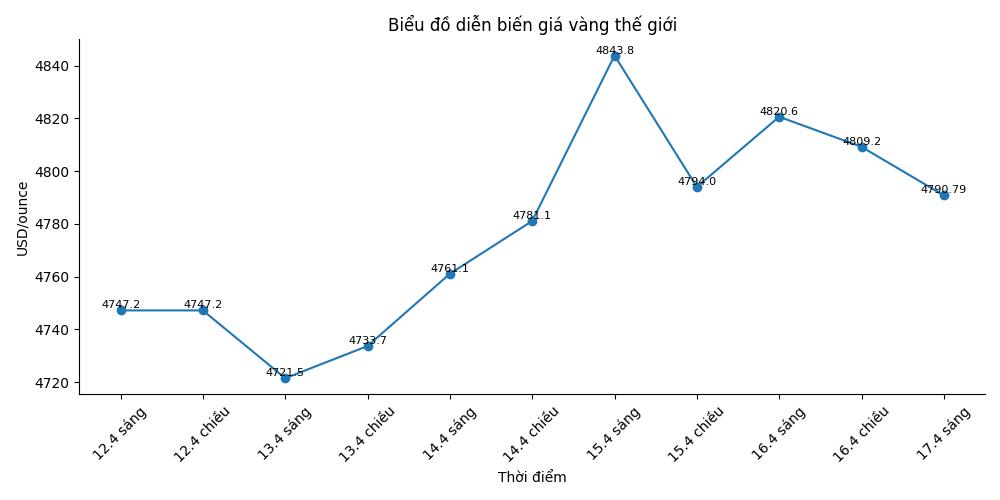
World gold prices fluctuated in a narrow range as the market simultaneously considered the progress of negotiations between the US and Iran and the existing risks in the Middle East.
The precious metal is heading for its fourth consecutive week of gains, maintaining around the threshold of 4,790–4,800 USD per ounce in recent sessions. Previously, gold prices were supported when Donald Trump expressed optimism about the possibility of reaching a long-term ceasefire agreement with Iran, thereby reducing concerns about energy disruptions and inflationary pressure.
According to President Donald Trump, Iran has accepted a number of important terms, including reopening the Strait of Hormuz. He also said that negotiations could resume in a short time, while some intermediary countries such as Pakistan are promoting the extension of the ceasefire to facilitate the peace process.
However, this prospect is still accompanied by many uncertainties. The Strait of Hormuz – a strategic transport route connecting the Persian Gulf with the global market – remains tense as the US maintains naval blockades, while Iran is considering applying a fee mechanism to ships passing through. This information has caused gold prices to narrow their gains in the session, as investors return to a cautious state.
At the same time, the rebound in US bond yields also put pressure on gold – a non-performing asset. Oil prices remained above the highs, reflecting concerns about energy supply, while the stock market adjusted after a period of strong growth.
However, some supporting factors are still forming. The recent cooling down of energy prices has somewhat reduced inflationary pressure – a factor that once made the market expect central banks to maintain high interest rates for a longer time.
Mr. John Williams – Chairman of the New York branch of the US Federal Reserve (Fed) said that the current high level of uncertainty makes it difficult for this agency to provide a clear direction on the interest rate roadmap, although still leaving open the possibility of long-term cuts. Meanwhile, the interest rate swap market still leans towards the scenario of the Fed keeping interest rates unchanged this year.
From a market perspective, Ms. Suki Cooper - Global Commodity Research Director at Standard Chartered said that gold has not yet escaped risk in the short term, as investors shift their attention to real yield developments and monetary policy. According to her, with the interweaving of inflation risk and slowing growth, policy response will play a decisive role in gold price trends.
Bloomberg strategists also believe that, to strengthen the recovery momentum, the gold market needs more demand from ETFs after a period of strong capital withdrawal in March. In fact, positive signals are appearing as gold holdings of ETFs have increased again by about 25 tons this month.
In the long term, Mr. Artem Volynets – Chairman of the Virgin Islands Minerals Corporation (ACG Metals) said that gold is still supported by geopolitical fluctuations, as central banks tend to increase reserves to diversify assets and reduce dependence on the USD.
Although it has recovered in recent weeks, gold prices have still fallen by about 9% since the conflict broke out at the end of February, mainly due to liquidity pressure in the early stages that forced investors to sell assets to offset losses in other markets.
In this morning's trading session, spot gold prices at 9:35 am Vietnam time were almost flat at 4,790.79 USD/ounce. Silver, platinum and palladium prices all slightly decreased, while the USD strength index increased by 0.1%.