The rice market on April 6 continued to fluctuate when it was simultaneously affected by abundant supply and increased cost pressure due to geopolitical tensions in the Middle East.
In the international market, export rice prices in key countries generally fluctuate little. In Thailand, 5% broken rice fluctuates in the range of 336-370 USD/ton, while 100% broken rice is at 349-353 USD/ton. In India, 5% broken rice is offered for sale from 335-339 USD/ton, and 100% broken rice is at 283-287 USD/ton.
This development reflects the picture of oversupply still dominating the Asian rice market. Although demand from some regions such as Africa shows signs of improvement, purchasing power is not strong enough to create a clear boost. Export activities at major centers such as India and Thailand continue to stagnate, especially as Thailand enters a new harvest season.
However, the strongest dominant factor currently does not lie in traditional supply and demand but comes from geopolitical tensions. Conflicts in the Middle East are pushing energy prices up, leading to escalating transportation and logistics costs, thereby directly affecting global food prices.
Analysts believe that the market is under two opposite pulling forces. On the one hand, large supply and slow trading make it difficult for prices to break through. On the other hand, increased input costs due to oil prices and the risk of supply chain disruption create upward pressure on prices in the medium and long term. If the conflict lasts, the risk of disruption of the food and fertilizer supply chain may cause rice prices to reverse to increase.
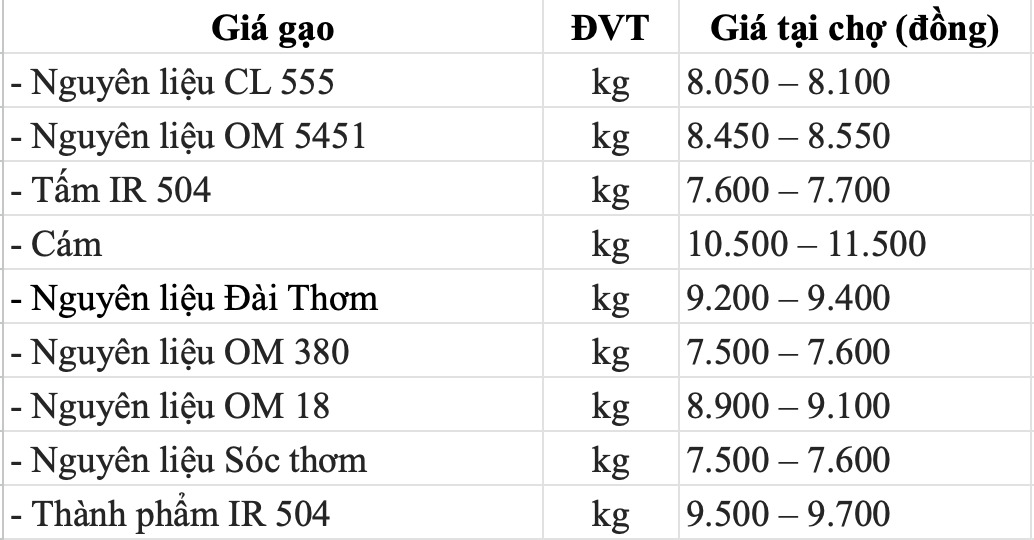
Domestically, the Mekong Delta region recorded continued sluggish trading. Raw rice prices of various types such as CL555, OM 5451, Dai Thom 8 or OM 18 fluctuated slightly around familiar levels, without significant fluctuations.
The group of by-products maintains a stable price level, commonly in the range of 7,600 - 11,500 VND/kg. In which, fragrant plate 504 fluctuates around 7,600 - 7,700 VND/kg, while bran is at a higher level, from 10,500 - 11,500 VND/kg.
Records in localities show that the market has a slight differentiation. In An Giang, rice prices tend to increase slightly but transactions are still slow. In Dong Thap, the amount of goods arriving at wharves is not large, warehouses still maintain purchases but prices are generally stable. Some other areas continue to record weak purchasing power, reflecting the cautious psychology of traders.
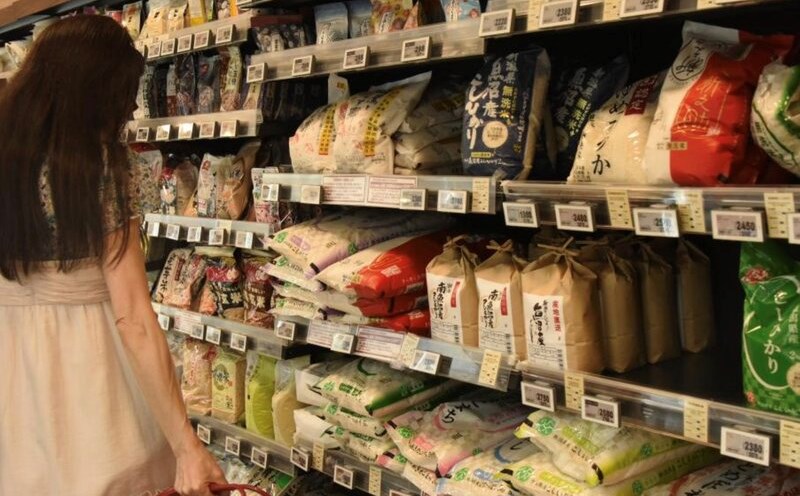
In the retail channel, rice prices tend to increase slightly compared to last week. Jasmine fragrant rice fluctuates from 14,000 - 15,000 VND/kg, regular rice is at 13,000 - 14,000 VND/kg. High-end rice lines such as Nang Nen, Huong Lai or Japanese rice still maintain high prices, of which Nang Nen is up to 28,000 VND/kg.
For rice, the purchasing price is generally stable. Popular varieties such as OM 18, Dai Thom 8, IR 50404 or OM 5451 fluctuate around the familiar price range, and trading transactions are still slow in many localities such as An Giang, Dong Thap, Can Tho or Vinh Long.
In the export market, Vietnamese rice prices continue to be maintained in many segments. 5% broken fragrant rice is offered for sale at about 400-445 USD/ton, 100% broken rice is at 329-333 USD/ton, while Jasmine rice fluctuates around 435-439 USD/ton.
In the short term, the rice market is forecast to continue to fluctuate in a narrow range, as geopolitical factors still play a large dominant role, while supply and demand have not created strong enough momentum to form a clear trend.