
Some large projects have been operated and verified
On June 22, based on the proposal of the Department of Finance, Gia Lai Provincial People's Committee reported to the Standing Committee of the Provincial People's Committee Party Committee on the results of reviewing and assessing the impact related to the Kanak Float Solar Power Project in Kbang commune and the Plei Tho Ga 2 Float Solar Power Project combined with a battery storage system in Chu Puh commune.
Accordingly, floating solar power technology has been deployed in many countries such as Singapore, China, Thailand and Vietnam.
The Provincial Department of Finance said that some floating solar power projects have been and are operating such as Dau Tieng, Da Mi, Tan Chau, Tianjin and many floating solar power projects on other hydropower reservoirs.
The Dau Tieng Lake Solar Power Plant project is known as one of the largest floating solar power projects in Southeast Asia, built on the Dau Tieng reservoir, Tay Ninh province.
This is a reservoir with a particularly important role at the national level, both performing the function of regulating and irrigating to serve agricultural production, and providing raw water for water plants serving domestic use in Tay Ninh, Dong Nai and Ho Chi Minh City provinces.
The actual operation of projects such as Dau Tieng Lake Solar Power Plant (500 MW) put into operation from 2018 and Tan Chau 1 Solar Power Plant (50 MWp) put into operation from 2020 shows that the development of floating solar power on reservoirs with domestic water supply functions has been verified, ensuring safety, and does not affect the quality as well as the ability to exploit water sources to serve people in downstream areas.
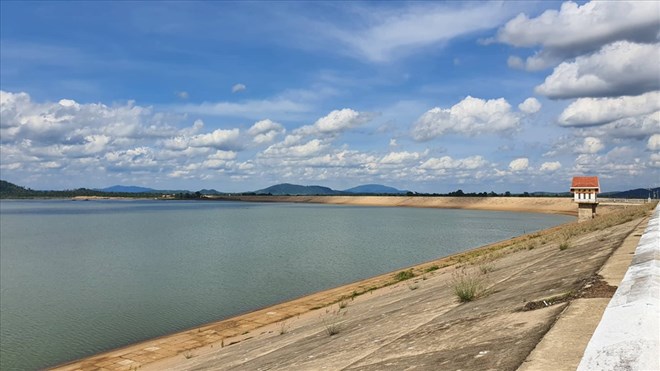
According to investors, these projects show that floating solar power technology can operate safely if applied in accordance with technical standards and environmental management procedures.
Investors commit to protecting the environment and water resources
In Gia Lai, investors commit that photovoltaic panels are made from high-strength materials such as tempered glass, pure silicon, anodized aluminum alloy and a waterproof film.
These materials have corrosion resistance, do not generate harmful substances in normal operating conditions and have a lifespan of over 25 years.
During operation, the investor commits to prioritizing the application of dry cleaning technology or using pure water and not discharging toilet water directly into the reservoir.
In addition, investors are committed to applying technical solutions such as controlling the lake surface coverage rate, arranging distances between battery clusters, maintaining water circulation corridors, ensuring the ability to exchange dissolved oxygen and natural flow in the reservoir.
The investor also commits to periodically monitoring and supervising water quality according to the provisions of law; developing plans for prevention and response to environmental incidents...
Currently, the Provincial People's Committee has submitted a report to the Standing Committee of the Provincial People's Committee Party Committee for consideration and approval of the policy to implement projects in Kbang and Chu Puh.


