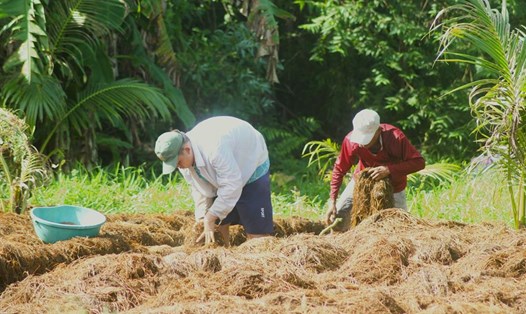
Over the past month, straw mushroom prices in many Mekong Delta provinces have increased by 5,000 - 15,000 VND/kg and are currently maintained at a high level. In specialized areas, round straw mushrooms ( night- harvested mushrooms) are purchased by traders for 60,000 - 75,000 VND/kg, while long straw mushrooms (parachute mushrooms) range from 35,000 - 45,000 VND/kg. At markets and supermarkets, retail prices are even higher, reaching 80,000 - 105,000 VND/kg for round mushrooms and 60,000 - 70,000 VND/kg for long mushrooms, respectively.
It is noted that in Nga Nam ward, the traditional straw mushroom growing area of Can Tho city currently has very few production households. Along the Quan Lo - Phung Hiep route and National Highway 61B through Nga Nam ward, the number of mushroom trading households is also limited.
According to a mushroom grower here, the increase in mushroom prices is mainly due to high consumption demand during the full moon, while supply in many localities has decreased sharply. "Currently, many places have not yet harvested rice, some areas have not yet planted, even some low-lying areas are flooded, so there is almost no straw to make mushrooms, leading to a scarce supply," this person said.
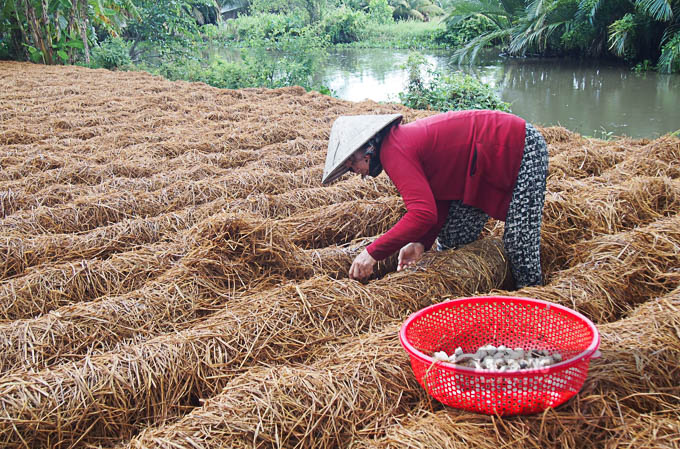
According to the International Rice Research Institute, annual rice production in the Mekong Delta generates more than 24 million tons of straw. Previously, farmers often burned or buried straw in the fields to prepare for the new crop.
However, since participating in the Project "1 million hectares of high-quality and low-emission rice cultivation associated with green growth in the Mekong Delta", many cooperatives have implemented a circular economic model from straw, turning this bypass into a sustainable source of income.
According to statistics, in Can Tho, in 2024, there will be about 2,248 hectares of straw mushroom land, with an average yield of about 9.2 tons/ha. Field studies show that applying the circular economic model from straw has helped farmers increase their income by 25-35% compared to growing only pure rice.
The exploitation of straw not only helps solve the problem of scarcity of raw materials for mushrooms but also contributes to increasing income, reducing emissions, and moving towards sustainable agricultural production in the Mekong Delta.