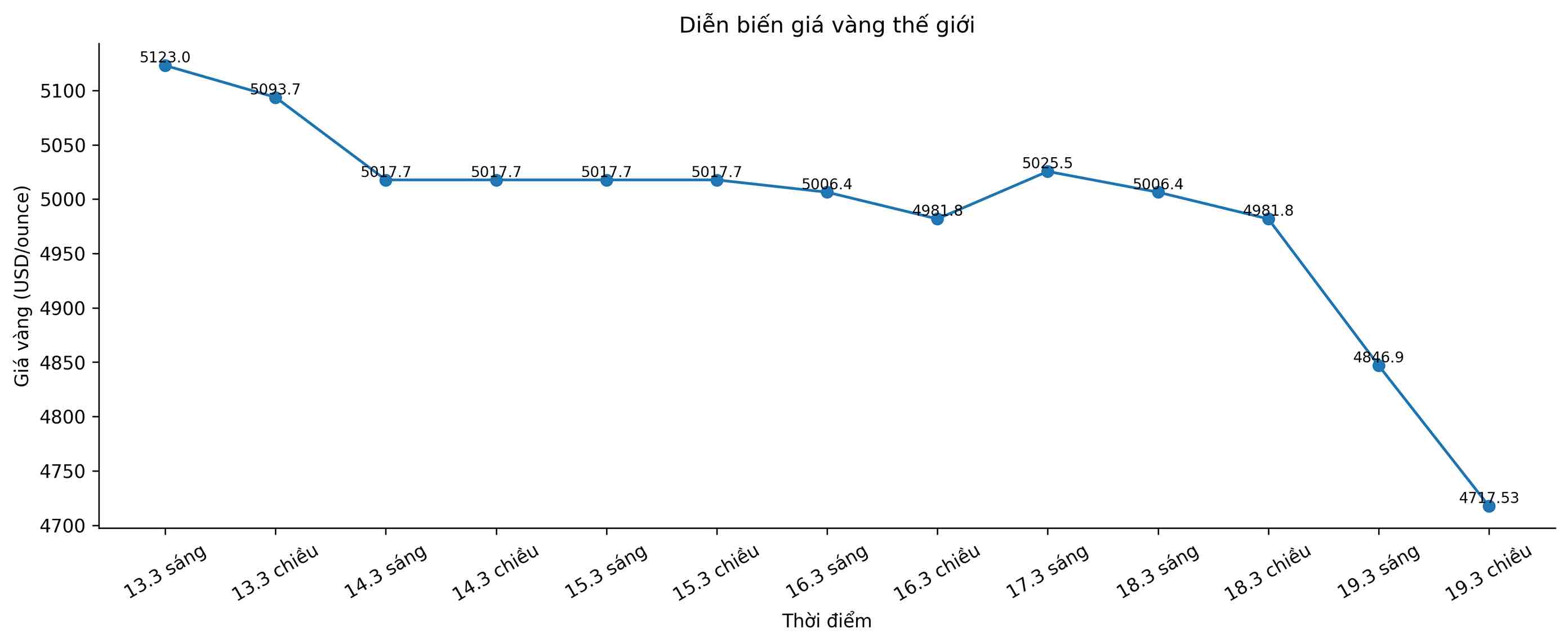
Gold prices fell for the seventh consecutive session as escalating conflict in the Middle East pushed oil prices up, thereby reducing expectations of a short-term interest rate cut by the US Federal Reserve (Fed).
The precious metal at one point fell by 1.5%, reversing after increasing by about 1% at the beginning of the session, and is heading towards its longest streak of decline since October 2023.
In the most recent meeting, the Fed decided to keep interest rates unchanged and only forecast one cut this year. Chairman Jerome Powell emphasized that interest rate cuts will depend on the progress of inflation. The Fed also assessed that the US economic outlook is becoming "unpredictable" due to the impact of conflict.
Oil prices rose sharply on Thursday after Iran and Israel attacked key energy facilities in the Persian Gulf region. After nearly three weeks of fighting, rising oil and gas prices are increasing inflationary pressure, making the possibility of monetary policy easing by the Fed and other central banks less feasible. This is a disadvantage for gold, a non-performing asset. The strengthening USD is also putting pressure on commodities valued in this currency.
Mr. Nicholas Frappell, Global Director of Organizational Markets at ABC Refinery Australia, said that the strength of the USD and policy tightening pressure in developed economies are making the short-term outlook for gold uncertain. However, in the medium term, if inflation increases faster than nominal interest rates, pulling real interest rates down, gold can still be supported.
However, since the beginning of the year, gold prices have still increased by more than 10%, but the increase has stalled in recent weeks as expectations of interest rate cuts weakened. Some investors have also sold gold to supplement margins for other positions. From a historical peak of over 5,595 USD/ounce at the end of January, gold prices have fallen nearly 9% since the conflict broke out on February 28.
Mr. Christopher Wood, Global Stock Strategy Director at Jefferies, said that gold is entering an accumulation phase. According to him, the fact that prices have not hit a new peak when conflict breaks out is a signal that the upward momentum has temporarily peaked. He predicts gold may fluctuate in the range of 4,500–5,500 USD/ounce in the near future.
After the policy meeting, Mr. Jerome Powell also made notable statements related to his personal future in the context of an investigation from the US Department of Justice. He affirmed that he has no intention of resigning until the investigation ends. If there is no successor when the Chairman's term ends in May, he may take on the interim role. These developments raise concerns about the possibility of political intervention in the Fed, thereby partly supporting the demand for gold holdings.
In this afternoon's trading session, spot gold prices fell 1.2% to 4,715.95 USD/ounce. Silver fell sharply 4.1% to 72.32 USD/ounce. Platinum and palladium also went down simultaneously. The Bloomberg Dollar Spot Index went sideways after increasing 0.5% in the previous session.