
Developing new generation aviation not only meets internal needs but is also becoming a strategic orientation for Vietnam to open up a new growth space from the aviation economy. In which, Gia Binh International Airport is considered a pioneering model for this development trend.
Vietnam is entering a pivotal stage of a new development cycle when the Government sets a double-digit GDP growth target in the period 2026-2030. In that context, infrastructure, energy and institutional reform are identified as strategic drivers to reshape the economy.
Repositioning Vietnam's aviation industry
In the trend of green growth and sustainable development, aviation is no longer simply a transportation industry but has become a strategic component of socio-economic infrastructure, playing a role in promoting growth, attracting investment, regional development and ensuring security and defense.

However, the new generation aviation is still a missing "piece" of the Vietnamese aviation market. According to the Government's orientation, new airports, including Gia Binh International Airport, will be developed according to international standards, towards a smart, green, sustainable and 5-star standard airport model.
According to the Civil Aviation Authority of Vietnam, although the world economy still has many fluctuations, the domestic aviation industry still maintains strong growth momentum. In the first 4 months of the year, the number of passengers reached more than 46 million, an increase of nearly 18% compared to the same period; cargo transported reached 616,000 tons, an increase of 17%. This increase is significantly higher than the world market average.
Mr. Dao Trong Khoa - Chairman of the Vietnam Logistics Services Business Association (VLA) - citing data from the International Air Transport Association (IATA) said that air transport accounts for about 33% of global merchandise trade value. With its strategic position in the Asia-Pacific center, Vietnam is emerging as an important link in the global supply chain.
The aviation industry currently directly creates about 100,000 jobs, contributing 1.9 billion USD to GDP. If including indirect impacts, the total contribution reaches about 17.5 billion USD, equivalent to 4.1% of GDP and creates about 2.5 million jobs.
The volume of goods transported by air in Vietnam also increased rapidly, reaching about 1.5 million tons in 2024, putting Vietnam at 20th place in the world in terms of air transport market size and 22nd in international trade related to air transport.
According to Mr. Dao Trong Khoa, these figures show the great potential of the Vietnamese market in connecting global production and consumption centers. The operations of airlines are recovering positively, ensuring operational safety and maintaining the stable growth momentum of aviation services.
Policy momentum and infrastructure "key
Assoc. Prof. Dr. Nguyen Thuong Lang - senior lecturer at the Institute of International Trade and Economics - said that developing synchronous and modern infrastructure continues to be one of the three strategic breakthroughs identified in the Resolution of the 14th Party Congress.
In which, aviation infrastructure is considered a key sector with great spillover potential, not only serving transportation but also creating new economic growth poles. New generation airports are gradually becoming the center of organizing logistics, trade, finance and urban flows.
According to Assoc. Prof. Dr. Nguyen Thuong Lang, this is a strategic orientation showing the Government's long-term vision to "awaken" the potential in many localities. In that context, Gia Binh International Airport emerged as a specific approach to a new development model.
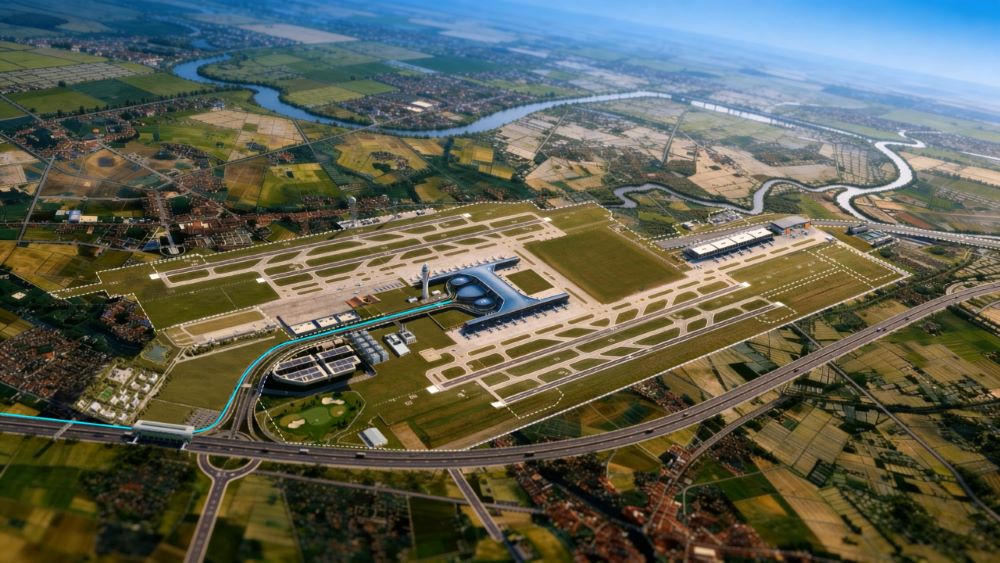
He believes that modern airports are not only runways or passenger transportation places but also an integrated economic ecosystem. There, aviation technology, modern management and related fields such as logistics, trade, finance, education, healthcare and entertainment develop together.
Building Gia Binh International Airport into an aviation economic complex is considered an inevitable trend. Many economies in the region have succeeded with this model, typically Changi Airport of Singapore or Chek Lap Kok Airport of Hong Kong (China). These are all multi-functional integrated aviation economic complexes, effectively exploiting space and creating great added value from service industries.
Assoc. Prof. Dr. Nguyen Thuong Lang said that the current direction of aviation economic development has more motivation from new policies. In particular, Resolution 68-NQ/TW of the Politburo has opened an important policy corridor, encouraging the private sector to participate more deeply in dynamic fields and large-scale integrated development models.
In addition to policies, the decisive factor lies in connectivity infrastructure. In 2026, public investment capital is expected to be deployed at a high level, focusing on regional, inter-regional and international connectivity projects, clearly showing the orientation of "infrastructure ahead to welcome growth".
According to the plan, Gia Binh International Airport will be connected to many strategic traffic routes such as the Hanoi - Gia Binh expressway, Ring Road 4 of the Capital region, Gia Binh - Hai Phong expressway and Lach Huyen port. At the same time, the railway system will also be developed with key routes such as the Hanoi - Quang Ninh high-speed railway and the Hanoi - Lao Cai - Hai Phong route, creating a synchronous multimodal transport network.
When market, policy and infrastructure conditions converge, integrated models such as Gia Binh International Airport show a new direction for Vietnam. Aviation is not just a connecting tool but is becoming a platform to organize and amplify economic flows, thereby expanding the growth space in a completely new way.
On May 8, Politburo Member, Standing Deputy Prime Minister Pham Gia Tuc chaired a meeting on adjusting the National Airport System Plan for the period 2021-2030, with a vision to 2050. The Deputy Prime Minister emphasized that the plan must be strategic, synchronous and have a long-term vision, and at the same time noted the need to develop air freight transport associated with tourism, services and synchronous infrastructure.


