
Unlocking development resources
Speaking at the conference "Energy Security to 2030: Unlocking resources for energy infrastructure development" held on July 17 in Ho Chi Minh City, Dr. Tran Van Tung - Chairman of the Vietnam Association of Science and Technology Information (VASTI) - said that Vietnam's energy industry has achieved many positive results but is also facing many challenges such as rapidly increasing electricity demand, the need to shift to green energy, fluctuations in the world energy market and pressure to ensure supply for the digital economy.
According to Mr. Tung, the development of artificial intelligence (AI), cloud computing, data centers and high-tech industries is driving a very large energy demand. Therefore, Vietnam needs not only to increase investment but also to invest effectively and with a long-term vision.
He emphasized that energy policies must be based on sufficient data, accurate information and quality scientific research. In addition to capital sources, it is necessary to unlock resources in knowledge, technology and people, creating companionship between the State, businesses, scientists and people to form an innovative ecosystem, contributing to ensuring energy security.
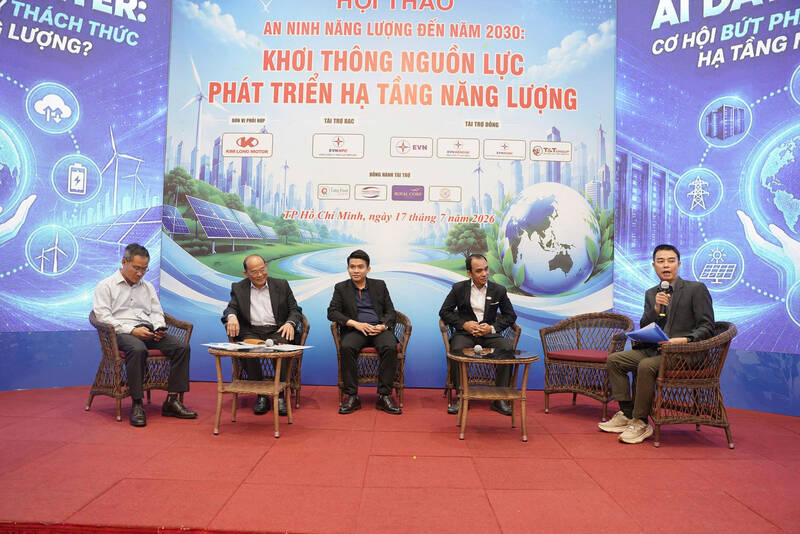
From a research perspective, Prof. Dr. Vo Xuan Vinh - Director of the Institute of Business Research (IBR), Ho Chi Minh City University of Economics - said that Vietnam's energy security is being affected by three major trends. These are geopolitical fluctuations that increase the risk of LNG and imported coal supply; the AI and data center boom that causes global electricity demand to increase sharply; and the pressure to shift energy to implement the Net Zero commitment while Vietnam's commercial electricity demand is still forecast to increase by 10-12% per year.
Ho Chi Minh City promotes rooftop solar power
Faced with increasing electricity demand, Ho Chi Minh City is identifying rooftop solar power as one of the important solutions to reduce pressure on the power system and promote green energy conversion.
According to Mr. Phan Quang Vinh - Deputy Head of Business Department of Ho Chi Minh City Power Corporation (EVNHCMC), after merging Binh Duong and Ba Ria - Vung Tau, Ho Chi Minh City continues to be the locality with the largest electricity demand in the country. In 2025, commercial electricity output reached 56.1 billion kWh, maximum load capacity 8,936 MW, serving about 3.91 million customers. By 2030, commercial electricity output is forecast to reach about 75 billion kWh.
Currently, the city has more than 25,900 rooftop solar power systems with a total capacity of about 1,928 MWp, emitting an average of 231 million kWh per month, equivalent to 4.4% of the total commercial electricity output of the entire system. The total installed capacity reaches about 21.6% of the maximum load capacity.
Notably, self-produced and self-consumed solar power systems are increasing rapidly. From 2025 to the end of the first 6 months of 2026, there were more than 5,000 new systems with a total capacity of nearly 478 MWp.
According to the adjusted Power Plan VIII, by 2030, the total rooftop solar power capacity of Ho Chi Minh City may reach about 2,786 MW. Along with that, Decree 243/2026/ND-CP expands the subjects eligible to develop rooftop solar power, simplifies procedures and allows many customer groups to sell excess electricity to the grid, creating motivation to promote investment.
EVNHCMC also proposed to encourage people and businesses to install rooftop solar power combined with a power storage system (BESS), contributing to improving electricity efficiency, reducing pressure on the power grid and enhancing energy security for the city.


