Add "regulating valve" to ensure power supply
Among the continuous production plants in Song Khe Industrial Park (Bac Ninh), the 110kV Song Khe substation is likened to a "regulating valve", contributing to ensuring power supply for areas with high load demand in the province.
Last August, the electricity consumption capacity in Bac Ninh at one point reached about 3,229 MW. When electricity demand increased, Bac Ninh Power Company (PC Bac Ninh) mobilized about 30 MW from the BESS energy storage system to support the operation of the power grid.
The 110kV Song Khe substation is the first project completed in phase 1 of the project to install a battery storage system on the power grid managed by the Northern Power Corporation (EVNNPC).
Here, the system is equipped with two energy storage batteries, and a transformer substation, creating additional support for the power grid in times of high load.
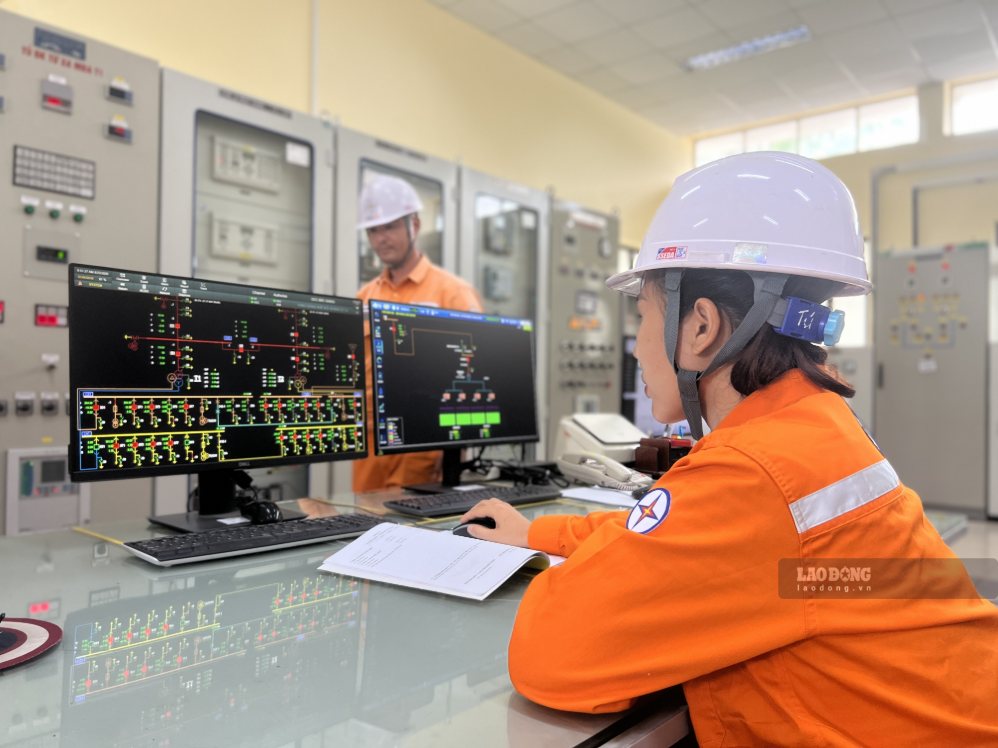
Inside the control room, technical staff continuously monitor the status of the battery system, from charge and discharge capacity, temperature to protection system and technical warnings.
Each parameter displayed on the screen is closely monitored. Each inspection shift complies with strict procedures, with coordination between dispatchers, technical management units and staff directly operating at the station, to ensure the system operates stably, and parameters are always within safety limits.
Talking to Lao Dong Newspaper, Mr. Lai Viet Anh - Head of Dispatch Department, PC Bac Ninh - said that with the characteristics of an industrial province, Bac Ninh concentrates many large industrial parks, including many FDI enterprises and high-tech enterprises. This requires the power system to operate stably and reliably.
In addition, the power grid development speed of Bac Ninh province in the coming time is forecast to be high, averaging about 12-13%/year. Especially during peak hours during hot spells, load increases very high, and there is a large difference in capacity between peak hours and off-peak hours. Therefore, according to Mr. Lai Viet Anh, investing in BESS storage systems for the power system is appropriate and effective.
This is a new field with high technology content, so it requires management and operation forces to research, understand and grasp to master the technology, serving operational work. Bac Ninh Power Company has also proactively and actively directed its affiliated units in receiving, managing, inspecting and operating the BESS system," Mr. Lai Viet Anh said.
According to the Head of the Bac Ninh PC Dispatch Department, when put into operation, the BESS system will play a multi-functional role, being both an electricity source system and a load. The system can supplement power during peak hours when the load increases; contributing to adjusting and moving the load out of peak hours, especially cutting the system's power peak.
Through this, BESS contributes to supporting the power system to operate stably and safely, improving the reliability of power supply and economic efficiency.
At the 110kV Yen Phong 4 substation, the BESS system was put into operation from August 16. Mr. Nguyen Van Duong - Head of the Yen Phong Mobile Operations Team - said that when the electricity demand increases or the system needs to mobilize more power, the battery will discharge electricity to support.
Conversely, when the electricity demand is low and conditions are suitable, the system will charge the battery, store electricity for use at necessary times afterwards.
Create more room for the power grid to operate more flexibly
Mr. Vu Anh Phuong - Deputy General Director of EVNNPC said that the deployment of a battery energy storage system is one of EVNNPC's important steps in the process of modernizing the power grid, improving flexibility in operation and the ability to meet increasing load demand.
EVNNPC's BESS project is implemented in 3 phases, with a total scale of 530MW/1,060MWh.
In which, phase 1 has a scale of 305 MW/610MWh, installed at 47 transformer stations belonging to 8 power companies and has now completed installation at 9/47 stations. Phase 2 has a scale of 140MW/280MWh at 23 transformer stations, and is in the process of completing procedures. Phase 3 is expected to be implemented with a scale of 85MW/170MWh at 13 transformer stations.
When put into operation, the BESS system will contribute to supplementing power sources during high load times, supporting to reduce operating pressure on the power grid, limiting the risk of overload and incidents in some areas. Improving reliability, quality and ability to provide safe and stable power to serve socio-economic development.
BESS creates more room for the power grid to operate more flexibly in the context of the increasing proportion of renewable energy sources. The ability to store electricity when the source is abundant and mobilize it back when the system needs it, contributing to improving the efficiency of exploiting renewable energy sources, increasing supply-demand balance and supporting safe and stable operation of the power system," Mr. Phuong said.