
Historical choice
The renovation process initiated and led by our Party is a historical choice, a great creative cause of historical stature, of great significance, consistent with Vietnamese practice, laws, and general development trends of the era.
After 40 years of implementing the renovation process, Vietnam has achieved outstanding socio-economic achievements, recognized by the international community as an "Asian miracle". These results are not only reflected in growth figures, but also reflect profound changes in people's lives, in social structure and national position.
If in the early renovation period (1986-1990), the average annual GDP growth rate was only 4.4%, then in the period 1991-1995, the average GDP doubled, reaching 8.2%/year, and subsequent periods all had quite high growth rates.
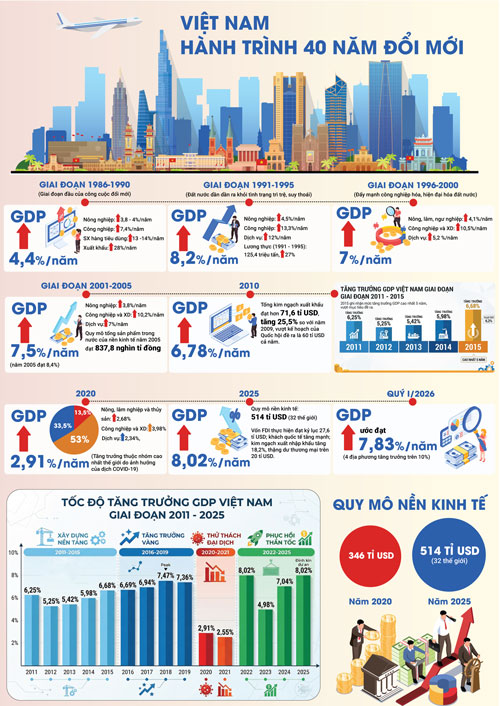
In the 10 years 1990–2000, the average GDP growth rate reached 7.5%. In the period 2006-2010, our country's economy overcame many difficulties and challenges. The macroeconomy was basically stable, maintaining a fairly good growth rate, the potential and scale of the economy increased rapidly, our country has emerged from a state of underdevelopment. The average 5-year economic growth rate reached 7%. The scale of gross domestic product (GDP) in 2010 reached 101.6 billion USD (3.26 times higher than in 2000).
In the period 2011-2020, the macroeconomy maintained solid stability, inflation was controlled and maintained at a low level, creating an environment and motivation for socio-economic development.
In the period 2011-2015, the growth rate of gross domestic product (GDP) averaged 5.9%/year; the period 2016-2019 is estimated at 6.8%/year. Vietnam became one of the fastest growing economies in the region and the IMF assessed Vietnam as one of the top 20 economies contributing the most to global growth in 2019.
Notably, in 2020, under the impact of COVID-19, many countries in the world fell into recession. However, Vietnam is one of the few countries that still maintains positive growth (2.9%), ensuring social security.
According to assessments by domestic and foreign economic organizations, by the end of 2020, Vietnam had achieved a "double goal" in preventing and combating COVID-19 and maintaining economic growth. The Economist magazine in August 2020 ranked Vietnam in the Top 16 most successful emerging economies in the world.
The scale and level of the economy have been improved, if in 1989 it only reached 6.3 billion USD/year, then by 2020 it had reached about 268.4 billion USD. People's lives both materially and spiritually have improved significantly, in 1985 the average per capita income only reached 159 USD/year, then by 2020 it reached about 2,750 USD/year.
GDP at current prices in 2024 is estimated at 11,511.9 trillion VND, equivalent to 476.3 billion USD, marking a step forward in Vietnam's economic development. In particular, GDP per capita reached 114 million VND (4,700 USD), an increase of 377 USD compared to the previous year, showing that people's living standards are constantly improving. This is an encouraging result, affirming the effectiveness of economic policies and the comprehensive development of the country.
In addition, in Vietnam, key economic regions have been formed to be the driving force for regional and national economic development; developing concentrated economic zones and industrial parks to attract investment capital for development, and at the same time forming specialized areas for crops and livestock associated with industrial processing... In general, industries and fields of the economy have had strong development steps.
Over 40 years, from a food shortage, Vietnam has become one of the largest agricultural exporters in the world. The export turnover of many agricultural products such as: coffee, rice, cashew nuts, vegetables and fruits, shrimp, wood and wood products... has always been maintained at a high level. Other export items have also made great strides.
By 2025, the GDP growth rate will reach 8.02%, ranking high in the region and the world; the scale of the economy will reach 514 billion USD, ranking 32nd in the world. Inflation is well controlled; the monetary market and basic interest rate level are stable. State budget revenue increased sharply compared to estimates. FDI realized capital reached a record 27.6 billion USD; international visitors increased sharply; import and export turnover increased by 18.2%, trade surplus of over 20 billion USD. E-commerce increased by 25%. The e-Government Development Index increased by 15 places compared to 2020, ranking 71st/193.
Continuing innovation in the new era of the nation
The achievements are not only reflected in economic growth indicators, but also affirmed by comprehensive improvements in social life, people's quality of life, international position and belief in the future.
However, innovation has no stopping point but is a continuous and non-stop journey. New challenges in the context of globalization, digital transformation, climate change and international competition require Vietnam to continue to innovate thinking, institutions, development models and approaches. Innovation in the new era is not only economic innovation, but also innovation in institutions, culture - society, science - technology, national governance and human development. It is comprehensive, profound, creative and sustainable innovation.
The aspiration to rise to become a developed high-income country by 2045 is completely feasible, as Vietnam continues to promote the spirit of innovation, maintain political and social stability, improve internal capacity, and effectively take advantage of opportunities from international integration and technological transformation.
The success of 40 years of Doi Moi is a miracle of the era, creating a solid and energetic foundation for Vietnam to confidently enter the era of national rise, for peace, independence, democracy, prosperity, prosperity, civilization, happiness, firmly moving towards socialism.


