Building planting area planning, creating stable output for cassava plants
Cassava has been suitable for climate and soil conditions in many regions for many years, but still faces limitations in unstable prices, unstable output and fragmented production.
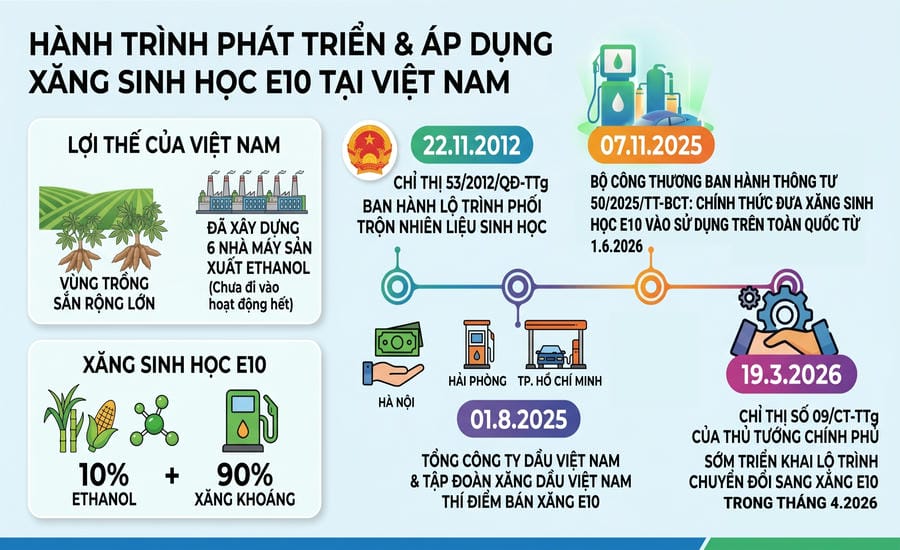
The deployment of E10 gasoline from April 2026 will help the demand for cassava purchases to take place regularly, creating a basis for planning concentrated growing areas, associated with processing and logistics, thereby stabilizing output and improving the value of agricultural products.
In the roadmap for deploying E10 bio-gasoline, Tay Ninh is assessed as one of the localities with great potential to participate in the ethanol production raw material supply chain thanks to the area and output of cassava belonging to the largest group in the country.
Tay Ninh currently maintains about 55,000 - 62,000 hectares of cassava, with an output of over 2 million tons per year. Not only is it a key growing area, the locality is also a large cassava starch processing center with many factories operating stably.
The main raw material source serves processing and export, forming a fairly sustainable linkage chain between businesses and farmers. This is the foundation for Tay Ninh to promote deep processing, including ethanol fuel production.
According to Mr. Nguyen Dinh Xuan - Deputy Director of the Department of Agriculture and Environment of Tay Ninh province, in the direction of developing the cassava industry in the coming time, diversifying cassava processed products, including ethanol, is considered one of the directions to improve the added value of the industry.
Leaders of Tay Ninh Provincial People's Committee also identified developing the cassava industry in a sustainable direction, improving the efficiency of deep processing as an important task of the locality. In the context of the expected increase in ethanol demand when deploying E10 gasoline, the advantage of a large-scale cassava raw material area is expected to create conditions for Tay Ninh to gradually participate more deeply in the raw material supply chain serving biofuel production.
E10 gasoline opens a new consumption path for Quang Ngai cassava
In recent years, the construction of cassava starch processing plants in mountainous areas has contributed to stable consumption of output, helping cassava continue to play the role of a key crop in the poverty reduction effort in Quang Ngai province.
According to Mr. Nguyen Hoai Tam - Head of the Sub-Department of Crop Production and Plant Protection, Quality Management (Department of Agriculture and Environment of Quang Ngai province), in 2025 the cassava area of the whole province reached more than 51,096ha, average yield of 170.5 quintals/ha, output of about 871.130 tons, mainly concentrated in communes in the western region.
Currently, the cassava growing area of Quang Ngai is mainly concentrated in highland communes such as: Sa Thay, Kon Braih, Kon Tum, Sa Loong... The fact that biofuel plants purchase agricultural products from people will provide a stable source of input materials for production, while harmoniously connecting industrial and agricultural needs, helping to improve people's lives.
Mr. Nguyen Manh, residing in Kon Braih commune (Quang Ngai) said: "My family has 3ha of cassava, every year we sell it to the cassava starch processing plant in the area. If the biofuel plant purchases long-term and sustainably, we can sign long-term contracts, competitive prices, and support on-site purchases for people. Cassava is a key crop of mountain farmers, so a stable purchase level with good profits will encourage people to invest, expand growing areas, and supply ethanol for biofuel.
During a survey of Dung Quat Biofuel Plant at the end of March 2026, the Quang Ngai Department of Industry and Trade assessed that the unit needs to cooperate with the agricultural sector to aim for product consumption, signing long-term purchasing contracts with cassava growers.
Currently, the price of fresh cassava is from 2,900 - 3,100 VND/kg, suitable for bio-gasoline plants to purchase products from people, serving the needs of large-scale ethanol processing, blending with mineral gasoline (from oil) to create E10 bio-gasoline.