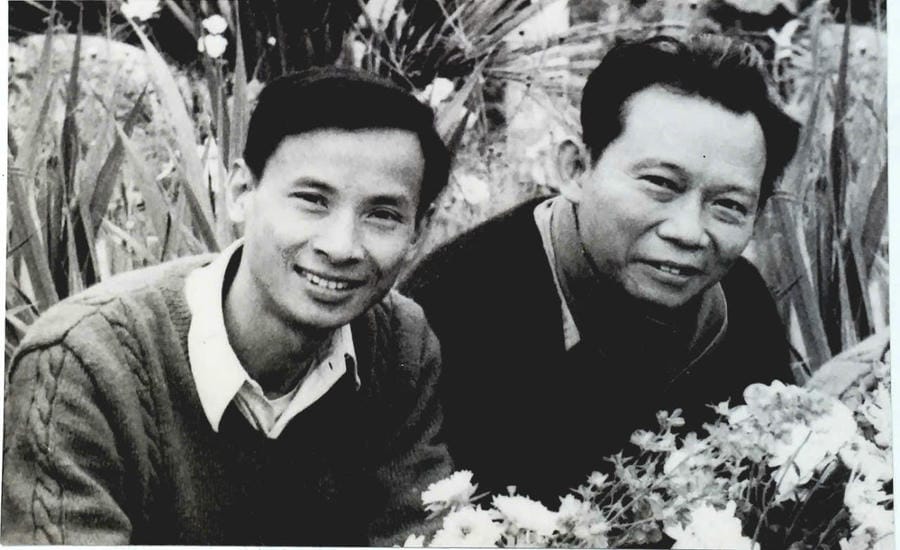
Recalling the years of resistance war against the US for national salvation, journalist Kim Toan - former reporter of Giai Phong Newspaper, former Editor-in-Chief of Hai Phong Newspaper, former Chairman of Hai Phong Journalists Association, former Standing Member of the Vietnam Journalists Association - does not consider himself a special case.
Sharing with reporters, he said that on the battlefield, not only journalists but all officers, soldiers and staff of agencies and units must hold guns. For journalists, holding guns is not only for self-defense but also to contribute guns with units fighting against the enemy.
For nearly a decade, working with colleagues across the southern battlefields, from mountains and forests to plains, from rural to urban areas, journalist Kim Toan has always accompanied his gun and pen.
Journalist Kim Toan still remembers a deep memory of the years of working as a journalist at the Front. That was the time he and journalist Hong Chau (aka Thep Moi) secretly infiltrated the enemy's stronghold, participating in the General Offensive and Uprising at the beginning of Spring Mau Than - 1968.
In a battle against the enemy's counter-attack at the city gateway, once the Military Medical Department of Sub-region 3 wrote a "death notice" sent to the editorial office of Giai Phong Newspaper in the War Zone, announcing that journalist Cao Kim (Kim Toan) had sacrificed. In fact, the sacrificed person was the Secretary of the Party cell cum Head of the T4 Propaganda Armed Team. Because before his death, the secretary still kept in his pocket a "Party membership letter" in the name of Cao Kim from the day the journalist was sent to join this unit to fight together, the forward military doctor made a mistake.
More than 3 months after the Giai Phong Newspaper organized the memorial service for "martyr" Cao Kim, journalist Kim Toan returned to continue journalistic activities with a front-line pen. The rare story of journalist Kim Toan clearly reflects the fierceness of war and the fragile boundary between life and death that battlefield journalists have experienced.
After the South was liberated and the country was unified, journalist Kim Toan returned to work as a journalist in his hometown Hai Phong Port City - where he had been attached for many years before volunteering to go to battle. Carrying the breath, experience, enthusiasm and fighting spirit of someone who used to hold a pen on the great front line, he worked wholeheartedly, actively contributing to building and innovating journalism for the cause of the city and country's development.
The press not only performs the task of information but also needs to promote its role as a weapon of revolutionary struggle. Learning from Uncle Ho's journalism example, journalists always remember his teachings: "Press officers are also revolutionary soldiers. Pens and paper are their sharp weapons".
Journalist Kim Toan believes that the journalism profession in each historical period has its own challenges. If in wartime, journalists have to face bombs and bullets surrounding them, enemy densely stationed, life and death are only a hair's breadth apart, then in peacetime, the "boundary" is also diverse; the fragility of the boundary depends on the bravery and professional ethics of each person.
According to him, the most important thing for journalists is their bravery and spirit of dedication to truth and justice. Moreover, the writer must be a good citizen, responsible to society; need to set higher requirements for themselves, must be a pioneer, and strive to become an excellent worker to meet the noble mission of the journalism profession.
To do that, journalists must constantly learn and improve themselves in all aspects. Not only study politics, culture, and professional skills, but also regularly train and foster life skills, ethics, behavioral skills and adaptability to the constant changes of modern life.
Going along with bravery is true love for the profession. Journalist Kim Toan emphasized the two words "truth", because for him, journalism can only go long when the journalist carries a pure motive, taking serving the country, serving the people and contributing to the development of society as a consistent goal.