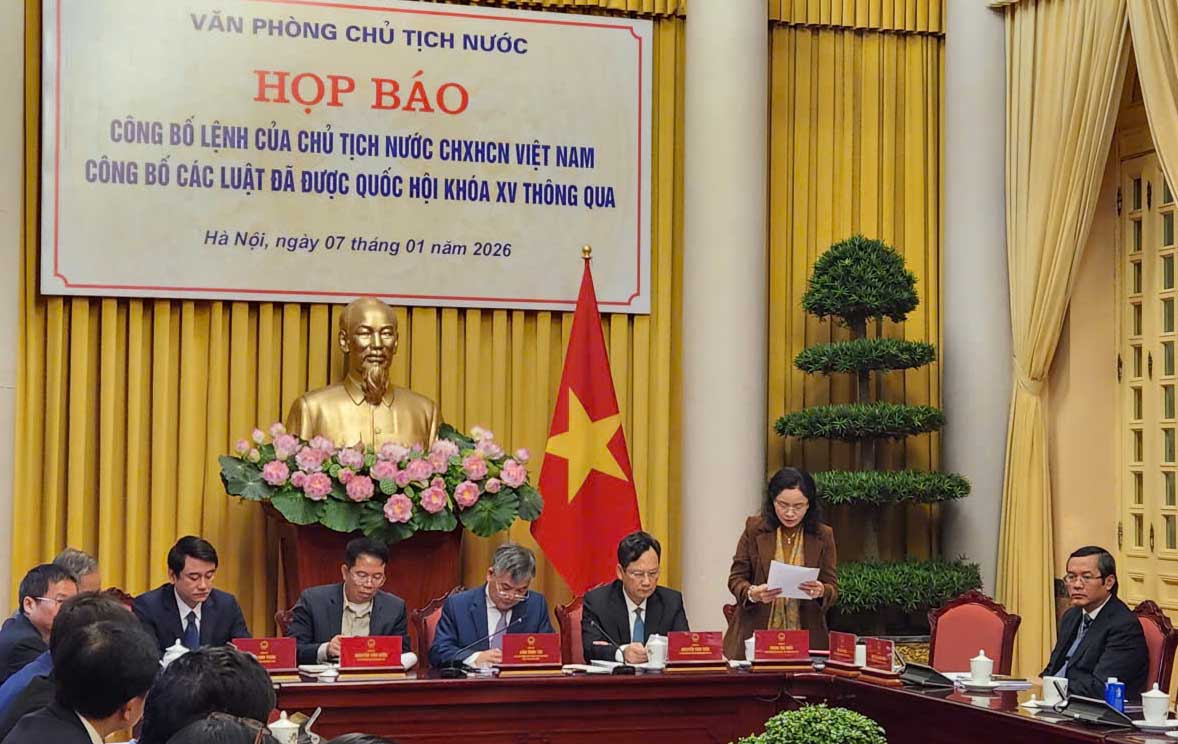
On January 7, the Presidential Office held a press conference announcing the President's order to announce 12 laws passed by the 15th National Assembly, including the Press Law 2025.
According to Deputy Minister of Culture, Sports and Tourism Trinh Thi Thuy, the Press Law 2025 includes 4 Chapters, 51 Articles, and takes effect from July 1, 2026.
Deputy Minister Trinh Thi Thuy said that the regulation "people working at scientific journals are not eligible for journalist card issuance" takes effect from January 1, 2026.
The regulation on the conditions for considering issuing a press card for the first time must go through a training class on journalistic nghiep vu and professional ethics, effective from January 1, 2027.
The Law stipulates principles on operating models, press economy, expanding operating space to develop journalism in the context of arranging and streamlining the organizational apparatus of the political system, meeting the requirements of information and propaganda in the new era.
Accordingly, the law supplements regulations that the main multi-media press agency has many types of press, directly affiliated press agencies; has specific financial mechanisms; is established in accordance with the Strategy for development and management of the press system approved by the Prime Minister.
This law has expanded the operating space for press agencies, which is press publishing in cyberspace.
According to the new law, the content channel of press agencies in cyberspace, the complete press content of the national digital press platform is a journalistic product.
The law supplements regulations that press agencies are allowed to link production of content, except for content on political news, security, national defense, and foreign affairs.
The Government is assigned to detail regulations on linking in press activities, transparency of responsibilities and rights of parties when participating in linking to promote press development.
Also according to the provisions of the new law, the State will assign tasks, order, bid and support transportation costs, cost of posting, transmission, and broadcasting for the press to serve political, security, national defense, cultural, and policy communication tasks...
The Law supplements regulations on new sources of revenue for press agencies, including: Revenue from selling reading, listening, viewing rights and allowing the exploitation and use of journalistic works; Revenue from financial activities and capital contributions to enterprises (if any).
Revenue from providing public non-business services assigned to tasks, ordering, bidding; Revenue from performing tasks, programs, projects, and projects assigned and approved by competent authorities; Revenue from people who need to publish scientific research articles.
The law also stipulates that radio and television agencies are allowed to export radio and television content and press agencies are allowed to import printed newspapers.
The Law assigns the Government to stipulate conditions for licensing establishments providing import-export press distribution services, ensuring transparency, and promoting press agencies and businesses providing import-export press distribution services.
Many regulations in the law aim to strictly manage press activities.
In which, supplementing regulations assigning the Government to detail the conditions for issuing press operating licenses for social organizations and socio-professional organizations to strictly manage magazine activities under social organizations and socio-professional organizations, improving operational efficiency.
Supplement regulations on revoking operating licenses of press agencies in cases where they do not operate, do not ensure operating conditions, and have repeated violations; press agencies cease operations when their licenses are revoked.