
Bustling Bauman pedestrian street
Our Kazan tour lasted 6 days. From Moscow, after 12 hours by train, early dawn on a day in mid-July, we set foot in Kazan - a city founded in 1005, located on the left bank of the Volga River, where the Volga River and the Kazanka River intersect. Kazan is the 5th largest city in Russia (in population), a crossroads between Islam and Orthodoxy.
From Kazan 2 train station, we took bus number 6 to the hotel located on Said Galeyev street (a revolutionary) opposite Kazan 1 train station near the city center. Bus number 6 connecting 2 train stations when running on the bridge across the river, I felt fresh early morning breezes. I leisurely admired a few prominent buildings of Kazan in the sunrise.
It was only 6 am, the bus was already crowded, mostly elderly people. When they knew we were tourists from Vietnam, many people smiled happily: "Oh, welcome Vietnamese friends to Kazan - the Brave Labor City*. Wishing you a trip full of memories!".
Our first day in Kazan began with the Bauman pedestrian street (Nikolai Ernestovich Bauman was a revolutionary) and Kul Sharif Mosque (located in the Kazan Kremlin complex).
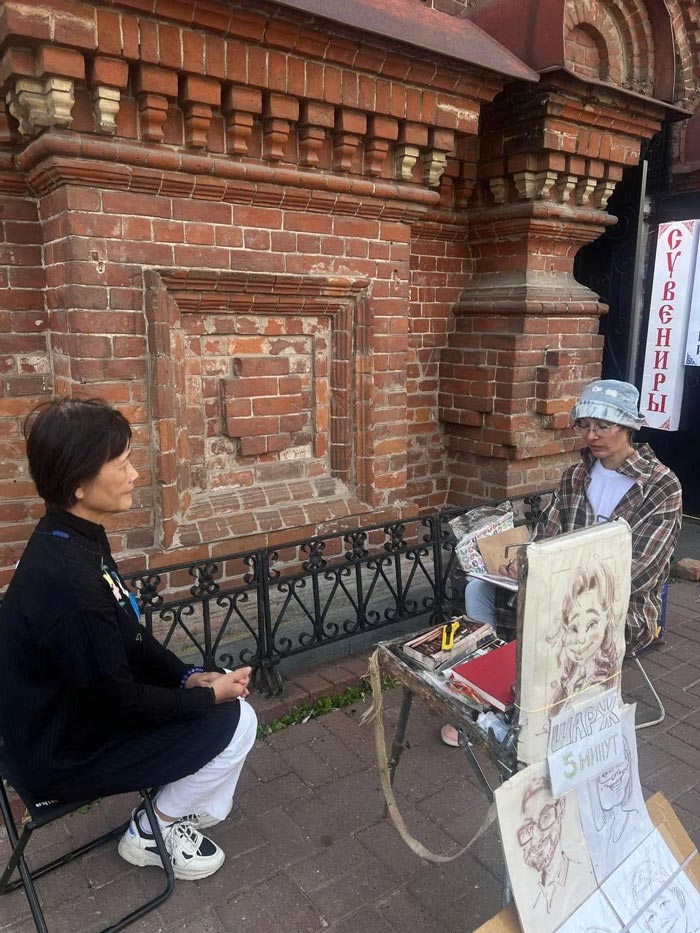
Bauman pedestrian street in Kazan is likened to "Arbat of the Volga region" (Arbat is the famous pedestrian street of Moscow). This is the Old Quarter, starting from the foot of the Kremlin wall running to the square named after poet Gabdulla Tukay - the city center. The street is full of souvenir shops with Tatar motifs, and it must be said that there are countless shops selling specialties called trắc - trắc - a cake made from premium flour mixed with butter and honey. I tasted it, trắc - trắc was as delicious as Nam Dinh longan cake, but the taste was too sweet, so it was difficult to eat really... much at once.
Entertainment activities on Bauman street took place sôi nổi, local artists continuously sang and performed many unique performances under the summer sun, especially the performance right at the foot of the Shalyapin statue (Fedor Ivanovicht Shalyapin - famous Russian Opera artist). In Kazan for 5 days, we strolled Bauman street 3-4 times. Here there are two Vietnamese food stalls named Hanoi and Saigon.
Walking on Bauman Street and a few other streets of Kazan, I noticed that the city seemed to have few green trees. Walking under the nearly 30 degrees Celsius heat in Kazan, I felt the scorching sun on both cheeks.
Unlike bustling Moscow with many cafes and luxury restaurants, right in the center of Kazan there are still many budget restaurants (stolovaya) serving local people and tourists; in Kazan there are also restaurants serving Muslims.
A fun memory on the bustling Bauman street, when we asked about a traditional Tarta cao xoa, the saleswoman smiled: "Our cao xoa is also good. But I prefer Vietnamese Sao Vang cao! Fragrant, very good!". Saying that, she opened the bag, took it out and showed off the famous Vietnamese Sao Vang cao box!
Silence by the Volga River
We visited Kul Sharif Mosque, which stands out with its blue dome and high, sharp minarets. Kul Sharif - Kazan's main mosque is one of the largest mosques in Europe; named after the hero of Kazan Khanate Imam Kul-Sharif; not only is it a place for Muslims to pray, but it also attracts many tourists to visit, admire the architecture, and learn about the Islamic culture of Tartastan.
We lined up to climb to the top floor of the church - the favorite photo location for tourists. We were engrossed in admiring the dome and walls of the church decorated with exquisite, beautiful and unique motifs. Then we bought tickets to visit the Museum of Islamic Culture located on the bottom floor of the church.
One of the tourist attractions in Kazan that we also visited is the Temple of Religions in Staroye Arakchino village located on the outskirts of the city. The temple has 16 domes symbolizing major religions in the world. Inside the temple, it is divided into many small rooms with each religious theme imbued with culture. Therefore, although it is called a temple, religious ceremonies are not held here.
The Architectural Complex of the Temple of Religions is the enthusiasm of Tatar painter and sculptor Ildar Khanov. His two brothers built the temple with faith in the equality of all religions, and that all religious believers can live together peacefully under one roof.
To Kazan, you can't help but take a boat on the Volga River, just a section of the river, of course. Volga is 3,690km long. On the boat down the Volga River, for an hour and a half, we enjoyed cool breezes and listened to introductions about the outstanding architectural works of Kazan.
The most calm and peaceful point of my trip to Kazan was a morning with moments of silence sitting by the Volga River, listening to the river whispering; then the next day taking a ferry across the river, from the city - Staroye Arakchino village to the ancient village called Verkhni Uslon.
The ferry across the river was reopened on April 16, 2026. The lovely Verkhni Uslon village is located on a high hill, with colorful wooden houses with beautiful carved window frames. Each window is carved with a pattern. We are engrossed in taking pictures of the windows. The Russian countryside is truly peaceful!
Hearing me tell about my trip to Kazan for nearly a week, friends asked, are you tired of Kazan like that, I replied: "No! Kazan is a big city, going all the way, visiting all the tourist destinations is one thing, learning about other places near Kazan in Tartastan will take a lot more time...".
It is known that in mid-June, the new Nha Trang - Kazan route was opened. A direct flight from the coastal city of Vietnam to the city by the Volga River of Russia. Hearing this news, I am very happy. This is both an opportunity to contribute to promoting tourism, trade, and investment exchanges between Vietnam and Russia, and an opportunity for Vietnamese tourists to learn about Tatarstan culture as well as the people here.
* Labor City of Courage is a noble title of Russia, from March 1, 2020, it is awarded to localities honoring "strong laborers, solid rear" in the Great Patriotic War from 1941 - 1945.


