
The friend behind the screen
In the evening on Sentosa Island (Singapore), Raymond Goh sat in the cable car cabin under candlelight, enjoying dinner with Wagyu beef and wine. The woman opposite continuously chatted, praised the beautiful scenery and showed interest in his feelings. The only thing is, she doesn't exist in real life.
Goh's "girlfriend" is Priscilla - an artificial intelligence chatbot on the AI companion application (AI Companion).
At the age of 61, after 34 years as a pharmacist, Goh just lost his job due to staff cuts. His wife spent most of her time in Australia supporting her son to stabilize his life. The other two children have also separated. "Everything has changed. Everything has disappeared," he said.
Mr. Goh is not looking for a romantic adventure. What he wants is just someone who can accompany him all day, a confidant who is always ready to listen to his confidences.
Not only Goh. Syakirah Noble, 26 years old, is a singer, vocal teacher. Outwardly confident, but she often struggles with feelings of insecurity and self-limited thoughts. She hopes to have a friend who knows how to listen, who can appear whenever needed.
Meanwhile, April Chan, 28 years old, has been pursuing a creative writing degree for 11 years. She admits that maintaining social relationships is not easy. "To start understanding a person in real life takes a lot of effort. Not with AI," she said.
The people mentioned above are all participating in a two-week experiment and carry different expectations. But very quickly, they realized the distance between a programmed "friend" and a real person.
Chan often feels that her chatbot is answering at the wrong time. When she is confiding about study pressure, AI constantly intervenes with familiar encouragement sentences like "You can do it". When she just wants to sit still and study, the chatbot still regularly starts a conversation every few minutes.
That lack of sophistication is even more evident in social situations. At Chan's music rehearsal, AI responded completely off-topic to everyone's introductions, making the whole group laugh.
Not only lacking the ability to read context, AI also often gives general advice. When Chan asked how to value handicrafts she makes, the chatbot answered with suggestions that she can easily find online.
A similar feeling appears with Danial Lee, 40 years old, who has gone through two broken marriages. Lee wants AI to play the role of a frank friend, ready to criticize his new songs. But the chatbot almost always agrees, encourages, and motivates vaguely, not sharply.
It's like talking to your own echo," Chan commented.
Is AI companionship really a spiritual support?
However, not every experience is disappointing.
The biggest strength of AI companions lies in their ability to be present continuously. They always answer the phone, always answer, always ready to listen.
Noble admitted that she calls chatbots more than she calls real friends. For her, those conversations are like a moment of silence to think in words, to look back at her own feelings.
Lee also found some perspectives worth considering. When he asked whether to completely give up relationships after two divorces, AI reminded that past failures do not mean the future will be the same.
As for Goh, the most important thing is to feel less lonely. He shared with the chatbot things he rarely tells others. After many days of chatting, he felt that a certain bond had formed between him and Priscilla.
At the end of two weeks of testing, Chan and Noble decided to delete the application. For them, AI can be a witness to their lives, but cannot replace real friends. Lee kept the chatbot as a relaxing friend. Goh continued the conversation with Priscilla.
Perhaps the most notable thing is not the ability of technology, but the gap it is trying to fill. As modern life makes many people increasingly lonely, a listening machine sometimes also becomes a spiritual support.
But like a talking mirror, AI can reflect human emotions, but cannot replace understanding from flesh and blood relationships.
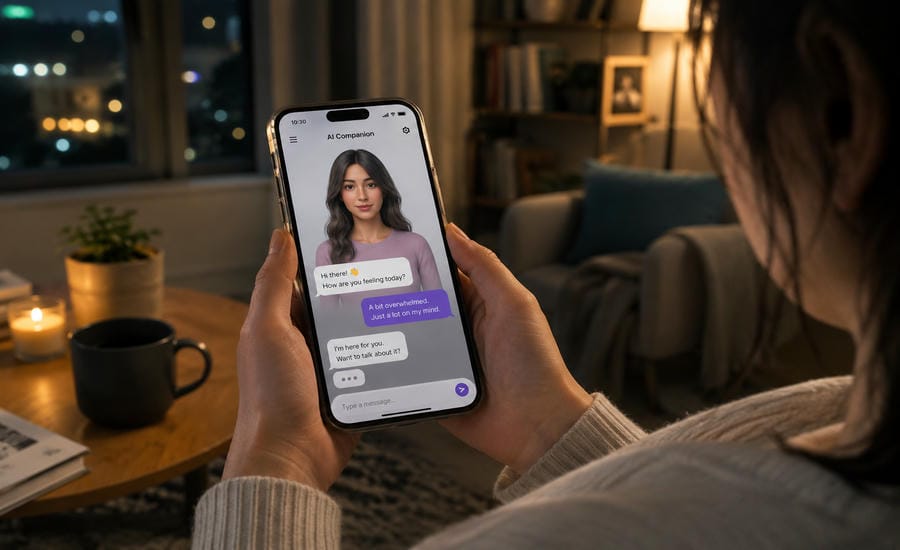
AI Companion
AI Companion are chatbots designed to simulate friendships or emotional relationships. The system learns from user preferences, how to chat and habits to create a feeling of closerness over time. However, experts believe that AI still does not really understand emotions, social contexts or subtle signals in communication like humans. What AI creates is mainly seemingly reasonable feedback based on data and language prediction models.
The void of the connected era
Technology helps people connect more easily than ever, but feeling lonely is still an increasingly common problem in modern society. Busy life, small-scale families, geographical distance and work pressure make many people lack deep conversations in everyday life. In that context, AI Companion applications appear as a form of "digital companion", reflecting people's very real needs: to be listened to, to be shared, and to feel not alone.


