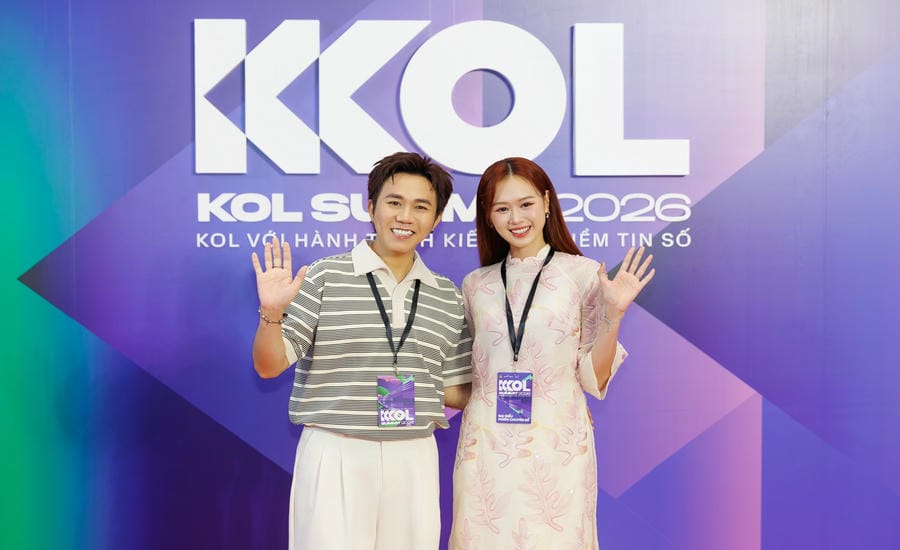
From the event of more than 1,000 artists, KOLs, content creators and experts attending the 2nd National KOL Conference in Ho Chi Minh City on September 7, it shows that behind the scale of an event gathering a series of famous faces, what is more noteworthy is the change in the way influencers see their own work.
If a few years ago, a KOL was usually recognized by the number of followers, interactions, or the ability to create viral content, now the concepts mentioned more are information verification, responsibility, reputation, AI, copyright and trust. It is not simply a change in keywords, but shows that the influential profession is entering a different stage.
From "being seen" to "being believed
One of the notable shares at the conference came from Miss H'Hen Nie. The Miss believes that to create trust, first of all, the person with influence must start with the truth and be the one to act first. In projects such as building a library in Lai Chau or planting forests, Miss H'Hen not only posted a call but also directly participated and shared the process with the public. According to her, when the information is accurate and the actions are substantive, the community will trust and accompany.
Actor Anh Duc looks at the story from the perspective of an artist using social networks. According to him, digital platforms help artists connect more directly with the public. But as the spread capacity increases, responsibility must also increase accordingly. Each content presented needs to be filtered, aimed at being useful and avoiding causing confusion or negative impacts on viewers.
This is a significant change for artists. Previously, most of the public statements of an actor or singer came to the public through newspapers, television or edited channels. Now, the artist's personal page can become a "media channel" with millions of people accessing it.
This is even clearer for creators who have grown up entirely from digital platforms. Le Tuan Khang currently has more than 13 million followers. The male TikToker said he mainly shoots what is real in his hometown, and does not do what is not true. Before posting the video, he also considers the content and possible impact on viewers.
The way of speaking is simple but touches on one of the increasingly important values in the AI era: Truthfulness. When AI can create an unreal face, a fake voice, an unprecedented scene or even a complete story in just a few minutes, human real experiences can become a new form of advantage.
Content creator Con Co This also believes that AI should be seen as a supporting tool instead of a platform to replace the entire creative process. According to the male TikToker, the first responsibility of an influential person is to provide accurate and valuable information, not just chasing attention or view-baiting content.
Trinh Pham, after about 12 years of content creation, emphasized the seemingly very small moment but deciding most of KOL's responsibility: The time to "press the post button". According to her, when content has been posted on social networks, it can affect many people, so creators must think and carefully select before each sharing.
Regarding the same issue, martial artist Truong Dinh Hoang looks from the impact on young people. He believes that people with large followers need to verify information and prioritize content with positive value, because young people currently use social networks with high frequency.
AI makes the responsibility problem more difficult
The development of AI makes this story more complicated. Celebrities can be victims of deepfake, being photoshopped, imitating voices or making untrue statements. But at the same time, KOLs can also use AI to create content that audiences find it difficult to distinguish between real and synthetic products. When the speed of content creation increases, verification ability is at risk of not keeping up.
The essence of the problem therefore does not only lie in the technique of distinguishing AI content. More importantly, is the person with influence willing to take responsibility for the content they spread? A celebrity may not be the one who creates false information, but if using personal reputation to share it with millions of people without verification, social impact still exists.
On the other hand, AI also changes the competition in the creative world. If KOLs used to compete by thinking of ideas, filming, or producing content quickly, then technology can now support most of those tasks in a shorter time. What AI is more difficult to replace is the identity, experience, and real relationship between creators and the community. Therefore, when technology makes "creating content" increasingly easier, what helps an artist or KOL maintain a position may no longer be the number of products they post, but the level of audience trust in the person behind the account.
KOL Summit 2026 also marks the launch of the "Reliability of the Influenced One" program, with operating standards, training courses including 7 topics on advertising law, personal data protection, information verification, professional ethics, media crisis management, responsibility when using AI and copyright. This is a sign that KOL activities are gradually shifting from a spontaneous development field to a profession that requires knowledge, legality and standards.
However, a set of standards or training courses cannot create prestige on their own. Ultimate trust is still verified in each specific choice: Which product does an artist receive advertising for, whether TikTokers check the source before posting, how do celebrities handle when their content is wrong, is the creator transparent when using AI? More importantly, are they willing to refuse a short-term benefit if they know it can harm public trust?
Deputy Director of Ho Chi Minh City Department of Culture and Sports - Nguyen Ngoc Hoi at the conference also raised a thought-provoking issue when saying that the creative community is currently paying much attention to stories that cause frustration and controversy, while beautiful stories and kind actions have not been exploited commensurately. He said that KOL, KOC does not necessarily have to do anything too great, but can start from positive stories they directly witness and experience.
Therefore, "KOL responsibility" should not be simply understood as just posting positive things. The more important value lies in the fact that the content must be correct, transparent, well-founded and the poster understands the consequences of the influence they have. An artist can completely talk about a negative issue if it is true and has warning value; a KOL can refute a social phenomenon. The difference lies in how they verify, interpret and take responsibility for information.
Looking from artists and content creators, it can be seen that they come from different fields but are facing the same problem: Influence management. Views are still important, the number of followers still has commercial value, virality is still an advantage, but those numbers are no longer enough to ensure that a person can survive for a long time in the digital environment.
Therefore, the competition in the art and KOL circles in the coming time may no longer be simply who has more followers. After the race to be seen, another more difficult race is taking place: who is trustworthy enough for the public to continue listening for a long time.