
From the voice of the production place...
At a business, what employees need is not always big slogans. Sometimes, it's a cooling fan at work, a more suitable protective clothing, less inconvenient shift handover procedures, more nutritious meals, gas money, childcare fees, or clear answers about salary, bonuses, and insurance.
These issues, if not listened to in time, can easily accumulate into frustration. But if they are received, classified, put into dialogue and followed to the end by the trade union, it becomes an opportunity for businesses to adjust, workers to feel secure in production, and labor relations to be kept stable.
The story at Matsuo Industries Vietnam Co., Ltd. in Hanoi is an example. At the 2026 Employee Conference, 41 opinions and recommendations from employees were gathered and presented. The recommendations are not general but very specific: Professional skills training, application of artificial intelligence in work, improvement of working conditions such as protective clothing, cooling fans, shift waiting process between shifts.
A noteworthy point is that all 41 opinions have been recorded by the company's Board of Directors, committing to direct department heads to research and overcome according to a specific roadmap. This is the trade union's way of turning "hearing" into a representative mechanism. When the Dialogue Group is elected, employees no longer reflect individually and disjointedly, but have an official channel to convey opinions. When the Trade Union Chairman plays the role of group leader, the voice of employees has people following, following and requesting feedback. When businesses commit to overcome according to a roadmap, dialogue is no longer a formal meeting but becomes an action process.
... To dialogue to prevent grievances from becoming hotspots
The role of the trade union is even clearer in labor relations situations with signs of tension. At Long Yi Vietnam Shoe Co., Ltd., Sao Vang commune, Thanh Hoa province, on the morning of July 2, hundreds of workers collectively stopped working to petition about some welfare regimes. The main concerns revolved around salary increases, overtime pay, gasoline support and insurance regimes.
These are contents close to the lives of workers. For direct workers, salaries, overtime, gasoline, and insurance are not just figures in documents but daily living expenses, tuition fees for children, rent, medicine, and money to send home. When questions are not fully explained, the psychology of comparing one business with another can create instability.
After receiving the workers' opinions, functional forces, trade unions and the company reviewed and reviewed the related contents. By the morning of July 3, after the enterprise had issued a notice responding to the petitions, hundreds of workers had returned to work normally. Representatives of Sao Vang Commune Trade Union said that through review, the company's payment of regimes was basically ensured according to regulations; currently the company has about 700 workers and union members, workers who have returned to work.
From this case, it can be seen that trade unions do not only appear when organizing movements or visiting and giving gifts. In sensitive times, trade unions are an important intermediary force to listen, explain, connect workers with businesses, and coordinate with functional agencies to maintain production stability.
Once workers are fully listened to, answered transparently and guaranteed a channel to continue reflecting, tensions can be relieved. That is also a way to protect the legitimate rights of workers but at the same time protect the stable production environment of enterprises.
Listen to substance to protect substance
From Sedo Vinako in Da Nang, Matsuo Industries in Hanoi, Long Yi in Thanh Hoa, the common point is that workers all need to speak and receive feedback. But for that voice to become a right, the organizational role of the trade union is needed.
There are good models that need to be spread immediately on this occasion, typically the model "Morning Coffee - Listening to the voices of union members and workers" in Binh Loi ward, Ho Chi Minh City. Organized in a commodity manufacturing enterprise, this program is expected to spread and become a forum for workers to express their recommendations and aspirations.
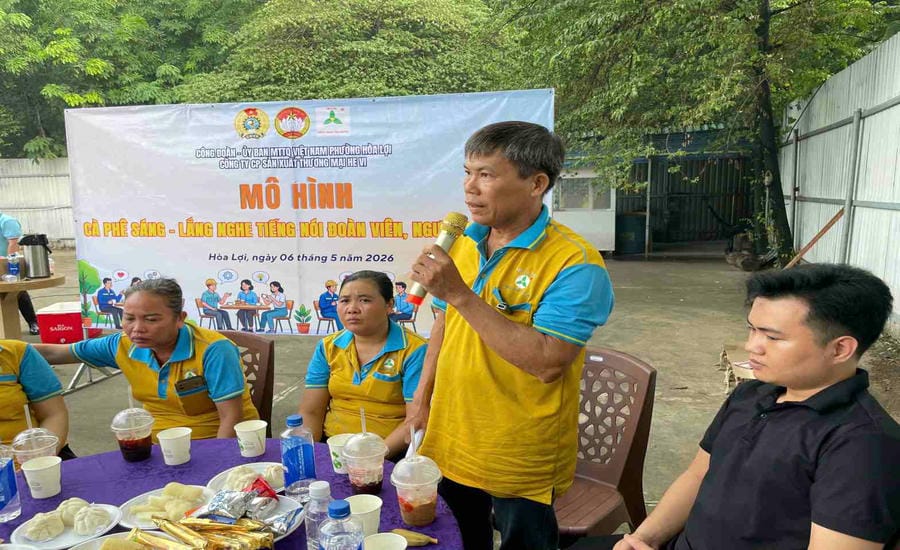
At He Vi Trading and Production Joint Stock Company (HCMC), the program "Morning Coffee - Listening to the voices of union members and workers" took place with the participation of ward leaders, businesses and 125 workers.
Workers have exchanged and proposed many people's livelihood issues such as handling sidewalk encroachment, improving traffic safety and upgrading infrastructure such as clean water and street lighting.
Workers also proposed ensuring that there are always enough vaccines at the ward health station to reduce costs when having to get vaccinated at private hospitals; proposed that public hospitals ensure full medicines and medical supplies so that workers no longer have to go out to buy; proposed that localities support workers in carrying out administrative procedures, reducing inappropriate procedures that cause time and trouble...
This is a very meaningful program. There have never been activities like this before. Through the program, workers can meet directly with local leaders and business leaders. Through this, workers can propose inadequacies for localities to overcome and resolve" - Mr. Phan Van Duc (51 years old, residing in Ho Chi Minh City), a worker at He Vi Production and Trading Joint Stock Company shared.
The role of the Trade Union organization is both to collect opinions, classify issues, select key contents, represent dialogue, negotiate, supervise and urge implementation. The Trade Union must also be a place to explain policies, provide accurate information, and help workers avoid psychological frustration due to lack of information or incomplete comparisons.
In the context of a rapidly changing labor market, increasing pressure on orders, income, living expenses and new skill requirements, workers are increasingly in need of a close, courageous and professional representative organization. Listening cannot just be recording opinions. Listening must be accompanied by responsibility to respond. Responding must be accompanied by action. Action must lead to specific results.
The month of listening to union members and workers speak" opens up a space for dialogue, and is meaningful when it does not stop at just one month. Listening to workers to act so that each petition is recorded, each agreement is signed, each meal is improved, each support is increased, each worker's legitimate and lawful rights are protected. That will be a real measure of the Trade Union organization in the new period.


