
Dry grass season
When the dry season knocks on the door of the remote border region of Cao Bang, Vinh Quy grasslands (Vinh Quy commune, Cao Bang province) quietly shelved their lush green to put on a melancholic yellow-brown color. Not brilliant, not ostentatious, Vinh Quy appears as an ancient, wild but attractive memory, enough to hold back travelers on their journey to explore the Northeast region.
Located on the border between Khum Din and Bac Vong hamlets, Vinh Quy grass hill separates itself from the noisy rhythm of life. There, there is no urban lights, no car horns, only wind, grass and slow steps returning to the rare peace in modern life.
We arrived at the foot of Vinh Quy hill in a dry afternoon. The sunlight gradually turned to honey yellow, shimmering on the dry grass slopes. By the path leading up the hill, a small water stall temporarily built of wood and green tarpaulin quietly nestled. The water stall woman with a sunken face poured a cup of tea from an old aluminum teapot, smiling gently: "Now it's time to go up, in time to watch the sunset".
The trail leading to the top of the hill appears simple, just enough for leisurely steps. The dry season grass is no longer soft but dry and brittle, gently scratching the pants legs, emitting very faint, very real rustling sounds. The slope gradually increases, sweat soaks into the back of the shirt even though the afternoon wind in the highlands has begun to chill.
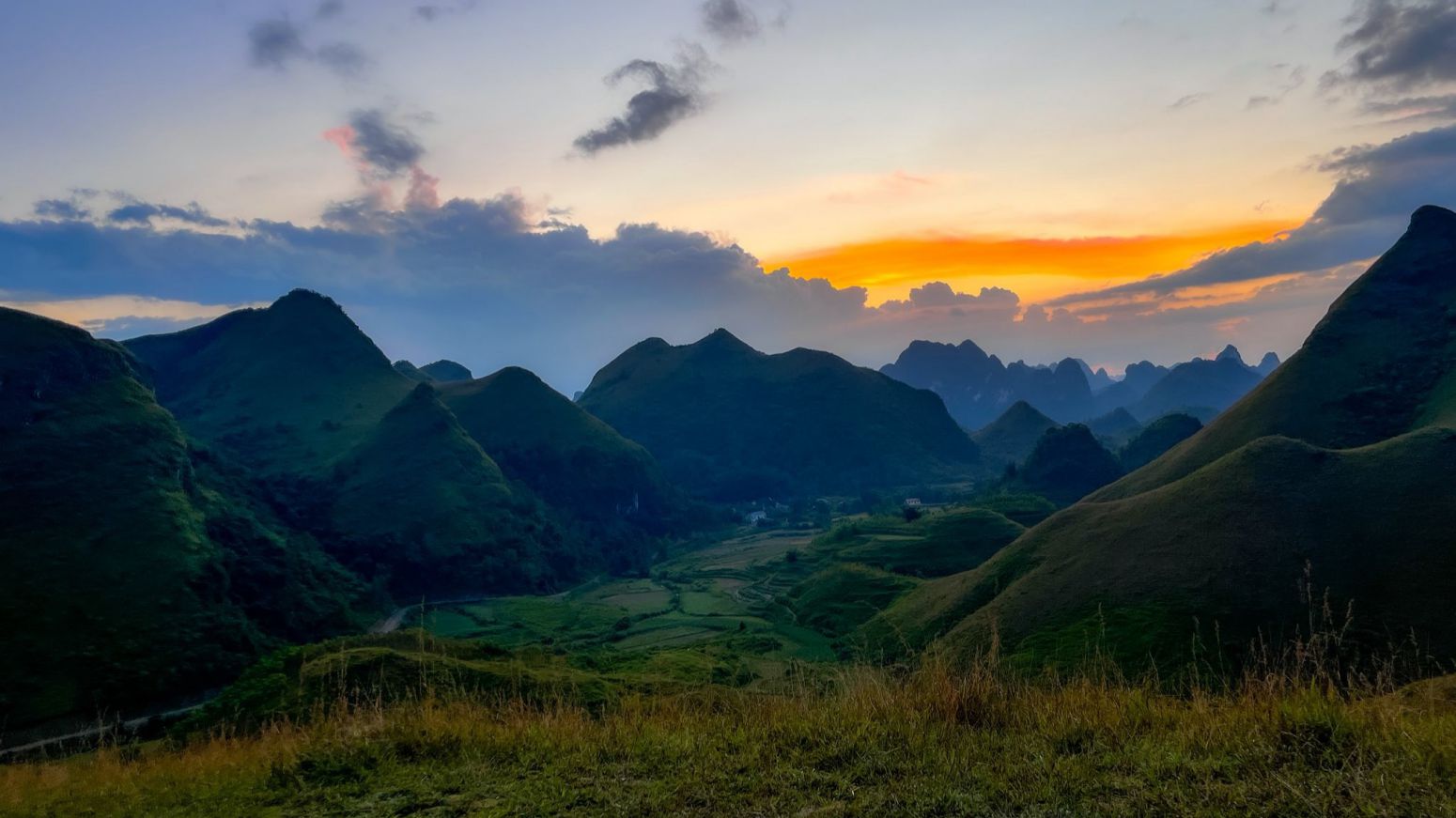
After nearly half an hour of climbing the slope, when the breathing has just slowed down, the moment of nature opening up a spectacular performance is in front of you. The sun slowly disappears behind the distant mountains, dyeing the grass slope with a layer of brilliant orange-yellow light. In that "golden hour", the dry grass blades sparkle like brass threads, creating a scene that is both majestic and fragile, making people unconsciously realize their smallness in front of the vast nature.
Under the starry sky of the remote region
Sunset falls, darkness rushes down Vinh Quy surprisingly quickly. The night wind in the border region blows stronger, bringing the cold gradually into each layer of clothes. Amidst the vast sea of grass, a small tent is erected, becoming a fulcrum for travelers on their "star hunting" journey.
When all artificial light sources are completely turned off, the night sky on Vinh Quy hill appears so clear that it is overwhelming. No street lights, no urban light, the Milky Way is clearly visible, spanning the sky like an endless river of light. Tiny stars connect with each other, quietly telling the story of millions of years of the universe.
In this remote borderland, the sky is not only beautiful but also very close, very real. It seems that just raising your hand can touch the stars that are silently burning brightly. In that space, people are forced to slow down, listen and face themselves.
Dawn and the remaining desolation
Near dawn, the cold awakened us after a nap. The wind was stronger, carrying the humidity of the mountains and forests. Stepping out of the tent, the eastern sky faded, the last stars receded into memory.
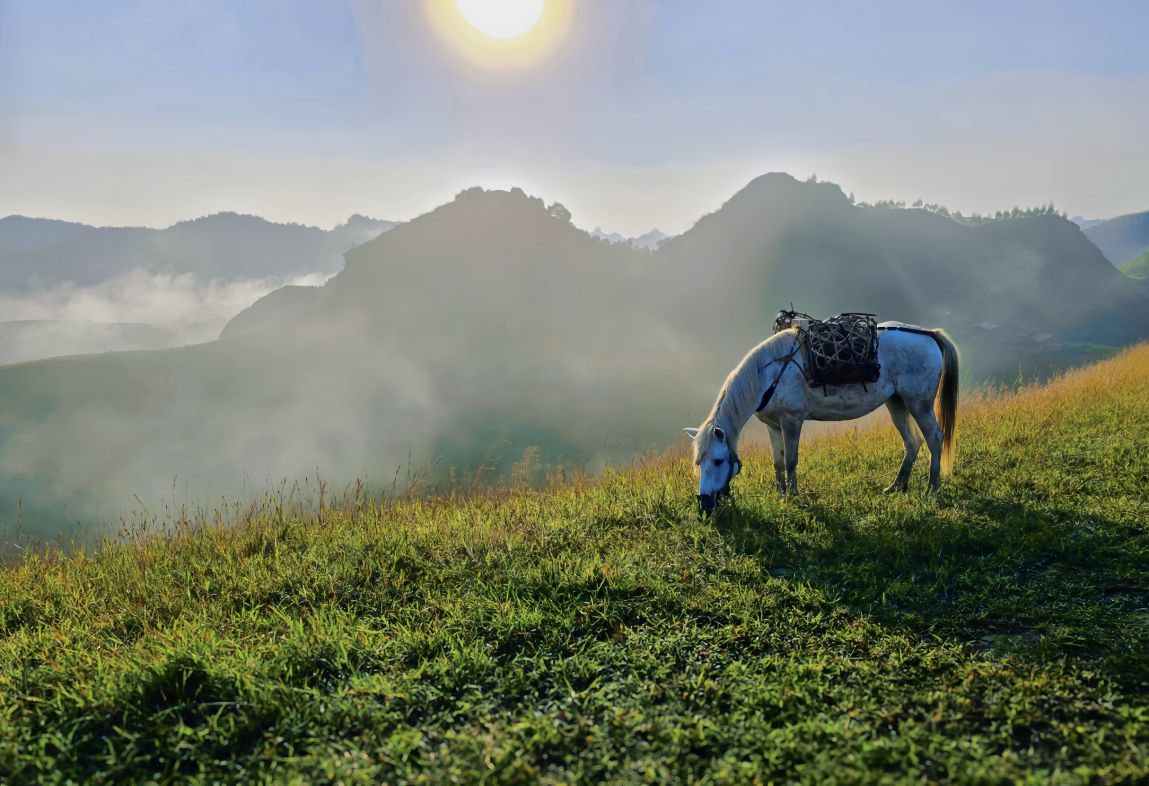
The sun rises, the fog dissipates, revealing undulating hillsides like dinosaur backs, dotted with lonely rows of trees standing leaning in the wind. A proud but solitary beauty, enough to make people's hearts silent, wanting to slow down in the hurried pace of life.
Vinh Quy in the dry season is not noisy, not showy. The beauty here lies in the silence, in very gentle moments, but deep enough to stay long in the memory of those who have ever set foot there.
Land with many lingering concerns
Not only is it an experiential tourist destination, Vinh Quy also evokes many thoughts about the relationship between people and nature in the context of increasingly urgent modern life. In a place where phone signals are intermittent, familiar amenities seem to be left behind, people are forced to face themselves more. No longer dense schedules, no longer continuous notifications appearing on the screen, every moment passing by in Vinh Quy is slow and complete.
The beauty of the dry season grass hills lies not in freshness, but in persistent vitality. The golden brown grass hills stretch, seemingly barren, but still rooted in the soil, waiting for the rainy season to return. Amidst the harsh nature of the border region, that existence bears the appearance of the people here - quiet, resilient and not ostentatious.
The people of Vinh Quy commune still live closely with the mountains and forests, with small houses nestled at the foot of the hills. Life is still difficult, but the simplicity and hospitality are present in every look, smile. A cup of hot tea at a roadside water stall, a short but thoughtful instruction, enough for travelers to feel the warmth in a land that seems to only have wind and grass.
In recent years, Vinh Quy has become more known through experiential trips, photos of sunsets and starry skies spreading on social networks. However, this place still retains its rare originality. No shops close together, no mass tourism services, Vinh Quy is like a remaining silence, where nature has not been intervened too deeply by human hands.
When leaving the grass hill, looking back at the golden brown grass hills gradually sinking into the early morning sunlight, the feeling of nostalgia is hard to name. Vinh Quy does not bring immediate overwhelm, but gradually permeates, like how the cold of the highlands penetrates into the skin, like how the stars silently deeply imprint into memory after a long night.
The journey to Vinh Quy is over, but the aftertaste remains for a very long time. That is the feeling of living slowly in a world that is spinning too fast; it is the moment of realizing that sometimes people need to leave the urban lights, leave the familiar noise, to find balance from the simplest things.
Amidst the vast grass hills, amidst the sparkling starry sky at the border, each person finds their own quiet moment. And perhaps, those quiet moments are the most precious thing that Vinh Quy gives to those who are patient enough to come, to stay and to listen.


