
It is a vivid, heroic and evidence-filled journey, going hand in hand with the nation's destiny.
The historical nature of the National Assembly lies deeply in the fundamental shift in function and position: From the mission of creating legitimacy for a young institution in the encirclement of hostility, to the role of exercising supreme power, supervising and deciding on the most important issues of the country in the era of integration.
From the "Dien Hong conference" of the new era to the Declaration of Independence
Few people know that the early form of the Vietnamese National Assembly was shaped even before the birth of the Democratic Republic of Vietnam. That was in the boiling August of 1945, when the peak of struggle against the domination of French colonialism and Japanese fascism reached its peak. Under the leadership of the Indochinese Communist Party and leader Ho Chi Minh, on August 16, 1945, the "National Congress" was convened at Tan Trao communal house, Son Duong district, Tuyen Quang province.
This is considered a "Dien Hong Conference" of the new era, a gathering place for the will of the entire nation. As the predecessor body of the National Assembly, the Tan Trao National Congress, on behalf of compatriots nationwide, made historic decisions: Unanimously approving the policy of the General Uprising and approving 10 major policies of the Viet Minh Front. More importantly, the Congress appointed the Committee for National Liberation (i.e., the Provisional Government) to lead the people to seize power. This event not only contributed decisively to the victory of the August Revolution but also created an initial legal basis for the birth of a new type of State - the first democratic people's state in Southeast Asia.
Establishing legal legitimacy
January 6, 1946 went down in history as a glorious milestone. It was not simply an election event, but a demonstration of the immense political force, carrying international legal significance about the right to self-determination of the Vietnamese nation.
The 1946 Constitution holds a special position in the history of Vietnamese legislation. This is a legal document laying the foundation for a democratic institution, recognizing personal freedom and a clear mechanism for allocating power. On the core ideology "All power in the country belongs to the people", the 1946 Constitution expresses President Ho Chi Minh's timeless thinking about the rule-of-law state. Although war conditions made many regulations unable to be fully implemented, the progressive values of this Constitution are still a guiding principle, a "red thread" throughout the constitutional activities of later generations. The National Assembly in this period operated extremely flexibly, both resisting and proclaiming the country, showing the close and fleshy connection between the will of the people and leadership decisions.
Persistently striving for unification and reconstruction in the smoke and flames of war
Entering the period 1946 - 1975, the history of the National Assembly was associated with two long-term resistance wars of the nation. After the 1954 Geneva Accords, the Vietnamese revolution entered the period of simultaneously implementing two strategic tasks in the two regions. At this time, the National Assemblies of the II and III terms mainly operated on the basis of the 1959 Constitution.
The highlight of this period lies in the extraordinary adaptability of the legislative body to the escalating war situation. The National Assembly is not only a law-making body but also a place to convey patriotism. Important resolutions have been issued to maximize human and material resources for the Southern front lines, and at the same time build technical and material facilities for socialism in the North. The National Assembly and the Government steered the country's ship through bombs and bullets, both producing and fighting.
The period 1971-1976 (term IV and term V), although short, played an important bridging role, maintaining the continuity of state power until the day of complete victory. This was a period when the National Assembly clearly showed its role as a symbol of the great national unity bloc. In the fiercest years of the destructive war, the National Assembly still maintained its activities, ensuring the legality of macro decisions, gathering all resources for the highest goal of independence and reunification of the Fatherland.
The era of unification: Difficulties and worries to find a way
The great victory of Spring 1975 opened a new era: the era of independence, unity and the whole country rising to socialism. The General Election to elect the National Assembly of the whole country in 1976 (National Assembly term VI) marked a historical turning point, completing unity in terms of the state. For the first time after many years of division, the mountains and rivers became one, and the National Assembly was the highest symbol of that unity.
The 6th National Assembly has a great responsibility to build a unified legal system for the whole country. The passage of the 1980 Constitution created a legal basis for the operation of the state apparatus during the subsidy period. However, this was also a challenging period. The centralized bureaucratic subsidy planning mechanism, although effective in war, revealed limitations hindering development in peacetime. The National Assembly at this time faced great concerns: How to make the law reflect the reality of life? How to remove difficulties for the economy that is on the verge of crisis?
Vivid reality and overlapping difficulties at this stage are the driving force for the National Assembly and the Party to re-examine management thinking, preparing for a great "makeover" called Doi Moi.
Innovation Era: The transformation of legislative thinking and parliamentary culture
The 6th Party Congress (1986) initiated the Doi Moi campaign, but it was the National Assembly that institutionalized this line into law, turning the Party's resolution into the State's will.
The 1992 Constitution was considered the "Constitution of the Doi Moi Era", marking a fundamental change in thinking. It replaced the old economic management thinking with a socialist-oriented market mechanism, recognizing the existence of many economic sectors, and establishing the principle of a socialist rule-of-law state.
Legislative activities in this period exploded in both quantity and quality. A series of important economic laws such as the Enterprise Law, Investment Law, Land Law, Commercial Law... were successively born. The National Assembly created a transparent legal corridor, untying up production, creating conditions for the private economy to develop and paving the way for Vietnam to deeply integrate with the international community.
Not only stopping at the content of laws, the form of operation of the National Assembly has also undergone strong changes. A strong imprint in this process is the shift in method from "discussion" to "debate", especially clearly from the early 21st century. Previously, sessions were often heavily focused on reading prepared reports. But gradually, the atmosphere of the parliament has changed. Question sessions began to become more frank, direct and "hot" than ever. National Assembly deputies not only play the role of pressing the button to pass, but also become sharp policy critics, representing the voice and aspirations of voters.
2013 Constitution and supreme supervisory power
Inheriting and developing previous constitutions, the passage of the 2013 Constitution is considered a milestone in modern constitutional history. For the first time, regulations on human rights and citizens' rights are placed in a solemn position (Chapter II), right after the chapter on political regime. This shows a profound change in thinking, putting people at the center of development. The 2013 Constitution also establishes a more strict mechanism for controlling state power, clearly defining authority and coordination and control between legislative, executive and judicial agencies.
In that democratic flow, the Supreme Supervisory Activity of the National Assembly has taken bold and effective steps. One of the unprecedented breakthroughs is the National Assembly's issuance of a Resolution on votes of confidence (in 2012) and implementation right before the 2013 Constitution was born, which was then firmly constitutionalized.
This is a flexible but powerful tool to control power. The results of the vote of confidence with levels of "high confidence", "confidence", and "low confidence" have become a public measure of political prestige, directly impacting personnel work. It forces positions elected or approved by the National Assembly to always strive, "self-examine" to perform tasks more effectively. There is no longer "safety" during the term, each leadership position must be subject to permanent supervision.
Parliament in the digital age and developmental constructive thinking
Entering the 15th term, the National Assembly of Vietnam faced unprecedented challenges, typically the COVID-19 pandemic. In the context of a boiling water, when the health and lives of the people are threatened, the National Assembly has shown extreme flexibility and a noble sense of responsibility.
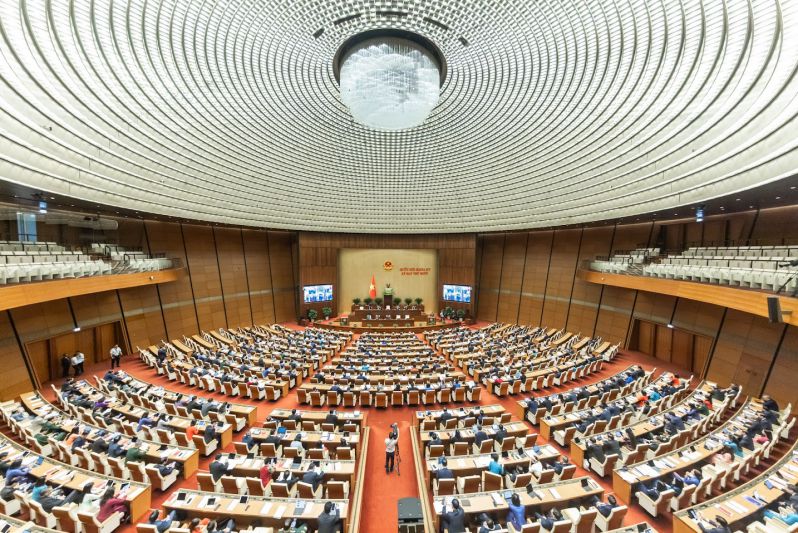
Also in this period, the "Electronic Parliament" model has made breakthroughs. The application of information technology helps maintain the operation of the National Assembly without interruption even during the most severe social distancing period. Online meetings connect from the National Assembly House to provincial and city bridge points; digitized documents replacing tons of printed papers; applying artificial intelligence in summarizing voter opinions... All have become a new normal state, improving the productivity and work efficiency of delegates.
Moreover, the legislative thinking of the National Assembly is undergoing a strong shift from "management" thinking to "creative development" thinking. Instead of just passively waiting for draft laws to be submitted, the National Assembly and Committees proactively get involved early and remotely. The National Assembly proactively reviews the legal system, removes bottlenecks and overlapping institutional contradictions that are hindering social resources. The law-making process is increasingly rigorous, focusing on the feasibility, long-term lifespan of documents and especially listening to social criticism.
In the new period, with the goal of building a powerful, prosperous and happy Vietnam, the National Assembly continues to be the embodiment of the great national unity bloc, a place to send the faith and aspirations of voters nationwide for a fair, democratic, and civilized society. The heroic history that has passed is a solid launching pad for the National Assembly of Vietnam to continue to innovate, worthy of being the highest representative body of the People, the highest state power body of the Socialist Republic of Vietnam.
Looking back at nearly 80 years of history, from the National People's Congress of Tan Trao in the days of the boiling uprising to the paperless sessions in the digital age, the Vietnamese National Assembly has gone through a process of dialectical development and outstanding growth.
It's a bit of a bit of a bit of a bit of a bit of a bit.
It's a bit of a bit of a bit of a bit of a bit of a bit.
It's a bit of a bit of a bit of a bit of a bit of a bit.


